
Index of English Translations of Sumerian Clay Tablets
Sumerian clay tablets that, as far as we could check, had no published English translation. We translate them ourselves. The page linked above is the index of the series. A new tablet is a new row there, not a list copied into every story.
All translations are new and unofficial, made from transliterations on the Cuneiform Digital Library Initiative (CDLI), and may contain errors. Tablet images are credited to the holding institutions and CDLI. Dates use the conventional middle chronology and are approximate.
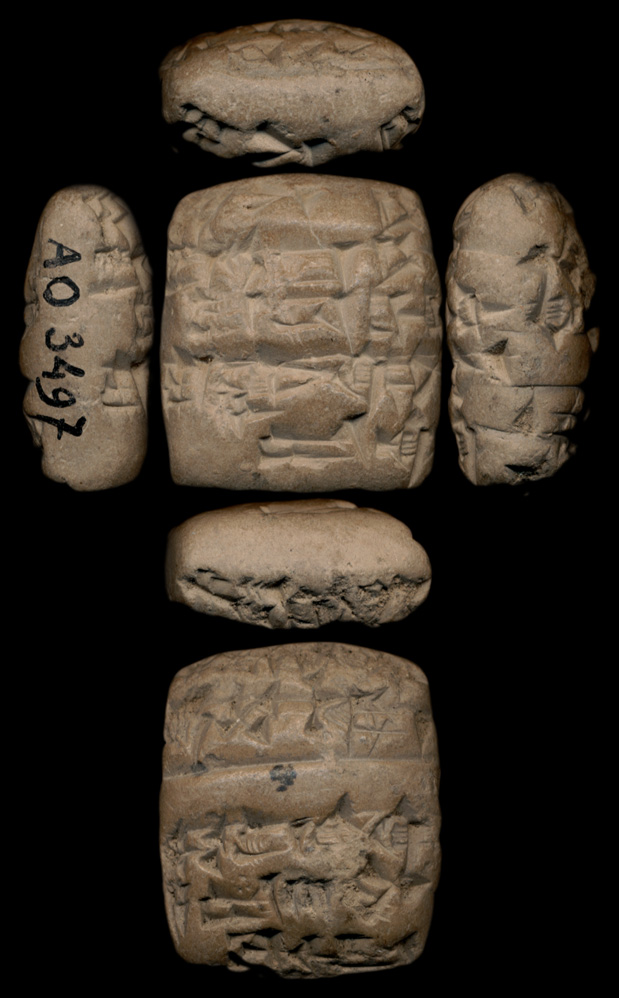
“5 litres of bread: Ur-nigar, the elite soldier, who has come from Iri-az. Booked out: the judge.”
Six lines, and a journey. An elite soldier reaches Girsu from a place called Iri-az, and the judge’s office issues his bread.
The tablet is from Girsu, modern Tello in southern Iraq. It is dated to the fifth month of Šulgi’s thirty-third year, the year “Karahar was destroyed for the third time”, around 2062 BC.
The soldier and the place
Ur-nigar is called aga-us gal-gal, an elite or senior soldier. He “has come from Iri-az” (iri-az{ki}-ta gen-na). Iri-az is written as a town. Its exact location is not settled; it appears in other Ur III travel notes as a point on the road network east or north-east of the Sumerian heartland.
Five litres of bread is a modest daily ration for one man, the sort of issue a way-station would make.
Booked out by the judge
The expenditure line is simply zi-ga di-ku5, “booked out: the judge”. In Girsu’s travel-ration archive, the judge’s office often appears as the account that pays messengers, soldiers and foreigners on the road. The tablet does not name which judge.
What the tablet doesn’t tell us
We don’t know why Ur-nigar was travelling, or whether Iri-az was his posting, his home, or only a stop.
We don’t know which judge authorised the bread.
And we don’t know how far Iri-az lay from Girsu. The tablet gives the place name and the verb of coming; nothing more.
Judges and the road
Girsu’s early Ur III ration texts, published long ago by Thureau-Dangin in Recueil de tablettes chaldéennes, are full of small bread and beer issues to people on the move. This one is typical in form and unusual in its clarity: one soldier, one origin, one office.
The month name, Munu-gu, is the local Girsu calendar’s month of malt-eating. The year name records Šulgi’s third destruction of Karahar, a town on the eastern road. A soldier coming from Iri-az into that world of named campaigns and named months fits the traffic the judge’s account was built to feed.
Earlier in this series, travel rations for Elamites and fugitive-catchers came from the same city. Here the traveller is a Sumerian soldier under the judge’s own account.
The tablet in full (our translation)
Front: 5 litres of bread: Ur-nigar, the elite soldier, who has come from Iri-az.
Back: Booked out: the judge. Month: Munu-gu. Year: Karahar was destroyed for the third time.
How we read it
Key lines in transliteration: ur-nigar{gar} aga3-us2-gal-gal, “Ur-nigar, the elite soldier”; iri-az{ki}-ta gen-na, “who has come from Iri-az”; and zi-ga di-ku5, “booked out: the judge”.
Uncertain: the location of Iri-az, and which judge held the account.
Our confidence: high. The text is short, unbroken and formulaic.
This translation is new and unofficial, made from the CDLI transliteration, and may contain errors. “Untranslated” means we found no translation on CDLI or in the tablet’s publication history (RTC, 1903 (Thureau-Dangin), hand copies of tablets then in the Louvre). Dates use the conventional middle chronology and are approximate.
For the full description of sources, method, uncertainties, dating conventions, limitations, and how to report corrections, see About the Translations and Methodology.