
Index of English Translations of Sumerian Clay Tablets
Sumerian clay tablets that, as far as we could check, had no published English translation. We translate them ourselves. The page linked above is the index of the series. A new tablet is a new row there, not a list copied into every story.
All translations are new and unofficial, made from transliterations on the Cuneiform Digital Library Initiative (CDLI), and may contain errors. Tablet images are credited to the holding institutions and CDLI. Dates use the conventional middle chronology and are approximate.
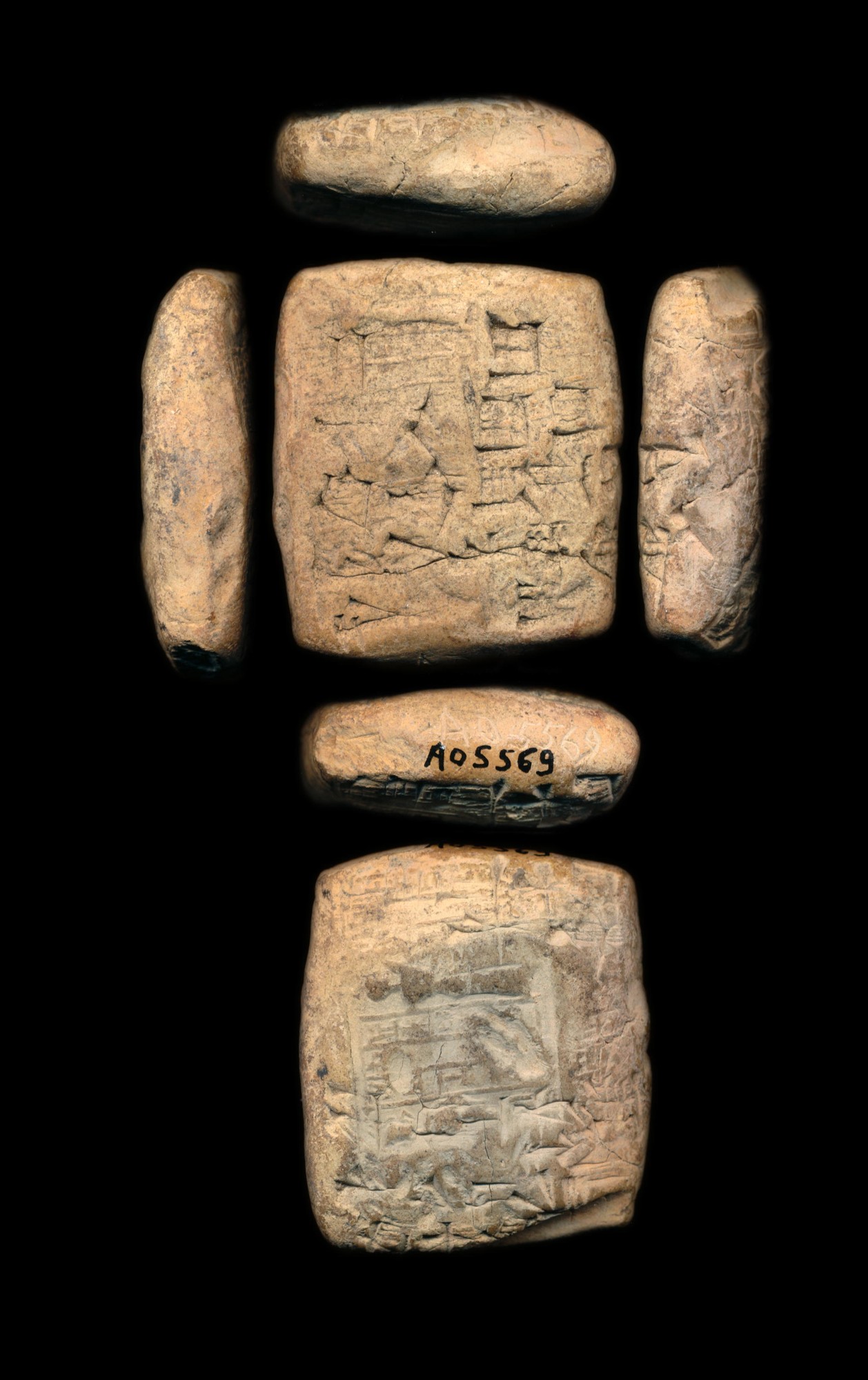
“2 sheep, on account of a ewe, from Nasa: Lu-dingira, the judge, took them.”
Five lines on the front and a seal on the back. It is a receipt from Puzriš-Dagan, the great livestock centre near Nippur, in what is now southern Iraq. It is dated to the month of the festival of Šulgi, in the year after Kimaš was destroyed: Šulgi’s 47th year, around 2048 BC.
A judge takes two animals. The reason is three words long.
The lines, one by one
“2 sheep (udu), on account of a ewe (mu u8-še3), from Nasa: Lu-dingira, the judge (di-ku5), took them (i3-dab5). Sealed by Ur-Suana.”
Nasa was the official in charge of the animal office at Puzriš-Dagan in these years, and many of his receipts survive. i3-dab5, “took over”, is the usual word when animals pass from one account to another.
The phrase mu X-še3 usually means “for X”, “because of X” or “in place of X”. Here X is a single ewe, u8.
Whose seal
The judge does not seal. The seal belongs to “Ur-Suana, scribe, son of Bazige”. Here we are speculating, but the scribe probably sealed on the judge’s behalf, or worked in his office.
What the tablet doesn’t tell us
We don’t know whose ewe it was, or what had happened to it. Two sheep “for a ewe” could be a replacement, a compensation or a payment; the same short phrase can cover all three.
We don’t know whether this was part of a case the judge was hearing.
And we don’t know why a judge needed sheep from the royal herds at all: for an offering, for his table, or to settle a claim.
Judges and animals at Drehem
Judges appear several times in this series at Puzriš-Dagan: bringing lambs, sealing for oxen. They were officials of the state as well as men who heard cases, and they took part in the flow of animals like other officials.
What makes this note different is its reason. Most receipts say the animals are for an offering, for the kitchen, or for a named person. This one says only: for a ewe.
The tablet in full (our translation)
Front: 2 sheep, on account of a ewe, from Nasa: Lu-dingira, the judge, took them.
Back: Sealed by Ur-Suana. Month: Festival of Šulgi. Year after Kimaš was destroyed.
Seal: Ur-Suana, scribe, son of Bazige.
How we read it
Key lines in transliteration: 2(disz) udu mu u8-sze3, “2 sheep, on account of a ewe”; and lu2-dingir-ra di-ku5 i3-dab5, “Lu-dingira, the judge, took them”.
Uncertain: what “on account of a ewe” meant in practice: replacement, compensation or payment.
Our confidence: medium-high. The text is short and clear; the reason behind “on account of a ewe” is not.
This translation is new and unofficial, made from the CDLI transliteration, and may contain errors. “Untranslated” means we found no translation on CDLI or in the tablet’s publication history (TCL 2, 1911 (Genouillac), hand copies of Louvre tablets with a short catalogue note). Dates use the conventional middle chronology and are approximate.
For the full description of sources, method, uncertainties, dating conventions, limitations, and how to report corrections, see About the Translations and Methodology.