
Index of English Translations of Sumerian Clay Tablets
Sumerian clay tablets that, as far as we could check, had no published English translation. We translate them ourselves. The page linked above is the index of the series. A new tablet is a new row there, not a list copied into every story.
All translations are new and unofficial, made from transliterations on the Cuneiform Digital Library Initiative (CDLI), and may contain errors. Tablet images are credited to the holding institutions and CDLI. Dates use the conventional middle chronology and are approximate.
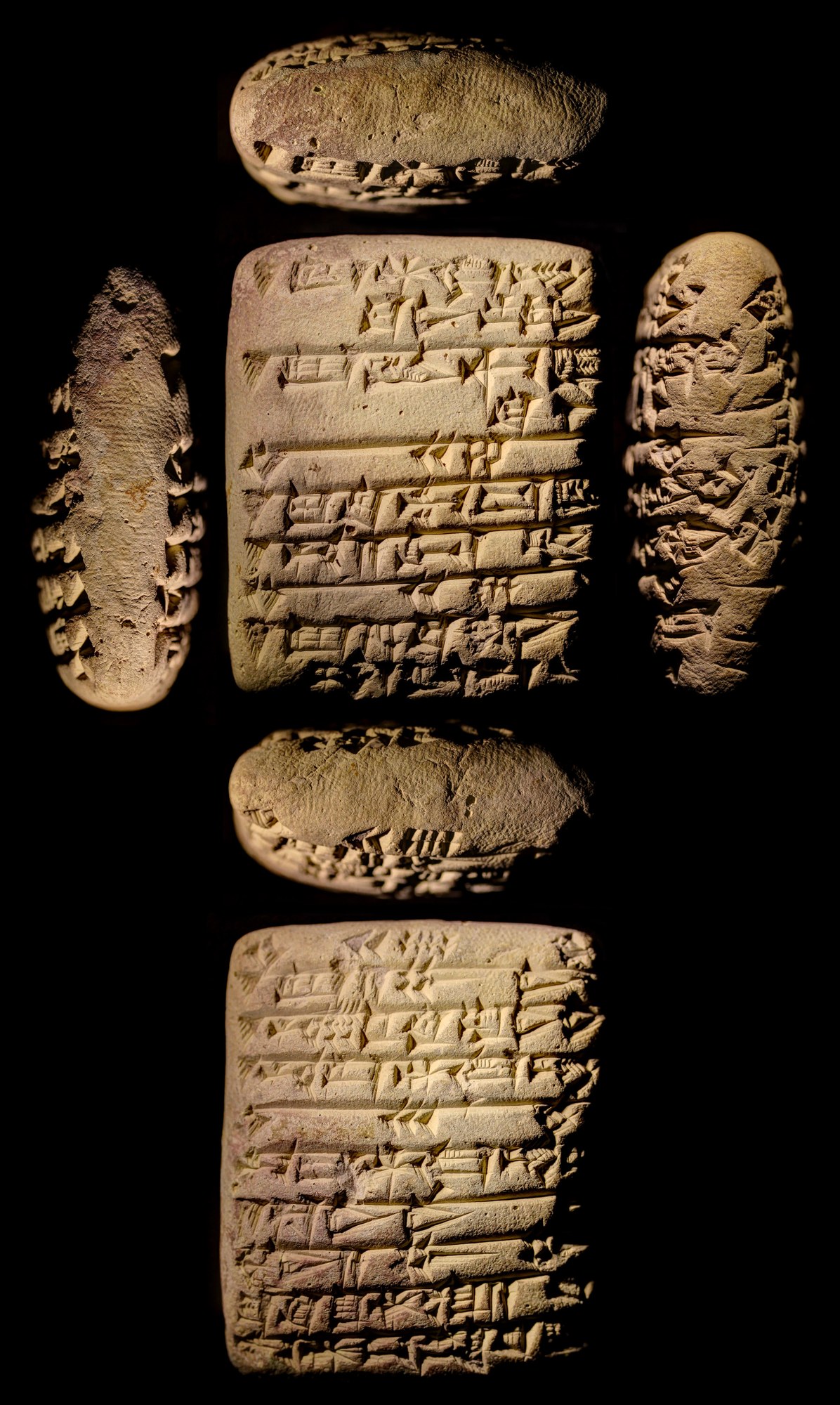
“Delivery for (the god) Šulgi: Ahuni received them.”
Seventeen lines from Drehem. Over six days at the end of a month, lambs and kids arrive for the cult of Šulgi, written with the divine name. Among the bringers is a judge.
The tablet comes from Puzriš-Dagan in what is now southern Iraq. It is dated to the month Ki-siki-Ninazu of the year “Amar-Suen became king”, around 2046 BC. Šulgi was dead. His successor was already on the throne.
Six days of animals
Day 25: a lamb from Šulgi-bani the steward, and a lamb from Lu-balasaga the judge. Day 26: a sheep from the king’s own deliveries, and a kid from Adatum the general. Day 28: a lamb from Habaluge, governor of Adab. Day 30: a lamb from Abuni, a kid from Šarrum-ili, a kid from Ur-Šulgi.
The summary line is mu-kux(DU) {d}šul-gi-ra, “delivery for (the god) Šulgi”. Ahuni took them in. Abubu handled the transfer.
A dead king written as a god
Šulgi’s name carries the divine determinative. The animals are not booked to a living king’s kitchen but to Šulgi’s cult. Earlier in this series, A Sheep for Šulgi’s Throne showed a sheep for his throne in the same first year. This tablet shows a run of deliveries to Šulgi himself as a god.
Lu-balasaga the judge stands on day 25 beside a steward. Generals and governors appear later in the week. The cult drew animals from the same ranks that supplied the living court.
What the tablet doesn’t tell us
We don’t know where the animals went after Ahuni received them: which shrine, which city.
We don’t know whether “delivery for Šulgi” here means a regular offering schedule or a special series at the change of reign.
We don’t know which court Lu-balasaga judged.
And we don’t know why the 27th and 29th days are blank on this tablet.
Continuity at Drehem
The first weeks of a reign are when continuity is most visible on clay. Drehem kept booking animals to the old king’s divine name while the new king’s year name headed the tablet. The livestock office did not wait to be told that Šulgi’s cult had ended. On this evidence, it had not.
The tablet in full (our translation)
Front: 1 lamb: Šulgi-bani, the steward. 1 lamb: Lu-balasaga, the judge. Day 25. 1 sheep from the king’s deliveries. 1 kid: Adatum, the general. Day 26. 1 lamb: Habaluge, governor of Adab.
Back: Day 28. 1 lamb: Abuni. 1 kid: Šarrum-ili. 1 kid: Ur-Šulgi. Day 30. Delivery for (the god) Šulgi. Ahuni received them. Via Abubu. Month: Ki-siki-Ninazu. Year: Amar-Suen (became) king.
How we read it
Key lines in transliteration: mu-kux(DU) {d}szul-gi-ra, “delivery for (the god) Šulgi”; lu2-bala-sa6-ga di-ku5, “Lu-balasaga, the judge”; and a-hu-ni i3-dab5, “Ahuni received them”.
Uncertain: the shrine that received the animals, and whether every named bringer acted in an official capacity.
Our confidence: high. This is standard Drehem day-book prose.
This translation is new and unofficial, made from the CDLI transliteration, and may contain errors. “Untranslated” means we found no translation on CDLI or in the tablet’s publication history (CST (JRL), 1932 (Fish), with collations in MVN 12, 1982 (Gomi)). Dates use the conventional middle chronology and are approximate.
For the full description of sources, method, uncertainties, dating conventions, limitations, and how to report corrections, see About the Translations and Methodology.
Further reading
- CDLI artifact page for P107741
- C. Tsouparopoulou, “A Reconstruction of the Puzriš-Dagan Central Livestock Agency” (2013)
- Wikipedia, “Shulgi”
- Wikipedia, “Amar-Sin”
- Wikipedia, “Puzrish-Dagan”
- Wikipedia, “Third Dynasty of Ur”
- ePSD2, the electronic Pennsylvania Sumerian Dictionary
- Oracc, Ancient Mesopotamian Gods and Goddesses