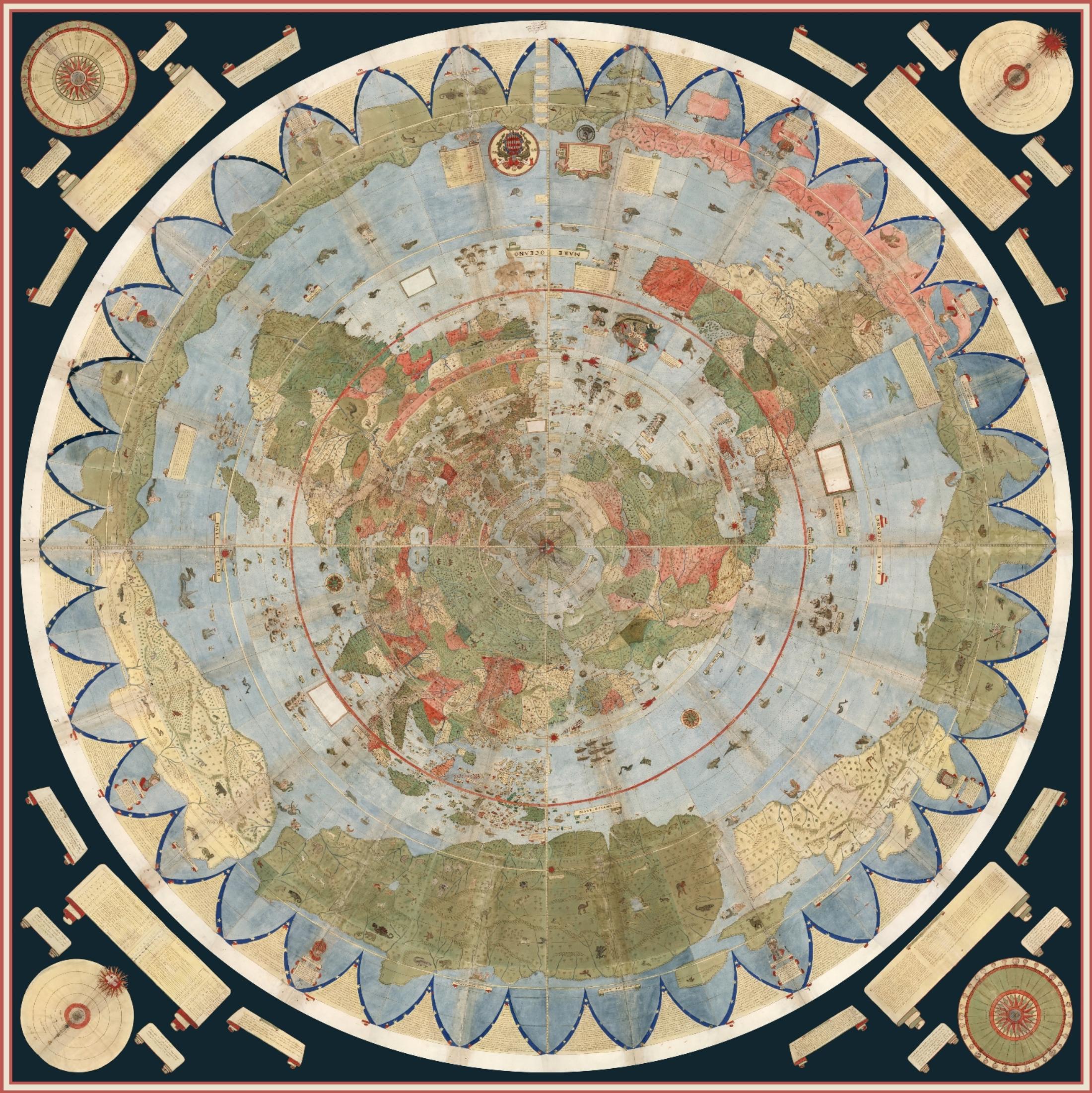
This is part two. The essay is part one.
Every sheet, every scroll and every caption on Urbano Monte’s 1587 planisphere, in his Italian with an English line, as first published on 6 October 2026. The text is unchanged.
Index
The four corners sit outside the disk. The sixty sheets are the manuscripts of Libro terzo. The name opens the reading of that sheet. Map opens the study window.
| Sheet | Map | On the sheet |
|---|---|---|
| Upper left | Map | Eight winds, Ostro to Garbino, and the degrees of the earth. |
| Upper right | Map | The eclipse of the sun. The sun is 166 times the earth. A table of the parallels. |
| Lower left | Map | The eclipse of the moon, the earth’s shadow, and a table of the parallels. |
| Lower right | Map | A second wind rose, named in the Spanish manner, and why some places are cold. |
| Tavola I | Map | King Arthur’s country, the ocean under the pole, and the Sereningeri. |
| Tavola II | Map | The column of the world, pygmies, the glacial sea, the magnet, and the Tartars. |
| Tavola III | Map | The Ielubiri, who camp in the open like the Tartars. |
| Tavola IV | Map | The day-length boxes, from five months at the pole, and Canada and Laborador. |
| Tavola V | Map | The Mediterranean, from France south into North Africa. One frame is blank. |
| Tavola VI | Map | The Black Sea, called Mare Maggiore, and the eastern Mediterranean. |
| Tavola VII | Map | Desert spirits, women who have themselves painted, and rhinoceroses. |
| Tavola VIII | Map | True rhubarb, men as large as elephants, musk, lions, serpents, and gems. |
| Tavola IX | Map | True porcelain, Japan, and the circle of Cancer, the summer circle. |
| Tavola X | Map | Humped cattle, and the Pacific coast from Quivira to New Galicia. |
| Tavola XI | Map | Florida. The men run with the beasts, and the women nurse until twelve. |
| Tavola XII | Map | The Indies fleet for Spain, the royal armada, and the circle of Cancer. |
| Tavola XIII | Map | The length and breadth of the regions, and the armada of Prester John. |
| Tavola XIV | Map | The gypsies, the Niger underground for sixty miles, and the mountains of the moon. |
| Tavola XV | Map | The Red Sea and the Horn. Prester John keeps his children in these mountains. |
| Tavola XVI | Map | The fleet of the Sophy, on the Sea of India. |
| Tavola XVII | Map | The body of St Thomas, Ceylon, Taprobana now called Sumatra, and the spice fleet. |
| Tavola XVIII | Map | Channels to Paloan and Boru. Cloves, cinnamon, nutmeg, and sandalwood. |
| Tavola XIX | Map | The fleet of the King of China, and countries not yet well known. |
| Tavola XX | Map | Open ocean, Mare del Sur, and a compass named in the Spanish manner. |
| Tavola XXI | Map | The fleet of the King of Spain in the New World, and the meridian of 180. |
| Tavola XXII | Map | The isthmus of New Spain, cows with a snout like elephants, and Vasco Nuñez, 1513. |
| Tavola XXIII | Map | Atabalipa, king of Peru, and Castile of Gold, named for the abundance of gold. |
| Tavola XXIV | Map | King Philip and the empire of the sea. Under the equinoctial the day is twelve hours. |
| Tavola XXV | Map | His arms, Nuntius custos, and the circle of Capricorn. Part of Terra de Vista. |
| Tavola XXVI | Map | The walrus fish, and Terra de Vista set in three words across the land. |
| Tavola XXVII | Map | The ship Victoria, Pigafetta and Magellan, back at Seville in 1522, and the Cape. |
| Tavola XXVIII | Map | The Portuguese route to the Moluccas, past San Lorenzo. |
| Tavola XXIX | Map | Open ocean, the island of Don Galopes, and summer for the Antarctic. |
| Tavola XXX | Map | The kingdom of Patalia. No foreigner may live there. They go naked, and are very white. |
| Tavola XXXI | Map | Terra di Patalia, and part of New Guinea. |
| Tavola XXXII | Map | Terra di Nova Guinea. An elephant, monkeys, and a lizard on the green. |
| Tavola XXXIII | Map | New Guinea. No trade with foreigners, and a country of jewels and porcelain. |
| Tavola XXXIV | Map | Brasilia, and the circle of Capricorn. |
| Tavola XXXV | Map | Brasielia, spelled so, and the land of Lacach. |
| Tavola XXXVI | Map | The land of Lacach. |
| Tavola XXXVII | Map | Seen from afar. Lacach, and Terra Galleca. |
| Tavola XXXVIII | Map | Our wintering, the ocean sea, and Terra Galleca. |
| Tavola XXXIX | Map | The islands of Magellan, and Terra Galleca. |
| Tavola XL | Map | Peru, Chile, the Plata, and the Strait of Magellan. Mountains always charged with snow. |
| Tavola XLI | Map | The farthest river, the mouth of the Plata, and Magellan’s ships. |
| Tavola XLII | Map | The sonnet to the readers, the note on the map, and his portrait. Dated 1587. |
| Tavola XLIII | Map | Part of Terra de Vista, and the notes on Spain and France. |
| Tavola XLIV | Map | Part of Terra de Vista. Flanders, Germany, and the pope. |
| Tavola XLV | Map | Part of Terra de Vista. Italy, the northern islands, and Prester John. |
| Tavola XLVI | Map | Terra de Vista. Muscovy, Mauritania, and Prester John. |
| Tavola XLVII | Map | Terra de Vista. Egypt, the Armenias, and Patala. |
| Tavola XLVIII | Map | Part of Patalia. The Holy Land, the Arabias, and a Roman emperor. |
| Tavola XLIX | Map | Patalia. Scythia, Calicut, and New Guinea. |
| Tavola L | Map | Part of New Guinea. India, and China. |
| Tavola LI | Map | Part of New Guinea. The king of China, and Taprobana. |
| Tavola LII | Map | Part of Brasilia. The Moluccas, and Borneo. |
| Tavola LIII | Map | Part of Brasilia. Zubut, and Japan. |
| Tavola LIV | Map | The land of Lacach. Quivira, and Xalisco. |
| Tavola LV | Map | The land of Lacach. Galleca, Mexico, and the sea of Cortés. |
| Tavola LVI | Map | Terra Galleca, and the Island of Pearls, called Taraquil. |
| Tavola LVII | Map | Terra Galleca, Terra del fuogo, Florida, and the Spanish Island. |
| Tavola LVIII | Map | Terra del fuogo, the Lucayan islands, and the rivers Plata and Maragnon. |
| Tavola LIX | Map | Terra del fuogo, the strait of Magellan, Cuzco and Chile. The banner writes LVIII again. |
| Tavola LX | Map | Terra del fogo, Terra de Vista, Popayán, and Quito. |
The writing on the sheets
His Italian is in italic. The English is in the ordinary face. Place names are left out unless a name is the whole of a label.
Upper left

Remarks
Six parts. The compass is a. The five texts are b to f.
Text
a. The compass
Ostro. Siroco. Levante. Greco. Tramontana. Maestro. Ponente. Garbino.
Eight winds, and a quarter-wind between each. Ostro, the south. Sirocco. Levante, the east. Greco. Tramontana, the north. Maestro. Ponente, the west. Garbino. The rim is marked in degrees, and a wind-head sits at each point. Under the names he sets a short note on what that wind does. Garbino undoes the hoar-frost and eases the cold. Greco is a healthy wind and does not trouble the air. A word in the smaller notes may still move.
b. The long scroll
De i venti, et ragioni della freddezza et caldezza che in molti parti del mondo.
Of the winds, and the reasons for the cold and the heat in many parts of the world. He sets five zones. The torrid zone lies between the tropics, and he calls it uninhabitable for the heat. On either side is a temperate zone, where men can live. Toward the poles are the cold zones, within the Arctic circle and the Antarctic circle. The winds, he says, are a cause of this cold and this heat. The hand of the body is small, and a word in it may still move.
c. The upper scroll
De i venti, antipodi, et altre.
Of the winds, the antipodes, and other matters. He writes of the parallels, of the people who live under them, and of the length of the day and the night as one goes north or south. The antipodes are those who stand with their feet against ours. A word in the body may still move.
d. The small scroll above the long one
Della rotondità della terra, et dell’orizonte.
Of the roundness of the earth, and of the horizon. The circle of the earth is divided into 360 degrees. The horizon is the circle that bounds what a man can see, and it changes as he moves. A word in this box may still move.
e. The scroll beside the compass
Li principali de questi venti sono quattro, cioè Levante, Ponente, Tramontana, et Ostro, quali sono così detti, perché spirano da queste parti principali del mondo. Nel mezzo de questi venti sono altri quattro, cioè Sirocco, Maestro, Greco, e Garbino, da quali primi et da questi sono al maniere di generati, come in essa rota prossima si vede.
The principal of these winds are four, that is Levante, Ponente, Tramontana, and Ostro, so called because they blow from these principal parts of the world. Between these winds are four others, that is Sirocco, Maestro, Greco, and Garbino, generated from the first, as may be seen on the rose beside this box.
f. The lower scroll
Il Levante et il Ponente sono le due contrarie, et il Settentrione et l’Ostro.
Levante and Ponente are the two contraries, and so are the north and Ostro. He then sets climates by their degrees, and names cities that stand in them, in Africa and toward the Ganges. A word in that list may still move.
Upper right

Remarks
The eclipse of the sun, and the table of the parallels. Six parts. The diagram is a. The table is b. The scrolls are c to f.
Text
a. The eclipse of the sun
Eclisse del sole. Il corpo del sole è maggiore della terra 166 volte. La luna è minore della terra, et è lontana dalla terra miglia 86.910. Il corpo della luna è lontano dal sole miglia 133.550. Il circolo della luna circonda 183.950 miglia. Mercurio che circonda 276.360 miglia, et è lontano dalla terra 955.500. Venere che circonda 314.600, et è lontano dalla terra 799.550. Il cielo del sole che circonda 3.585.600 miglia italiani, et è lontano dalla terra.
The eclipse of the sun. The body of the sun is 166 times greater than the earth. The moon is smaller than the earth, and stands 86,910 miles from it. The body of the moon is 133,550 miles from the sun. The circle of the moon measures 183,950 miles. Mercury’s circle measures 276,360 miles, and Mercury stands 955,500 miles from the earth. Venus’s circle measures 314,600 miles, and Venus stands 799,550 miles from the earth. The heaven of the sun measures 3,585,600 Italian miles, and stands far from the earth. The moon passes between the sun and the earth, and the shadow of the earth falls the other way. A figure in this roundel may still move.
A side note, not his words. The roundel is geocentric. The earth sits in the middle. The moon, Mercury, Venus, and the sun stand outward, which is the order he was taught. The figure 166 is the old volume, not the width. A body five and a half times as wide as the earth has about 166 times the bulk, and that is the number the schools used. The sun is in fact about 109 times as wide, and more than a million times the bulk. The moon is smaller than the earth, which he has right. His miles are Italian miles, shorter than the mile we use, and his distances are the distances of that school, not the distances measured since. The eclipse itself he has right: the moon passes in front of the sun.
b. The table of the parallels
Tavola dei climi et dei paralleli, per la lunghezza del giorno maggiore.
The table of the climates and the parallels, for the length of the longest day. Each row is a parallel. A cell may still move. The order does not.
| Parallel | Latitude | Climate | Longest day |
|---|---|---|---|
| Equinoctial | 0 | 12 hours | |
| Meroë | rising | 1 | 13 hours |
| Syene | rising | 2 | 13 hours 30 |
| Alexandria | rising | 3 | 14 hours |
| Rhodes | rising | 4 | 14 hours 30 |
| Rome | rising | 5 | 15 hours |
| Mouth of the Borysthenes | rising | 6 | 15 hours 30 |
| Riphaean mountains | rising | 7 | 16 hours |
| Arctic circle | 24 hours | ||
| The pole | 90 | 6 months |
He adds a column for the increase from one parallel to the next, half an hour through the seven climates, and then more sharply toward the pole. The latitude of each named parallel is written in degrees and minutes on the sheet. Those figures are left as his until a cell is read off again.
c. When the eclipse is made
Quando si fa l’eclisse del sole.
When the eclipse of the sun is made. It happens when the moon stands between the sun and the earth, and hides the sun from us. It is not seen from every place at once. A word in this box may still move.
d. The small scroll above the table
Perché la luna è minore del sole, et nondimeno lo cela.
Why the moon is smaller than the sun, and yet hides it. Because the moon is near us, and the sun is far. A word in this box may still move.
e. The scroll beside the roundel
Della grandezza del sole et della luna.
Of the size of the sun and of the moon. The sun is the greater body. The moon is the nearer. The miles are Italian miles. A word in this box may still move.
f. The lower scroll
Come si conosce l’eclisse.
How the eclipse is known. By the meeting of the sun and the moon on the same line, at the new moon. A word in this box may still move.
Lower left

Remarks
The eclipse of the moon, and the table of the parallels. Six parts. The diagram is a. The table is b. The scrolls are c to f.
Text
a. The eclipse of the moon
Eclisse della luna. Terra. Ombra della terra. Cielo della luna. Cielo di Mercurio. Cielo di Venere. Cielo del sole.
The eclipse of the moon. The earth sits in the middle. The sun stands outside the circles. The shadow of the earth falls away from the sun, and the moon is drawn in that shadow. The circles, outward, are the moon, Mercury, Venus, and the sun.
A side note, not his words. This is the pair of the upper right. There the moon passes in front of the sun, and the eclipse is of the sun, at the new moon. Here the earth stands between the sun and the moon, and the eclipse is of the moon, at the full moon. He has the geometry right. The red cone is the shadow. A lunar eclipse can be seen from anywhere on the night side of the earth. A solar eclipse cannot.
b. The table of the parallels
Tavola de i paralleli et de i climi con la elevatione del Polo et maggior giorno loro.
The table of the parallels and the climates, with the height of the pole and their longest day. The columns are the parallel, the climate, the degrees, the minutes, the places the parallel passes, and the longest day. A cell may still move. The order does not.
| Parallel | Climate | Where it passes | Longest day |
|---|---|---|---|
| Equinoctial | 12 hours | ||
| 1 | 1 | Meroë | 13 hours |
| 2 | 2 | Syene | 13 hours 30 |
| 3 | 3 | Alexandria | 14 hours |
| 4 | 4 | Rhodes | 14 hours 30 |
| 5 | 5 | Rome | 15 hours |
| 6 | 6 | Mouth of the Borysthenes | 15 hours 30 |
| 7 | 7 | Riphaean mountains | 16 hours |
| Tartary, Moscow, Prussia | 16 hours 30 to 18 | ||
| Gothia, Norway | 19 to 20 hours | ||
| Arctic circle | 24 hours |
The degrees and minutes of each parallel are written on the sheet. They are left as his until a cell is read off again.
c. When the eclipse is made
Quando si fa l’eclisse della luna.
When the eclipse of the moon is made. The earth stands between the sun and the moon, and the moon enters the shadow. It is the full moon. A word in this box may still move.
d. The small scroll
Perché la luna si oscura.
Why the moon darkens. Not because the sun fails, but because the earth stands in the way. A word in this box may still move.
e. The scroll under the table
Dell’ombra della terra.
Of the shadow of the earth. The shadow is a cone, narrowing as it goes, and the moon is small enough to enter it. A word in this box may still move.
f. The lower scroll
Come si conosce l’eclisse della luna.
How the eclipse of the moon is known. By the full moon, and by the moon standing opposite the sun. A word in this box may still move.
Lower right

Remarks
Six parts. The compass is a. The five texts are b to f.
Text
a. The compass
Nort. Nordest. Est. Sueste. Sur. Suroeste. Oest. Oestnort.
A second rose. The winds are named in the Spanish manner. North, north-east, east, south-east, south, south-west, west, north-west, and a quarter-wind between each. The rim is in degrees. A wind-head sits at each point.
b. The long scroll
De i gradi et longitudine in molte parti del mondo.
Of the degrees, and of the length of the day in many parts of the world. Each row is a parallel, counted from the equinoctial. A cell may still move. The order does not.
| Parallel | From the equinoctial | Longest day |
|---|---|---|
| Equinoctial | 0 | 12 hours |
| First | rising | 13 hours |
| Second | rising | 14 hours |
| Third | rising | 15 hours |
| Fourth | rising | 16 hours |
| Arctic circle | 66 and a half | 24 hours |
| The pole | 90 | 6 months |
Beside the numbers he names the lands the parallel crosses: Labrador, the land of the cod, Greenland, Norway, England, France, Spain, Italy, Germany, Livonia, Egypt. He writes that a degree of the equinoctial holds 62 and a half Italian miles. That figure is left as his.
A side note, not his words. The six months of day and six of night are right for the pole. The Arctic circle near 66 and a half degrees is the circle of his own century, the tilt of the earth being about 23 and a half. South of that circle the sun rises every day of the year. On it, one day in the year the sun does not set. At the pole it does not set for half the year. His mile is the Italian mile, and 62 and a half of them to a degree is the school figure, a little short of the distance measured since.
c. The upper scroll
Dove si dividono le quattro parti principali della terra.
Where the four principal parts of the earth are divided. The Tanais divides Asia from Europe. The Nile divides Asia from Africa. The Mediterranean divides Europe from Africa. The Strait of Anian divides Asia from the new world. The other parts, of that time and of this, are not yet well known. He includes the Antarctic pole, and Brasil.
d. The scroll beside the rose
La causa del freddo et del caldo.
The cause of the cold and of the heat. Some places are cold because they lie far from the path of the sun, and the winds that blow from those parts carry the cold with them. A word in this box may still move.
e. The lower scroll
Della lunghezza del giorno et della notte.
Of the length of the day and of the night. Under the equinoctial the day and the night are equal, twelve hours each. Toward the Arctic circle and the Antarctic circle the day grows, until at the pole the sun does not set for six months. A word in this box may still move.
f. The small scroll
Le zone della terra.
The zones of the earth. The torrid zone between the tropics, two temperate zones where men live, and two cold zones toward the poles. A word in this box may still move.
Tavola I

Head note
Tavola prima.
Side note
Libro terzo. Book three.
Text
a.
Paese di temperie sanissima fatto habitare dal Re Artu. A country of very healthy climate, made habitable by King Arthur.
b.
L’oceano è quì de quatro parte. Scorre sotto il polo circa una gran rupe ove si rompe. The ocean here is of four parts. It flows under the pole about a great rock, where it breaks.
c.
Sereningeri quasi Pigmei che vivono sotto terra d’ogni stagione. The Sereningeri, almost pygmies, who live underground in every season.
Foot note
L’inferiore a questa, è la Tavola 5 e 6. The sheet below this one is Tavola 5 and 6. Arabic numerals are used, not Roman.
Remarks
The first sheet. It touches the pole. Greenland is named. Northern Europe is drawn, with islands, ships, mountains, and rivers.
Tavola II

Head note
Tavola seconda.
Side note
Libro terzo. Book three.
Text
a.
Monte che per l’altezza sua è detta colonna del mondo. A mountain which, for its height, is called the column of the world.
b.
Qui habitano pigmei non più grandi de quatro palmi. Here live pygmies no taller than four palms.
c.
Mare settentrionale glaciale, non sempre. The northern glacial sea, not always.
d.
Polo de magnete et le Isole di C. Verde. The magnetic pole, and the Cape Verde islands.
e.
Statua dentro del monte Imao. A statue inside Mount Imaus.
f.
Tutti questi Tartari settentrionali non hanno habitatione alcuna, ma portano loro padiglioni di corame, et conducono carri coperti, quali usano in loco di case. All these northern Tartars have no dwelling, but they carry leather tents and drive covered carts, which they use in place of houses.
g.
Questi paesani cavalcano Rangiferi, animali che somigliano a i cervi. These country people ride reindeer, animals that resemble deer.
h.
In questi deserti vi sono spiriti, et inganano li viandanti, et farli pericolare. In these deserts there are spirits, and they deceive travellers and put them in danger.
i.
Qui si trovano animali con facia di donzella, il corpo di leone, et coda di scorpione. Here are found animals with a maiden’s face, the body of a lion, and the tail of a scorpion.
Foot note
L’inferiore a questa, è la Tavola 7 e 8. The sheet below this one is Tavola 7 and 8. Arabic numerals are used, not Roman.
Remarks
The second sheet. It touches the pole. The northern coast of Asia is drawn, with the Tartar hordes, their tents, and their carts. Mountains, rivers, and lakes are marked. A beast with a human face is drawn beside note i.
Tavola III

Head note
Tavola terza.
Side note
Libro terzo. Book three.
Text
a.
Ielubiri che stano alla campagna a modo de Tartari. The Ielubiri, who stay in the open country in the manner of the Tartars.
Foot note
L’inferiore a questa, è la Tavola 9 e 10. The sheet below this one is Tavola 9 and 10. Arabic numerals are used, not Roman.
Remarks
The third sheet. It touches the pole. Northern Asia is drawn, with Terra Incognita. Lakes, rivers, and mountains are marked. Dogs and a serpent are drawn.
Tavola IV

Head note
Tavola quarta.
Side note
Libro terzo. Book three.
Text
a.
Paralelo 90 a gradi 87, dove il maggior giorno è de mesi 5, e giorni 20, e hore 23, continui. Parallel 90, at 87 degrees. The longest day is 5 months, 20 days, and 23 hours, continuous.
b.
Paralelo 80 a gradi 82, dove il maggior giorno è de mesi 4, e giorni 24, e hore 14, continui. Parallel 80, at 82 degrees. The longest day is 4 months, 24 days, and 14 hours, continuous.
c.
Paralelo 70 a gradi 77, dove il maggior giorno è de mesi 3, e giorni 25, e hore 22, continui. Parallel 70, at 77 degrees. The longest day is 3 months, 25 days, and 22 hours, continuous.
d.
Paralelo 60 a gradi 72, dove il maggior giorno è de mesi 2, e giorni 21, e hore 17, continui. Parallel 60, at 72 degrees. The longest day is 2 months, 21 days, and 17 hours, continuous.
e.
Paralelo 50 a gradi 67, dove il maggior giorno è de giorni 23, e hore 21, continui. Parallel 50, at 67 degrees. The longest day is 23 days and 21 hours, continuous.
f.
Paralelo 40 a gradi 65 m. 35, dove il maggior giorno è de hore 21 3/4. Parallel 40, at 65 degrees 35 minutes. The longest day is 21 hours and three quarters.
g.
Paralelo 30 a gradi 61 m. 53, dove il maggior giorno è de hore 19 1/4. Parallel 30, at 61 degrees 53 minutes. The longest day is 19 hours and a quarter.
h.
Paralelo 20 a gradi 53 m. 17, dove il maggior giorno è de hore 16 3/4. Parallel 20, at 53 degrees 17 minutes. The longest day is 16 hours and three quarters.
i.
Qui sono pegmei longhi niente un bracio. Vivono sola e ani … fino a guerra con le cigogne. Here are pygmies an arm long. They live only so long, and they war with the storks. The years are not settled.
j.
Qui si trouano grifi bianchi, et vi sono tutti li animali bianchi, tanto da quatro piedi come volatili. White griffins are found here, and every animal is white, those of four feet as well as those that fly.
k.
Quando si scopersero questi paesi, vi si trouorno li homini et done grandissimi, quasi giganti, et portan li capelli sino alla cintura, senza lano, barba, et nudi. When these countries were discovered, the men and women were very large, almost giants. They wear their hair to the waist, without wool or beard, and they go naked.
l.
La magior parte de questa gente habitano in certe case fatte di legname, coperte di corame de pesci, et è gente gran corritora, et veste de pelle de animali fieri et corami cotti. Most of these people live in wooden houses covered with the skins of fish. They are great runners, and they dress in the skins of wild animals and in cured leather.
Foot note
L’inferiore a questa, è la Tavola XI e XII. The sheet below this one is Tavola XI and XII. Roman numerals are used.
Remarks
The fourth sheet. It touches the pole. The sea is Mare del North Glaciato. Beyond it is Terra Incognita Nova, and a griffin. South of that are Nova Francia, Canada, and Terra del Laborador, with the Golfo di Cast. A ship is drawn on the ocean. The eight boxes on the right give the longest day on a parallel, and a hand points to that degree. The box nearest the pole is water-damaged. The months, days, and hours are read through the stain. The parallel number, 90, follows the series. In the note on the pygmies, the years they live are not settled.
Tavola V

Head note
Tavola quinta, che ha sua superiore la Tavola prima.
Tavola V, which has Tavola I above it.
Foot note
L’inferiore a questa, è la Tavola XIII e XIIII. The sheet below this one is Tavola XIII and XIIII.
Side note
Libro terzo. Book three.
Remarks
The fifth sheet. The Mediterranean Sea is in the center. Europe is drawn from about halfway through France southward, and North Africa is drawn. A framed cartouche at the upper left of the sheet is blank.
Tavola VI

Head note
Tavola sesta, che ha sua superiore la Tavola prima.
Tavola VI, which has Tavola I above it.
Side note
Libro terzo. Book three.
Foot note
L’inferiore a questa, è la Tavola XIIII e XV. The sheet below this one is Tavola XIIII and XV.
Remarks
The sixth sheet. The Black Sea, called Mare Maggiore, and the eastern Mediterranean are drawn. Europe lies to the north, Asia Minor and the north coast of Africa to the south. Mountains and rivers are marked. A scale of miles is on the sheet. A sun with a face stands on the African coast, on the circle of Cancer. That circle is named on Tavola IX: circolo di cancro detto estivo, the summer circle. When the sun is on it, the day is the longest of the year and the night the shortest.
Tavola VII

Head note
Tavola settima, che ha sua superiore la Tavola seconda.
Tavola VII, which has Tavola II above it.
Side note
Libro terzo. Book three.
Text
a.
In questi deserti si trovano alcuni spiriti che ingannano li viandanti per farli pericolo et si perdono ivi. In these deserts are spirits who deceive travelers, so as to put them in danger, and there they are lost.
b.
Qui le done si fano depinger la persona. Here the women have their persons painted.
c.
Qui in questi monti sono i rinoceroti. Here in these mountains are the rhinoceroses.
Foot note
L’inferiore a questa, è la Tavola XVI e XVII. The sheet below this one is Tavola XVI e XVII.
Remarks
The seventh sheet. The Caspian Sea is on the west. East of it are Tartary, Persia, and the north of India. The Persian Gulf and the Gulf of Ormus are drawn. Mountains, rivers, and cities are marked, and two ships. Two figures stand in the desert beside note a.
Tavola VIII

Head note
Tavola ottava, che ha sua superiore la Tavola seconda.
Tavola VIII, which has Tavola II above it.
Side note
Libro terzo. Book three.
Text
a.
Qui nasce il vero reubarbaro. Here the true rhubarb grows.
b.
Qui sono homini grandissimi come elefanti et hano la lana più sottile delle pecore come seta. Here are very large men, as large as elephants, and they have wool finer than sheep’s, like silk.
c.
Qui nasce il vero muschio. Here the true musk grows.
d.
Quiui sono leoni ferocissimi. Here are very fierce lions.
e.
Qui sono serpe grandissime. Here are very large serpents.
f.
Qui si trovano rubini smeraldi e diamanti. Here are found rubies, emeralds, and diamonds.
Foot note
L’inferiore a questa, è la Tavola XVII e XVIII. The sheet below this one is Tavola XVII and XVIII.
Remarks
The eighth sheet. China is drawn, with Cambalu. The desert of Lop is at the north, and a beast is drawn in it. Mangi lies to the east, and the sea is at the south-east. Mountains, rivers, and cities are marked. An elephant is drawn, and a serpent beside note e.
Tavola IX

Head note
Tavola nona, che ha sua superiore la Tavola terza.
Tavola IX, which has Tavola III above it.
Side note
Libro terzo. Book three.
Text
a.
Qui si fano le vere porcelane. Here the true porcelains are made.
b.
Circolo di cancro detto estivo dove quando vi è il sole allora habiamo il magior giorno et la minor notte de l’ano. The circle of Cancer, called the summer circle. When the sun is on it, we have the longest day and the shortest night of the year.
Foot note
L’inferiore a questa, è la Tavola XIX e XX. The sheet below this one is Tavola XIX and XX.
Remarks
The ninth sheet. The coast of China is on the west. Japan, called Giapone, is the large island in the sea. The Lequios are drawn as a chain of small islands. A sun and a crab stand on the circle of Cancer. Ships are on the water. Mountains, rivers, and cities are marked.
Tavola X

Head note
Tavola X, che ha sua superiore la Tavola terza.
Tavola X, which has Tavola III above it.
Side note
Libro terzo. Book three.
Text
a.
Qui si trovano vacche et torri che hanno la gobba come cameli et hanno il petto et la coda come leoni et il resto come li nostri de Italia. Here are found cows and bulls that have a hump like camels, the chest and the tail like lions, and the rest like ours of Italy.
b.
Li indiani portano pendenti alle orecchie et al naso et tengono rasa la barba, la qual congegnano de certo liquore acio non vi nascessero peli, et percio chiamavano li spagnoli barbari. The Indians wear pendants at the ears and at the nose, and keep the beard shaved, which they treat with a certain liquor so that hair will not grow, and therefore they called the Spaniards barbarians.
c.
Nelle Indie si trovano arbori grandissimi de quali ne fanno navette de un sol pezzo. In the Indies are found very great trees, of which they make boats of a single piece.
d.
Tutti li Indiani avanti fossero soggiogati mangiavano carne humana et de ogni sorte de animaluzi schifosi come sono ratti lucerte pedochi et altri. All the Indians, before they were subjugated, ate human flesh and every sort of disgusting little animal, such as rats, lizards, lice, and others.
Foot note
L’inferiore a questa, è la Tavola XX e XXI. The sheet below this one is Tavola XX and XXI.
Remarks
The tenth sheet. It lies under Tavola III. The Pacific coast is drawn, from Quivira in the north through California to New Galicia. The Vermilion Sea is named. A ship is on the water. Cattle are drawn beside note a. Cities, rivers, and mountains are marked.
Tavola XI

Head note
Tavola XI, che ha sua superiore la Tavola quarta.
Tavola XI, which has Tavola IV above it.
Side note
Libro terzo. Book three.
A Messico. Integrar la terra a la vera † et el nome de z. cita, presso l’Arcadia, giunge a l’isola Cuba. At Mexico. Join the land at the true cross, and the name of the city z., near Arcadia, reaching the island of Cuba.
Text
a.
Qui li homini sono grandi corridori et corrono al paro delle fiere che vano catiando et vestono le lor pelle. Here the men are great runners, and they run abreast of the beasts they go hunting, and they wear their skins.
b.
Li naturali di questo paese de la Florida non rimangono sino a quarant’anni, et le done lattano li figlioli sin che essi hanno dodeci anni. The natives of this country of Florida do not live to forty years, and the women nurse the children until they are twelve.
c.
La Florida scoperta l’ano 1522, cosidetta dal Giorno di Pasqua nel quale si scoperse. Florida, discovered in the year 1522, so called from Easter day, on which it was discovered.
d.
Guanaba, la prima isola del mondo novo scoperta da xphoro Colombo l’ano 1492. Guanaba, the first island of the New World, discovered by Christopher Columbus in the year 1492.
Foot note
L’inferiore a questa, è la Tavola XXII e XXIII. The sheet below this one is Tavola XXII and XXIII.
Remarks
The eleventh sheet. It lies under Tavola IV. The east coast is drawn, from Terra de Noremberga and the lake of Arcadia down through Florida to the Gulf of Mexico. Cuba and the islands lie to the south. Two ships are on the water. A sun stands on the line, labeled Estate. The second side note is a later hand in the left margin. The cross is drawn as a cross. One word of the last line is stained.
Tavola XII

Head note
Tavola XII, che ha sua superiore la Tavola quarta.
Tavola XII, which has Tavola IV above it.
Side note
Libro terzo. Book three.
Text
a.
Flota delle Indie per Spagna. The fleet of the Indies, for Spain.
b.
Paralelo 10 a gradi 33 min. 46, dove il magior giorno è de hore 14 1/4. Parallel 10, at 33 degrees 46 minutes, where the longest day is of 14 and a quarter hours. A hand points to the degree.
c.
Armata del RE de Spagna. The armada of the King of Spain.
d.
Circolo di cancro dove quando vi è il sole noi habiamo il magior giorno, et la minor notte de l’ano. The circle of Cancer. When the sun is on it, we have the longest day and the shortest night of the year.
Foot note
L’inferiore a questa, è la Tavola XXIII e XXIIII. The sheet below this one is Tavola XXIII and XXIIII.
Remarks
The twelfth sheet. It lies under Tavola IV. The sea is open, with the coast of New France to the north and the Azores in the middle. A stacked fleet and the royal armada are drawn, and other ships. A compass rose stands in the water. A sun, labeled Estate, and a crab stand on the circle of Cancer.
Tavola XIII

Head note
Tavola XIII, che ha sua superiore la Tavola quinta.
Tavola XIII, which has Tavola V above it.
Side note
Libro terzo. Book three.
Capo di palme. Cape of Palms.
Auvertire a far li gradi della latitudine a faccia questa Tavola, et applicarli li nomi a suo luogo. Take care to make the degrees of latitude on the face of this sheet, and to set the names in their place.
Text
a.
Lunghezza dele regioni. The length of the regions.
b.
Ogni cinque gradi portano un terzo d’hora di tempo. Every five degrees carry a third of an hour of time.
c.
Larghezza dele regioni. The breadth of the regions.
d.
Armata del Prete Iani. The armada of Prester John.
Foot note
L’inferiore a questa, è la Tavola XXV e XXVI. The sheet below this one is Tavola XXV and XXVI.
Remarks
The thirteenth sheet. It lies under Tavola V. The coast of West Africa is drawn, from Cape Verde and the Senegal down through Guinea, with the Niger inland. The ocean lies to the south. A brown stain covers part of the sea, over the island of the Ascension. A fleet is drawn under the banner of Prester John, and other ships. An empty frame stands at the right. The red bar is the scale of length, and the upright scale at the left is the scale of breadth. The first meridian is marked, and west is marked Ponente. The two notes under Libro terzo are a later hand. In the lower one, a faccia and nomi are the reading of two crowded words.
Tavola XIV

Head note
Tavola XIIII, che ha sua superiore la Tavola V e VI.
Tavola XIV, which has Tavola V and VI above it.
Side note
Libro terzo. Book three.
Text
a.
Da questi paesi sono sparsi per il mondo li cingari. From these countries the gypsies are scattered through the world.
b.
Il Niger passa qui sotto terra sesanta miglia. The Niger passes here underground for sixty miles.
c.
Monti de la luna dove habitano infiniti popoli et altre nationi soggette al Prete Iani. The mountains of the moon, where numberless peoples dwell, and other nations subject to Prester John.
Foot note
L’inferiore a questa, è la Tavola XXVI e XXVII. The sheet below this one is Tavola XXVI and XXVII.
Remarks
The fourteenth sheet. It lies under Tavola V and VI. West and central Africa, from Benin and the Guinea coast inland to Nubia, Bornu, and the Nile. A red scale crosses the sheet. Islands lie off the coast, among them the island of San Tomé. A ship is on the sea. Animals are drawn and named: a leopard, a viper, a crocodile, a dromedary, a camel, and a lion. The left margin is blank.
Tavola XV

Head note
Tavola XV, che ha sua superiore la Tavola sesta.
Tavola XV, which has Tavola VI above it.
Side note
Libro terzo. Book three.
Text
a.
Qui in questi monti il Prete Jani tiene li suoi figli in guarda. Here in these mountains Prester John keeps his children under guard.
Foot note
L’inferiore a questa, è la Tavola XXVIII e XXVIII. The sheet below this one is Tavola XXVIII and XXVIII.
Remarks
The fifteenth sheet. It lies under Tavola VI. The Red Sea and the Gulf of Arabia, the Horn, Melinde, Zanzibar, Monomotapa, and Mozambique, with the island of San Lorenzo to the south. A temple is drawn in the mountains above the note. Two ships are on the sea. East is marked Levante. The upright scale at the right is marked distant from the first meridian, and six hours. The foot banner writes XXVIII twice.
Tavola XVI

Head note
Tavola XVI, che ha sua superiore la Tavola settima.
Tavola XVI, which has Tavola VII above it.
Side note
Libro terzo. Book three.
Text
a.
Armata del sophi. The fleet of the Sophy.
Foot note
L’inferiore a questa, è la Tavola XXVIII e XXX. The sheet below this one is Tavola XXVIII and XXX.
Remarks
The sixteenth sheet. It lies under Tavola VII. Almost all of it is sea. The Sea of India is named, with the Maldives, the west coast of India, and a strip of coast at the upper left. A compass is drawn on the sea, the needle pointing north. The letters around it are the eight winds: T tramontana, G greco, L levante, S sirocco, O ostro, G garbino, P ponente, and M maestro. West is also marked Ponente. A fleet of ships with red roundels sails under the caption. The foot banner writes XXVIII and XXX.
Tavola XVII

Head note
Tavola XVII, che ha sua superiore la Tavola VII e VIII.
Tavola XVII, which has Tavola VII and VIII above it.
Side note
Libro terzo. Book three.
Text
a.
Qui è il corpo de s. Tomaso Apostolo. Here is the body of St Thomas the Apostle.
b.
Isola de Zeilan, nella quale se ritrovano robini, zafiri, granate, topazzi et granati. The island of Ceylon, where rubies, sapphires, garnets, topazes, and garnets are found.
c.
Isola Taprobana, hora detta Sumatra. The island of Taprobana, now called Sumatra.
d.
Flotta che va ale Moluche per spetiarie et altre cose. A fleet that goes to the Moluccas for spices and other things.
Foot note
L’inferiore a questa, è la Tavola XXXI e XXXII. The sheet below this one is Tavola XXXI and XXXII.
Remarks
The seventeenth sheet. It lies under Tavola VII and VIII. India and the Gulf of Bengal, the Malay peninsula, Sumatra, and Java. Elephants are drawn on the land, and sea creatures in the south. A frame is drawn on the sea with nothing written in it. A tear crosses the Sumatra cartouche.
Tavola XVIII

Head note
Tavola XVIII, che ha sua superiore la Tavola ottava.
Tavola XVIII, which has Tavola VIII above it.
Side note
Libro terzo. Book three.
Text
a.
Canali dove passano li chini per andar a Paloan et a Boru. Channels where the Chinese pass to go to Paloan and to Boru.
b.
In queste isole vi nascono garofani, canella, noce moscate, penero, sandali, ambracano, et altre cose simili. In these islands grow cloves, cinnamon, nutmeg, penero, sandalwood, ambracano, and other such things.
Foot note
L’inferiore a questa, è la Tavola XXXII e XXXIII. The sheet below this one is Tavola XXXII and XXXIII.
Remarks
The eighteenth sheet. It lies under Tavola VIII. Cambodia and the China Sea, the Philippines, Borneo, the Moluccas, the Banda islands, and New Guinea. East is marked Levante. A bird and a figure are drawn on New Guinea. In the spice note, penero and ambracano are each written as one word.
Tavola XIX

Head note
Tavola XVIII, che ha sua superiore la Tavola nona.
Tavola XVIII, which has Tavola IX above it.
Side note
Libro terzo. Book three.
Text
a.
Armata del Re della china. The fleet of the King of China.
b.
In questi paesi non ancora ben conosciuti, li homini vano nudi, et fra loro i piu vechi fano offitio di Re, quali pero governano li altri a modo di republica, nel resto poi tutti vivono a modo de barbari senza civilita o politia. In these countries, not yet well known, the men go naked, and among them the oldest hold the office of king, but they govern the others in the manner of a republic. For the rest they all live as barbarians, without civility or polity.
c.
Largheza dele regioni. The breadth of the regions.
d.
Lungheza dele regioni. The length of the regions.
Foot note
L’inferiore a questa, è la Tavola XXXIIII e XXXV. The sheet below this one is Tavola XXXIV and XXXV.
Remarks
The nineteenth sheet of the set. The head banner writes XVIII, and says it lies under Tavola IX. Almost all of it is ocean, named Mare Oceano. West is marked Ponente. Brazil is drawn along the south, with animals and birds. The two scales are titled the breadth and the length of the regions.
Tavola XX

Head note
Tavola XX, che ha sua superiore la Tavola VIIII e X.
Tavola XX, which has Tavola IX and X above it.
Side note
Libro terzo. Book three.
Text
a.
l’ora nova gra. Uncertain. A small hand beside the compass. It may read l’ora nova, with a final flourish.
Foot note
L’inferiore a questa, è la Tavola XXXV e XXXVI. The sheet below this one is Tavola XXXV and XXXVI.
Remarks
The twentieth sheet. It lies under Tavola IX and X. It is open ocean, named Mare del Sur. A compass is drawn on the sea, the needle pointing north. The names around it are nort, nortest, este, suest, sur, suroest, oeste, and noroest. A few islands and sea creatures are drawn, and a ship sails with no caption.
Tavola XXI

Head note
Tavola XXI, che ha sua superiore la Tavola decima.
Tavola XXI, which has Tavola X above it.
Side note
Libro terzo. Book three.
Text
a.
Armata del Re di spagna nel mondo novo. The fleet of the King of Spain in the New World.
b.
Meridiano distante dal primo hore 180. The meridian distant from the first, marked 180.
Foot note
L’inferiore a questa, è la Tavola XXXVII e XXXVIII. The sheet below this one is Tavola XXXVII and XXXVIII.
Remarks
The twenty-first sheet. It lies under Tavola X. The coast of New Spain is drawn at the top, with the port of the Nativity and Cape Cortes. A small hand on the sea writes la mar del zur. East is marked Levante. A fleet of the King of Spain sails in the south.
Tavola XXII

Head note
Tavola XXII, che ha sua superiore la Tavola XI.
Tavola XXII, which has Tavola XI above it.
Side note
Libro terzo. Book three.
Text
a.
Istmo che parte la nuova spagna dal Peru. The isthmus that divides New Spain from Peru.
b.
Qui sono vache che hano le orechie grandi, et hano un grugno come li elefanti. Here there are cows that have large ears, and they have a snout like the elephants.
c.
Mare del Sur, scoperto l’ano 1513 da vasco nunez spagnolo. The South Sea, discovered in the year 1513 by the Spaniard Vasco Nuñez.
Foot note
L’inferiore a questa, è la Tavola XXXVIII e XXXIX. The sheet below this one is Tavola XXXVIII and XXXIX.
Remarks
The twenty-second sheet. It lies under Tavola XI. The land is Central America and the north of South America, with Panama, Darien, and the coast of Peru. West is marked Ponente. A framed cartouche on the sea is empty.
Tavola XXIII

Head note
Tavola XXIII, che ha sua superiore la Tavola XI e XII.
Tavola XXIII, which has Tavola XI and XII above it.
Side note
Libro terzo. Book three.
Text
a.
Qui parla Atabalipa Re del Peru, designato come nella tavola seguente. Quando sugetto a me, quel novo mondo, et al Demonio ancor, era Infelice, hora che è Tuo, sia molto giocondo. Here speaks Atabalipa, king of Peru, shown as on the following sheet. When subject to me, that new world, and to the Devil still, was unhappy. Now that it is yours, let it be very joyful.
b.
Castilia de l’oro, cosi detta da spagnoli per l’abondanza de l’oro che vi trovorno. Castile of Gold, so called by the Spaniards for the abundance of the gold that they found there.
c.
Qui sono arbori tanto grandi che quindeci homini non adabracciarne uno. Here there are trees so large that fifteen men cannot embrace one of them.
d.
Il mezo de questi larghi piani sono quasi inabitabili per li caldi eccessivi ch’ivi sono. The middle of these broad plains is almost uninhabitable for the excessive heats that are there.
e.
Samsagama, dove fu rotto dal presidente a nome de c. v. Fran.co Pizarro secondo, et fatto morire. Samsagama, where he was defeated by the president named C. V. Francisco Pizarro the second, and put to death.
f.
Caxamalca, dove Fran.co Pizarro prese a man salva Atabalipa, Re del Peru. Cajamarca, where Francisco Pizarro took Atabalipa, king of Peru, prisoner.
g.
Il maggior caldo de questi paesi è del mese di decembre, cioè quando il sole è nel Tropico di capricorno. The greatest heat of these lands is in the month of December, that is, when the sun is in the Tropic of Capricorn.
h.
Benbon, queste montagne sono quasi sempre cariche di neve. Benbon. These mountains are almost always covered with snow.
i.
Quando li spagnoli scopersero questi paesi vi erano li canibali antropofagi che mangiavano carne humana, robustissimi, che notando ancora, tiravano con l’arco frezze avelenate, et disabitavano li vicini per la crudelta loro. When the Spaniards discovered these lands there were cannibals, eaters of men, who ate human flesh. They were very strong, and even while swimming they shot poisoned arrows with the bow, and they drove out their neighbors by their cruelty.
Foot note
L’inferiore a questa, è la Tavola XXXX e XXXXI. The sheet below this one is Tavola XXXX and XXXXI.
Remarks
The twenty-third sheet. It lies under Tavola XI and XII. The land is Peru, New Granada, Castile of Gold, and the Amazon. A giant is drawn in the sea off the coast.
Tavola XXIV

Head note
Tavola XXIII, che ha sua superiore la Tavola XII.
Tavola XXIII, which has Tavola XII above it. The banner repeats XXIII.
Side note
Libro terzo. Book three.
Qui si vede il Bassolo trinar dritto alla mina del polo di magnete, sempre nordestante dal vero Polo. A later hand in the right margin. Here one sees the compass bowl turn straight to the point of the magnetic pole, always northeast of the true pole. The first words are uncertain.
Text
a.
Eccoti o Re magnanimo, e soprano, che come meriti, il marinesco stolo del mar l’Imperio son questi a te dare. Behold, O magnanimous and sovereign king. As you deserve, this seafaring fleet and the empire of the sea are given to you.
b.
Sotto il circolo detto equinotiale, il giorno è sempre hore 12, equale ala notte. Under the circle called the equinoctial, the day is always twelve hours, equal to the night.
c.
Li naviganti passato che hano il circolo equinotiale non si servono piu della stella verso il Polo Artico, detta Tramontana, atteso che piu non la vedono, ma si governano dalle stelle verso il Polo Antartico, dette il cruciero, che sono sei stelle. Tre in fila da alto a basso, et tre che li fano un capello, essendo quella di mezo piu alta delle due laterali, quale sono piu risplendenti alle nostre, come ben dichiarano Luigi cadamosto, et Girolamo Girava. The navigators, once they have passed the equinoctial circle, no longer use the star toward the Arctic Pole, called Tramontana, since they no longer see it. They steer by the stars toward the Antarctic Pole, called the Cross, which are six stars. Three stand in a line from high to low, and three make them a hat, the middle one higher than the two at the sides, and brighter than ours, as Luigi Cadamosto and Girolamo Girava well declare.
Foot note
L’inferiore a questa, è la Tavola XXXXI e XXXXII. The sheet below this one is Tavola XXXXI and XXXXII.
Remarks
This is the sheet after the one also headed XXIII. The banner repeats that number, and it lies under Tavola XII. Brazil is drawn in the south. A figure labeled Re Philipo Max. sits with his fleet, and a sea figure offers a wreath. East is marked Levante. The sea is labeled Mare.
Tavola XXV

Head note
Tavola XXV, che ha sua superiore la Tavola XIII.
Tavola XXV, which has Tavola XIII above it.
Side note
Libro terzo. Book three.
A un fine de far li gradi della latitudine atacati a questa Tavola per appresso. Li climi a suo luogo. A later hand below the sheet. In order to set out the degrees of latitude, attached to this sheet further on. The climates in their place. The opening word is uncertain.
Et la narratione. P. la qualita … pannola. A second later hand, beside the foot banner. The second line is not clear.
Text
a.
Nostra invernata. Circolo di capricorno dove quando vi è il sole noi habiamo la magior notte et il minor giorno de l’anno, et habiamo l’Invernata, et li Antartici hano la Estate. Estate ali Antartici. Our winter. The circle of Capricorn, where, when the sun is there, we have the longest night and the shortest day of the year, and we have winter, and the Antarctics have summer. Summer for the Antarctics.
b.
Antiparalelo 10 gradi 33 e minuti 46, dove il maggior giorno è de hore 14 1/4. Antiparallel, 10 degrees 33 minutes 46, where the longest day is 14 hours and a quarter.
c.
Antiparalelo 20 gradi 53 m. 17, dove il maggior giorno è de hore 16 3/4. Antiparallel, 20 degrees 53 minutes 17, where the longest day is 16 hours and three quarters.
d.
Nomi de Geografi et de Libri de quali si è servito in quest’opera. Alessandro Picolomini. Caio Plinio. Claudio Tolomeo Alexandrino. Coiro. Comentarij di Cesare. Fernando Cortes. Fernando colombo. Ferrante Lopez. Francesco Alvarez. Gerardo Mercatore. Giovani Gonzalez. Giovani Lorenzo d’Anania. Giacomo Castaldi. Gerolamo Girava. Luigi cadamosto. Lettere de Gesuiti. Marco Polo. Nicolò et Antonio Zeni. Olão magno Gotho. Paolo veneto. Paolo Giovio. Pietro Messia. Quinto curthio. Vicentio Pigafetta. Conformando tutti questi a i lochi dove essi descrivono i loro pareri al meglio se potuto fare, conciosia che non tutti in tutti i luoghi siano concordi, ma molti, in molti luoghi variando discordano. Names of the geographers and of the books used in this work. Alessandro Piccolomini. Caius Pliny. Claudius Ptolemy of Alexandria. Coiro. The Commentaries of Caesar. Hernán Cortés. Fernando Colombo. Ferrante Lopez. Francisco Alvarez. Gerard Mercator. Giovanni Gonzalez. Giovanni Lorenzo d’Anania. Giacomo Gastaldi. Girolamo Girava. Luigi Cadamosto. Letters of the Jesuits. Marco Polo. Nicolò and Antonio Zeno. Olaus Magnus the Goth. Paolo the Venetian. Paolo Giovio. Pedro Mexía. Quintus Curtius. Vicentio Pigafetta. Bringing all of these into agreement with the places they describe, as well as could be done, since they do not all agree in every place, but many of them, in many places, differ.
Foot note
L’inferiore a questa, è la Tavola XXXXIII. The sheet below this one is Tavola XXXXIII.
Remarks
The twenty-fifth sheet, under Tavola XIII. It is open sea, with the circle of Capricorn and a red sun. The arms are lettered Nuntius custos, and Urbano Monte. A piece of land at the lower right is labeled parte di Terra de vista.
The names in box d. Each row is the person or the book, with the dates and the work Monte could have used. Where the sheet gives only a surname, the match is marked as such.
| On the sheet | Who | When | What they did | Source |
|---|---|---|---|---|
| Alessandro Picolomini | Alessandro Piccolomini of Siena | 1508–1578 | Astronomer and writer. These two books taught the sphere, and the fixed stars, in Italian. | De la sfera del mondo and De le stelle fisse (Venice, 1540) Treccani, Dizionario Biografico/) |
| Caio Plinio | Gaius Plinius Secundus, Pliny the Elder | 23 or 24–79 | Roman official. The 37 books were the standard encyclopedia of the world, including its geography. | Naturalis historia Treccani/) |
| Claudio Tolomeo Alexandrino | Claudius Ptolemy of Alexandria | active in the 2nd century | The Geography gave the coordinates and the projections that Renaissance maps still followed. The Almagest set out the earth-centered heavens. | Geographia; the Almagest Treccani, Enciclopedia della Matematica/) |
| Coiro | Not identified | — | The line is clearly written Coiro. No book or geographer of that name has been matched to it. | — |
| Comentarij di Cesare | Julius Caesar | 100–44 BC | His own account of the Gallic war, read in the Renaissance as history and as a description of peoples and places. The civil-war books go under the same title of Commentaries. | Commentarii de bello Gallico Perseus, Gallic War |
| Fernando Cortes | Hernán Cortés | 1485–1547 | Letters to Charles V on the expedition into Mexico, describing the cities, the lake, and the campaign. | Cartas de relación Library of Congress |
| Fernando colombo | Fernando Colón, son of Christopher Columbus | 1488–1539 | The life of his father, printed in Italian by Alfonso Ulloa. He also built the library now called the Colombina. | Historie della vita e dei fatti dell’Ammiraglio don Cristoforo Colombo (Venice, 1571) Treccani, Dizionario Biografico/) |
| Ferrante Lopez | Most likely Fernão Lopes de Castanheda | about 1500–1559 | The sheet gives only the name. This is the geographical book that fits, and it was soon put into Italian. | História do descobrimento e conquista da Índia pelos Portugueses (Coimbra, from 1551) Universidade Nova de Lisboa |
| Francesco Alvarez | Francisco Álvares | about 1465–1540 | Chaplain of the Portuguese embassy to Ethiopia, 1520–1526. | Verdadeira informação das terras do Preste João das Índias (Lisbon, 1540) University of Southern California |
| Gerardo Mercatore | Gerard de Kremer, Gerardus Mercator | 1512–1594 | The world chart on the projection that keeps a compass course as a straight line. He also made globes, and he used the word atlas for a book of maps. | Nova et aucta orbis terrae descriptio (1569) KU Leuven Libraries |
| Giovani Gonzalez | Juan González de Mendoza | 1545–1618 | He did not reach China. The book is compiled from missionary reports, and it was the account of China that Europe read. | Historia de las cosas más notables, ritos y costumbres del gran reino de la China (Rome, 1585) Review of Sola, Universidad de Barcelona |
| Giovani Lorenzo d’Anania | Giovanni Lorenzo d’Anania | about 1545 – between 1607 and 1609 | A cosmography in four books, with long accounts of distant peoples. Reprinted at Venice in 1576. | L’universale fabrica del mondo, overo Cosmografia (Naples, 1573) Treccani, Dizionario Biografico/) |
| Giacomo Castaldi | Giacomo Gastaldi | about 1500–1566 | The leading Venetian cartographer of the mid-century. The sheet spells the name Castaldi. His oval world map is of 1546. | La geografia di Claudio Tolomeo (Venice, 1548), with his new maps Treccani, Dizionario Biografico/) |
| Gerolamo Girava | Jerónimo Girava | died 1556 | Describes the Indies and gives practical rules for latitude. He is the Girava named with Cadamosto on the previous sheet for the southern stars. | Dos libros de cosmographia (Milan, 1556) Universidad de Valladolid |
| Luigi cadamosto | Alvise Da Mosto, called Cadamosto | born about 1429 | Venetian. In 1455 and 1456 he sailed the African coast for Prince Henry. Ramusio printed the same relation. | His navigation, in Paesi novamente retrovati (Vicenza, 1507) Treccani, Dizionario Biografico/) |
| Lettere de Gesuiti | The printed letters of the Jesuits | from 1542, in Italian from the 1550s | Annual letters from India, Japan, and the other missions, collected and printed at Rome and Venice. | Avisi particolari delle Indie di Portogallo; Lettere del Giapone S. Favi, Università Ca’ Foscari |
| Marco Polo | Marco Polo | 1254–1324 | The book of his years in Asia. Monte would have known it in Ramusio’s Navigationi et viaggi. | Il Milione (Divisament dou monde) Treccani, Dizionario di Storia/) |
| Nicolò et Antonio Zeni | Nicolò and Antonio Zeno | the brothers are placed in the 14th century | Published by a later Nicolò Zeno, with a map of the northern islands. Later scholars treat the voyage with caution. | Dello scoprimento dell’isole Frislanda, Eslanda, Engrouelanda, Estotilanda et Icaria (Venice, 1558) Yale Center for British Art |
| Olão magno Gotho | Olaus Magnus | 1490–1557 | Last Catholic archbishop of Uppsala, in exile in Italy. The Carta marina (Venice, 1539) is the map that the book expands. | Historia de gentibus septentrionalibus (Rome, 1555) Stanford University Libraries |
| Paolo veneto | Paolo Nicoletti, called Paolo Veneto | about 1372–1429 | Augustinian, and a noted commentator on Aristotle at Padua. His own books are the Logica magna and the Summa naturalium. A different Franciscan, Paolino Veneto (died 1344), was the one who drew maps. | De compositione mundi, attributed to him Treccani, Enciclopedia Italiana/) |
| Paolo Giovio | Paolo Giovio of Como | 1483 or 1486–1552 | Bishop and historian. The histories, and the commentary on the Turks, were widely read for distant peoples. | Historiarum sui temporis libri; Commentario de le cose de’ Turchi Treccani, Dizionario Biografico/) |
| Pietro Messia | Pedro Mexía | 1497–1551 | A miscellany of history, cosmography, and natural lore, often reprinted and translated. | Silva de varia lección (Seville, 1540) Biblioteca Virtual Miguel de Cervantes |
| Quinto curthio | Quintus Curtius Rufus | 1st century AD | The Latin history of Alexander. Ten books were written; the first two are lost. | Historiae Alexandri Magni Perseus |
| Vicentio Pigafetta | The line reads Vicentio Pigafetta | — | Antonio Pigafetta (born between 1480 and 1491, died perhaps in 1531) sailed with Magellan. Marc’Antonio Pigafetta (born about 1540) wrote the 1567–68 embassy. The sheet does not say which. | Antonio: the relation of Magellan’s voyage. Marc’Antonio: Itinerario of the embassy to Constantinople Antonio/); Marc’Antonio/) |
Tavola XXVI

Head note
Tavola XXVI. Che ha sua superiore la Tavola XIII e XIIII.
Tavola XXVI, which has Tavola XIII and XIIII above it.
Side note
Libro terzo. Book three.
690. A later number at the upper right of the page.
Text
a.
Rosmarus piscis. The walrus fish. Written under the tusked head at the upper left of the sea.
b.
Terra de Vista. The three words are set apart across the southern land: Terra, de, Vista.
Foot note
L’inferiore a questa, è la Tavola XXXXXIIII. The sheet below this one is written with five X and four I.
Remarks
The twenty-sixth sheet, under Tavola XIII and XIIII. Open sea. A ship with red crosses has no caption. A second tusked animal swims under the upper parallel, and a coiled sea-serpent crosses the middle parallel. Neither is labeled. Two birds are drawn over the water. On the land, a bird and an animal like a sloth stand among the trees. The degrees run from 21 to 40 along the top, and from about 30 to 53 down the left side. The foot writes XXXXXIIII. In the plan, the sheet under this one is XLIV.
Tavola XXVII

Head note
Tavola XXVII. Che ha sua superiore la Tavola XIIII.
Tavola XXVII, which has Tavola XIIII above it.
Side note
Libro terzo. Book three.
193. A later number at the upper corner of the page.
Text
a.
Vittoria. Nave de Antonio Pigafeta che, de capitan et Magalhones, che dopo circondato il mondo ritorna a Seviglia in Spagna l’ano 1522. Victoria. The ship of Antonio Pigafetta, which, with captain Magellan, after circling the world returned to Seville in Spain in the year 1522. The words de capitan are crossed, and et Magalhones is written over them. The word read as circondato is crowded.
b.
Capo di bona speranza. The Cape of Good Hope. Written on a scroll in the sea, and again on the cape.
c.
Isola de Tristano. The island of Tristan.
d.
Terra de vista discoperta da Portughesi per fortuna ma non si fermorno. Terra de Vista, discovered by the Portuguese by chance, but they did not stay.
Foot note
L’inferiore a questa, è la Tavola XXXXXV. The sheet below this one is written with five X and a V.
Remarks
The twenty-seventh sheet, under Tavola XIIII. The Cape, and the sea to the south of it. The coast is named throughout. Read clearly: Baixos, S. Antonio, Deserto, Galle, Soras, S. Caterina, Infante fiume, S. Cristina, c. de l’infante, c. de las Baxas, Pedron della croce, and capo S. Biagio. A river is lettered CVMIA. Several smaller names are still open. On the southern land the name Terra de Vista is also set apart, as on the sheet before. Ships, an ostrich, and animals on the green. The degrees run from 41 to 60 along the top. The foot writes XXXXXV. In the plan, the sheet under this one is XLV.
Tavola XXVIII

Head note
Tavola XXVIII. Che ha sua superiore la Tavola XV.
Tavola XXVIII, which has Tavola XV above it.
Side note
Libro terzo. Book three.
196. A later number at the upper corner of the page.
Text
a.
Quando si scopersero questi mari da Portughesi per andare alle isole Moluche, dove nascono le migliore spetiarie del mondo, solevano far questo viaggio per mare, cioè, Tornegianano la costa d’Africa del mare oceano di Ponente, la costa de Guinea, et passavano il Regno Manicongo, il capo di bona speranza, l’Isola san Lorenzo, il Regno di Calicut, l’Isola Taprobana, et finalmente le Due Isole Giave, quale passate si trovano le dette isole Moluche orientalissime. When these seas were discovered by the Portuguese, so as to go to the Molucca islands, where the best spices in the world grow, they used to make this voyage by sea. That is, they coasted the shore of Africa on the western ocean, the coast of Guinea, and they passed the kingdom of Manicongo, the Cape of Good Hope, the island of San Lorenzo, the kingdom of Calicut, the island of Taprobana, and at last the two islands of Java. Once those are passed, the said Molucca islands are found, the furthest to the east. Per is written as the abbreviation. The word read as Tornegianano may move.
b.
Armata del Gran Turco. The fleet of the Grand Turk. Written over the ships in the channel.
c.
Isole de los Romeros. The islands of the Romeros.
Foot note
L’inferiore a questa, è la Tavola XXXXXVI. The sheet below this one is written with five X and VI.
Remarks
The twenty-eighth sheet, under Tavola XV. The channel between Africa and the island lettered Lorenzo, which the scroll calls San Lorenzo. On the African side, read clearly: Fiume, Buro, Terra alta, capo de corenti, Alagoa, and santa Lucia. In the channel: Vcique picole, Vcique grande, Aprilocchio, and Basse beside a shoal. The first of those names is uncertain. By Lorenzo: cuara, s. clara, Antipera, and a cape whose name reads cabo de santallaria. On the southern land the name Terra de Vista is set apart, as on the sheets before. Birds and a pale animal on the green. The degrees run from 61 to 80 along the top. The foot writes XXXXXVI. In the plan, the sheet under this one is XLVI.
Tavola XXIX

Head note
Tavola XXVIII. Che ha sua superiore la Tavola XV. e XVI.
Written Tavola XXVIII, which has Tavola XV and XVI above it.
Side note
Libro terzo. Book three.
199. A later number at the upper corner of the page.
Text
a.
Mare Oceano. The ocean sea.
b.
Ababoma.
c.
Santa Polonia.
d.
Le Arene. The sands.
e.
Nostra Invernata. Our wintering place.
f.
Isola de Don Galopes. The island of Don Galopes.
g.
Estate ali antartici. Summer for the antarctic. Written by the sun, on the line. The second word may be alli.
Foot note
L’inferiore a questa, è la Tavola XXXXXXVII. The sheet below this one is written with six X and VII.
Remarks
The twenty-ninth sheet, under Tavola XV and XVI. The banner repeats XXVIII. Open ocean, with a few islands along the north. The cape at the upper left is lettered Franosara. On the southern land the name Terra de Vista is set apart on the left, and Patalia on the right. A sun stands on the line, a sea creature and figures in the water, and animals and a bird on the green. The degrees run from 81 to 100 along the top. The foot writes XXXXXXVII. In the plan, the sheet under this one is XLVII.
Tavola XXX

Head note
Tavola XXX. Che ha sua superiore la Tavola XVI.
Tavola XXX, which has Tavola XVI above it.
Side note
Libro terzo. Book three.
200. A later number at the upper corner of the page.
Text
a.
Isola de Pomeri. The island of Pomeri.
b.
Patalia reg. In questi paesi non c’è permesso, che vi habiti forastiero, et tutti vano nudi, et sono bianchissimi. The kingdom of Patalia. In these countries it is not permitted that a foreigner live there, and they all go naked, and they are very white.
Foot note
L’inferiore a questa, è la Tavola XXXXXVIII. The sheet below this one is written with five X and VIII.
Remarks
The thirtieth sheet, under Tavola XVI. The southern land is lettered Patalia across the hills, as well as in the note. Ships, an eel, a bird on the cape, a lion, and other animals on the green. The degrees run from 101 to 120 along the top. The foot writes XXXXXVIII. In the plan, the sheet under this one is XLVIII.
Tavola XXXI

Head note
Tavola XXXI. Che ha sua superiore la Tavola XVII.
Tavola XXXI, which has Tavola XVII above it.
Side note
Libro terzo. Book three.
205. A later number at the upper corner of the page.
Text
a.
Parte de noua Guinea. Part of New Guinea.
Foot note
L’inferiore a questa, è la Tavola XXXXXVIII. The sheet below this one is written with five X and VIII.
Remarks
The thirty-first sheet, under Tavola XVII. The land is lettered Terra di Patalia. A green cape at the right is the part of New Guinea. A ship, figures in the sea, a bird, and animals on the green. The degrees run from 121 to 140 along the top. The foot writes XXXXXVIII, the same numeral as on the sheet before. In the plan, the sheet under this one is XLIX.
Tavola XXXII

Head note
Tavola XXXII che ha sua superiore la Tavola XVII e XVIII.
Tavola XXXII, which has Tavola XVII and XVIII above it.
Side note
Libro terzo. Book three.
208. A later number at the upper corner of the page.
Foot note
L’inferiore a questa è la Tavola L. The sheet below this one is Tavola L.
Remarks
The thirty-second sheet. The banner names both XVII and XVIII as the sheet above. The land is lettered Terra di Nova Gvinea. A ship, a sea creature, and animals on the green, among them an elephant, monkeys, and a lizard. The degrees run from 141 to 160 along the top. The foot writes L, which is the sheet under this one in the plan.
Tavola XXXIII

Head note
Tavola XXXIII. Che ha sua superiore la Tavola XVIII.
Tavola XXXIII, which has Tavola XVIII above it.
Side note
Libro terzo. Book three.
211. A later number at the upper corner of the page.
Text
a.
Li habitanti de questi paesi non vogliono comertio de forastieri, né l’amicitia loro, et questo è prohibito dalli loro re sotto gravissime pene, et sono idolatri. The inhabitants of these countries do not want trade with foreigners, nor their friendship, and this is forbidden by their kings under very grave penalties, and they are idolaters.
b.
È paese abondante, et vi sono infinite gioie, et porcellane, che è una pietra finissima et di gran pregio. It is an abundant country, and there are infinite jewels and porcelains, which is a very fine stone and of great value.
Foot note
L’inferiore a questa, è la Tavola LI. The sheet below this one is Tavola LI.
Remarks
The thirty-third sheet, under Tavola XVIII. The land is lettered Terra de Nova Gvinea. People, a camel, birds, and other animals on the green. The degrees run from 161 to 180 along the top. The foot writes LI, which is the sheet under this one in the plan.
Tavola XXXIV

Head note
Tavola XXXIIII. Che ha sua superiore la Tavola XVIII.
Tavola XXXIIII, which has Tavola XVIII above it. The sheet number is written with four I’s.
Side note
Libro terzo. Book three.
214. A later number at the upper corner of the page.
Text
a.
Circolo di capricorno, dove quando vi è il sole allora noi habbiamo il minor giorno et la maggior notte de l’ano, et è detto circolo iemale, o vernale, et tropico di capricorno. The circle of Capricorn, where, when the sun is there, we have the shortest day and the longest night of the year, and it is called the winter circle, or the vernal, and the tropic of Capricorn.
b.
Invernata alli Asiatici et a questi paesi estate. Winter for the Asians, and summer for these countries.
c.
Qui vano li piedi del capricorno di dietro. Here go the hind feet of Capricorn.
Foot note
L’inferiore a questa, è la Tavola LII. The sheet below this one is Tavola LII.
Remarks
The thirty-fourth sheet. The banner writes the sheet above as XVIII. The land is lettered Brasilia. A red sun stands on the tropic, which is the line of text. A camel, a lake, animals, and a figure with a beast. The degrees run from 181 to 200 along the top. The foot writes LII, which is the sheet under this one in the plan.
Tavola XXXV

Head note
Tavola XXXV. Che ha sua superiore la Tavola XIX e XX.
Tavola XXXV, which has Tavola XIX and XX above it.
Side note
Libro terzo. Book three.
217. A later number at the upper corner of the page.
Text
a.
Brasielia. Brazil, spelled Brasielia.
b.
Terra de Lacach. The land of Lacach.
c.
Ciclops vel monoculus. A cyclops, or a one-eyed man.
Foot note
L’inferiore a questa, è la Tavola LIII. The sheet below this one is Tavola LIII.
Remarks
The thirty-fifth sheet. The banner names both XIX and XX as the sheet above. The green land is Brasielia. Across the water, the pale land is Terra de Lacach. A one-eyed figure is labeled beside it. A spotted beast, and figures in the sea. The degrees run from 201 to 220 along the top. The foot writes LIII, which is the sheet under this one in the plan. An earlier note about trees so large that sixteen men cannot encircle one is not on this sheet.
Tavola XXXVI

Head note
Tavola XXXVI. Che ha sua superiore la Tavola XX.
Tavola XXXVI, which has Tavola XX above it.
Side note
Libro terzo. Book three.
220. A later number at the upper corner of the page.
Text
a.
Terra de Lacach. The land of Lacach.
Foot note
L’inferiore a questa, è la Tavola LIIII. The sheet below this one is Tavola LIIII. The number is written with four I’s.
Remarks
The thirty-sixth sheet, under Tavola XX. The land is lettered Terra de Lacach, the same land named in script on Tavola XXXV. A large bird, a griffin, animals, and two figures. The degrees run from 221 to 240 along the top. The foot writes LIIII, which is the sheet under this one in the plan. An earlier note about cannibals of the coast is not on this sheet.
Tavola XXXVII

Head note
Tavola XXXXVII. Che ha sua superiore la Tavola XXI.
Tavola XXXXVII, which has Tavola XXI above it. The sheet number is written with four X’s.
Side note
Libro terzo. Book three.
223. A later number at the upper corner of the page.
Text
a.
Viste da lontano. Seen from afar.
b.
Terra de Lacach. The land of Lacach.
c.
Terra Galleca. The land of Galleca.
d.
Struzo. An ostrich.
Foot note
L’inferiore a questa, è la Tavola LV. The sheet below this one is Tavola LV.
Remarks
The thirty-seventh sheet. The banner writes the number with four X’s, and names XXI as the sheet above. Most of the sheet is sea. A scroll, Viste da lontano, sits over two small green islets, and three figures on a point look out across the water. The pale land is still Terra de Lacach. The green land is Terra Galleca, with an ostrich labeled beside it. The degrees run from 241 to 260 along the top. The foot writes LV, which is the sheet under this one in the plan.
Tavola XXXVIII

Head note
Tavola XXXVIII. Che ha sua superiore la Tavola XXI e XXII.
Tavola XXXVIII, which has Tavola XXI and XXII above it.
Side note
Libro terzo. Book three.
226. A later number at the upper corner of the page.
Text
a.
Nrā. invernata. Our wintering.
b.
Mare Oceano. The ocean sea.
c.
Terra Galleca. The land of Galleca.
Foot note
L’inferiore a questa, è la Tavola LVI. The sheet below this one is Tavola LVI.
Remarks
The thirty-eighth sheet. The banner names XXI and XXII as the sheets above it. The top of the gore is open sea, under the title Mare Oceano. A small scroll above the red sun reads nrā. invernata: the stroke over the a is the abbreviation for nostra. The green land continues Terra Galleca, the two words split across the fold. The degrees run from 261 to 280 along the top. The foot writes LVI, which is the sheet under this one in the plan.
Tavola XXXIX

Head note
Tavola XXXXVIII. Che ha sua superiore la Tavola XXII.
Tavola XXXXVIII, which has Tavola XXII above it. The sheet number is written with four X’s.
Side note
Libro terzo. Book three.
229. A later number at the upper corner of the page.
Text
a.
Le isole de i Magalha. The islands of Magellan.
b.
La nuova guinea. New Guinea.
c.
Pachirama. Pachirama.
d.
Entenga o Tarapaca. Entenga, or Tarapaca.
e.
Terra galleca. The land of Galleca.
f.
L’ano 1519 Fernando Magalianes Portughese parti da seviglia con cinque nave a nome di Fernando Re di spagna con intentione di trovare le isole Moluche per via verso ponente, de una de quale fu capitano Antonio Pigafeta vicentino caunglier di Rodi, quale con detto Magalianes havendo navigato il mare oceano ocidentale et appressatesi al Polo Antartico a gradi 34 et lontani da l’equinotiale gradi 56 voltorno verso Ponente et passorno il stretto detto dal nome del capitano Magalianes, et inthorno nel gran mare del sur, fui presso al stretto, detto pacifico, di qui arrivò Magalianes all’isola Matan dove in una scaramuza dalli Indiani fu amazato da la quale isola partitosi il Pigafeta tenendo verso ponente, indi tanto seguito il suo viagio che tornegiando la circonferenza del mondo, dopo se lasciando le dette isole Moluche, et da li lasciando l’Asia et l’Africa da man dritta, sempre lontano da l’equinotio gradi 40, masimamente per contro al capo di bona speranza per paura de incontrar portughesi, a tal che havendo circondato tutto il mondo et fatto 43340 miglia, torno finalmente in ponente nel mare oceano, et l’ano 1522 gionse a seviglia in spagna.
In the year 1519 Ferdinand Magellan, a Portuguese, left Seville with five ships in the name of Ferdinand, King of Spain, meaning to find the Molucca islands by the way toward the west. Of one of them Antonio Pigafetta of Vicenza, knight of Rhodes, was captain. He, with the said Magellan, having sailed the western ocean and drawn near the Antarctic Pole, at 34 degrees and 56 degrees from the equinoctial, turned west and passed the strait named for Captain Magellan, and around into the great South Sea, close by the strait called Pacific. From there Magellan came to the island of Matan, where the Indians killed him in a skirmish. Leaving that island, Pigafetta held west, and followed his voyage so far that, sailing round the circumference of the world, and then leaving the said Molucca islands, and from there leaving Asia and Africa on his right hand, always 40 degrees from the equinoctial, and especially off the Cape of Good Hope for fear of meeting the Portuguese, having gone round the whole world and made 43,340 miles, he returned at last westward into the ocean sea, and in the year 1522 reached Seville in Spain.
Foot note
L’inferiore a questa, è la Tavola LVII. The sheet below this one is Tavola LVII.
Remarks
The thirty-ninth sheet. The banner writes the number with four X’s, and names XXII as the sheet above. Most of the gore is open sea. Two lines in a rapid hand name the islands of Magellan and New Guinea. At the upper right are the islets Pachirama and Entenga o Tarapaca. The southern land is still Terra galleca. The long scroll is the voyage of Magellan and Pigafetta, from Seville in 1519, through the strait, to his death at Matan, and the return in 1522. The distance is written 43340 miles. The spellings are kept as written, among them Magalianes, Pigafeta, seviglia, caunglier, and Matan. The degrees run from 281 to 300 along the top. The foot writes LVII, which is the sheet under this one in the plan.
Tavola XL

Head note
Tavola XXXX. Che ha sua superiore la Tavola XXIII.
Tavola XXXX, which has Tavola XXIII above it. Forty is written with four X’s.
Side note
Libro terzo. Book three.
230. 232. Later numbers at the upper corners of the page.
Longo 264 e largo 50. A later hand, under the map, with two small sums written above the words. Length 264 and breadth 50.
Text
a.
Queste montagne sono sempre cariche di neve et rendono grandessimo fredo e però sono inhabitabile. These mountains are always loaded with snow, and they give off a very great cold, and so they are uninhabitable.
b.
Quito Prov. The province of Quito.
c.
Carcas. Charcas.
d.
In questi paesi del Perù vi sono pecore grande come cameli il corpo somiglia al camelo, et la testa alle pecore di spagna et li paesani se adoprano a lavorar la Terra, et a somegiare, et sono bonissime da mangiare. In these countries of Peru there are sheep as large as camels. The body is like the camel, and the head like the sheep of Spain, and the country people use them to work the land and to carry loads, and they are very good to eat.
e.
Provincia della Plata. The province of the Plata.
f.
Montes Andes. The Andes mountains.
g.
Chile. Chile.
h.
Chica. Pr. Paesi fredi sempre con nene. The province of Chica. Countries always cold, with snow.
i.
Qui li fiumi corrono solamente di giorno perche di notte sono agiaciati, et questo causano le nene che di giorno dileguano dalle montagne, et di notte agiacieno. Here the rivers run only by day, because by night they are frozen, and the snows cause this: by day they melt off the mountains, and by night they freeze.
j.
Regione de Giganti. The region of the giants.
k.
Strechio de Magalianes. Longo miglia 400, largo 9. Passato da lui l’ano 1519. The strait of Magellan. Four hundred miles long, and 9 wide. Passed by him in the year 1519.
l.
Tierra del Fuego. The land of fire.
m.
Spernoci popoli neri. The Spernoci, black peoples.
n.
Campagna de Roldan. The country of Roldan.
o.
Cabo di bon segno o di maestro. The cape of the good sign, or of the master.
Foot note
L’inferiore a questa e la Tavola LVIII. The sheet below this one is Tavola LVIII.
Remarks
The fortieth sheet. The banner writes XXXX, and names XXIII as the sheet above. The degrees run from 301 to 320. It is the west of South America, from Quito and Charcas down through Chile and the Plata to the strait and Tierra del Fuego. Towns are lettered in a small hand along the coast and the rivers. Among the clearer names are Tarapica, Pisaqua, Coquimbo, San Francisco del Quito, Santiago, Concepción, Valdivia, and the Rio de Maule; inland, Paria, Potosi, Porco, and the Rio de la Plata; toward the strait, Porto s. Juliano, the canal de Todos santos, the isole de Sanson, and the isola cristalina. Giants are drawn in their region, and large birds stand on the southern land and in the sea. The foot writes LVIII with e, and no comma. The later sum in the margin, length 264 and breadth 50, sits under a strait the map itself measures at 400 miles by 9.
Tavola XLI

Head note
Tavola XXXXI. Che hà sua superiore la Tavola XXIII e XXIIII.
Tavola XXXXI, which has Tavola XXIII and XXIIII above it. Forty-one is written with four X’s and an I.
Side note
Libro terzo. Book three.
237. A later number at the upper corners of the page.
Text
a.
Rio estremo. The furthest river.
b.
Rio de la cananea. The river of Cananea.
c.
Plata. The Plata.
d.
Rio de san’ Francisco. The river of San Francisco.
e.
Rio. Tibichiro. The river Tibichiro.
f.
Porto de los patos. The port of the ducks.
g.
Rio de los negros. The river of the blacks.
h.
Santspirito. The Holy Spirit.
i.
S.ta Barbara. Santa Barbara.
j.
Foce del Fiume de l’argento. The mouth of the river of silver.
k.
Capo s.ta Maria. Cape Santa Maria.
l.
Coriente. The current.
m.
S. Catarina. Santa Catarina.
n.
S. Barbara. Santa Barbara, on an island.
o.
S. Maria. Santa Maria, on an island.
p.
Nave de Fernando Magalianes che scopersero il stretto detto del suo nome. Ships of Fernando Magellan, which discovered the strait called by his name.
q.
Terra del fuogo. The land of fire. Written fuogo.
Foot note
L’inferiore a questa, è la Tavola LVIII. The sheet below this one is Tavola LVIII.
Remarks
The forty-first sheet. The banner writes XXXXI, and names XXIII and XXIIII as the sheets above. The degrees run from 321 to 340. It is the Atlantic side of the Plata, continuing the coast of Tavola XL, and then open sea down to a last pink land. The ships under the Magellan cartouche have no captions of their own, and the birds and the sea creature are not named. A short Rio at the left edge runs off the sheet. The foot writes LVIII, the same number as Tavola XL, here with the comma and è.
Tavola XLII

Head note
Tavola XXXXXII. Che ha sua superiore la Tavola XXIIII.
Tavola XXXXXII, which has Tavola XXIIII above it. Forty-two is written with five X’s and two I’s.
Side note
Libro terzo. Book three.
240. 42. Later numbers. 240 at the upper corners, and 42 at the upper right.
Il ritratto fe. A later hand, under the map. The portrait was made.
Text
a.
Sonetto in continenza de questa opera a lettori. Ecco lettori, in breve, e piciol parte, come Ben’ siede l’universo ordito, in climi, in zone, e’n gradi compartito et de paesi le qualità sparte. Vi mostro ancor’ intorno d’ogni parte, delle genti i costumi in detto sito, se legerete con spirto gradito, saciando l’occhio con diletto et arte. In’oltra in questo Mapamondo nostro come variano i miglia, notte, e giorni, mostran dinersi e differenti gradi. E nelli Angoli poi, circoli Adorni, de venti i nomi, et altre qualitadi, con doi eclissi in quelli vi dimostro. E in dubio stò se in opera d’inchiostro unqua si trovi un Tal nel secol nostro.
A sonnet on the contents of this work, to the readers. Here, readers, in brief and in a small part, is how the universe sits well ordered, shared into climates, into zones, and into degrees, and the qualities of the countries set apart. I show you further, all around, the customs of the peoples in that place, if you will read with a willing spirit, filling the eye with pleasure and with art. Besides, in this map of our world, how the miles, the nights, and the days vary, they show different and differing degrees. And then in the corners, adorned circles, the names of the winds and other qualities, and two eclipses, I show you in them. And I am in doubt whether, in a work of ink, such a thing was ever found in our century.
b.
Discretti et Benigni Lettori. Questo Mapamondo è fatto a modo de una palla schiacciata che habbi la parte da basso distesa et allargata intorno egualmente in ponte, nel mezo del quale è quella stella figurata per il polo Artico, et nella circonferenza quale è ridotta in punte, si ha da imaginare che in tutte le parte di essa circonferenza vi sia il Polo Antartico, quale ponte reducendosi insieme o imaginandosi di redurle, si puo imaginar parimente che fariano l’effetto istesso che fano le ponte, quale finiscono al Polo Artico. Et è fatto da urbano Monte, l’ano 1587, doppo la Natività di nostro signore.
Discreet and kindly readers. This map of the world is made in the manner of a flattened ball, which has the lower part spread out and widened equally all around into points. In the middle is that star figured for the Arctic pole, and on the circumference, which is reduced to points, one must imagine that in every part of that circumference lies the Antarctic pole. Those points, drawn together, or if one imagines drawing them together, would do the same as the points which finish at the Arctic pole. And it was made by Urbano Monte, in the year 1587, after the Nativity of our Lord.
c.
Terra del fuogo. The land of fire. Written fuogo.
d.
Terra de vista. A land of sight, a land that has been seen.
e.
Urbano Monte d. anni XXXXX. Urbano Monte, of fifty years. Five X’s stand on the ring between the stops.
Foot note
L’inferiore a questa, è la Tavola LX. The sheet below this one is Tavola LX.
Remarks
The forty-second sheet. The banner writes XXXXXII, one X more than forty-two needs, and names XXIIII as the sheet above. The degrees run from 341 to 360. It is open sea. Terra del fuogo continues along the south, and a green Terra de vista sits at the right. The sonnet is the note on what the book contains. The cartouche explains the plan of the map: the star at the center is the Arctic pole, and the points of the rim are the Antarctic, which would meet if they were gathered in. He writes both ponte and punte for those points. The note is dated 1587. His portrait hangs under it. The beasts and the birds have no captions. The foot writes LX, with the comma and è.
Tavola XLIII

Head note
Tavola XXXXIII. Che ha sua superiore la Tavola XXV.
Tavola XXXXIII, which has Tavola XXV above it. Forty-three is written with four X’s and three I’s.
Side note
Libro terzo. Book three.
43. A later number at both upper corners.
Avvertire de far li gradi della latitudine a questa tavola stacati, per puoterli applicare li estremi a suo luogo. A note in the lower margin, crossed through. Take care to have the degrees of latitude on this sheet detached, so that the ends can be set in their place.
Text
a.
Parte de Terra de vista. Part of the land of sight. The name is spread across the green.
b.
Circolo Antartico. The Antarctic circle.
c.
Oceano Avstrale. Glaciato. The southern ocean. Frozen. Written Avstrale.
d.
Della Spagna. Questa punta dalli scrittori è stata rasomigliata molto all’Italia per la conformità della belleza del paese, per la fecondia degl’ingegni, et per la copia et grandeza dei frutti, et si ancora per esser apresso al’Isole fortunate et sotto il quarto clima che fa il paese di ottima temperanza in ogni sua cosa, et sopra tutto ella è degnissima di soma consideratione, il veder che a questa natione Iddio hà datto il ritrovar un novo, così grande, e notabil mondo, et il Governer oggi la maggior parte della Christianità, et farla un continuo propugnaculo contra Infideli, onde si deve ancor sperare ragionevolmente, che per le lor mani si habbia da ridurre la maggior parte del mondo sotto l’ale della nrā santissima cristiana lege.
Of Spain. This point of land has been likened by writers very much to Italy, for the likeness in the beauty of the country, for the fertility of its minds, and for the abundance and greatness of its fruits, and also for lying near the Fortunate Isles and under the fourth climate, which makes the country of the best temper in every thing. And above all it is most worthy of the highest regard, to see that God has given this nation the finding of a new world, so great and notable, and the governing today of the greater part of Christendom, and the making of it a continual bulwark against the infidels. From which one may reasonably hope that by their hands the greater part of the world is to be brought under the wings of our most holy Christian law.
e.
Della Francia. Le memorie di questa grande et valorosissima natione, doppo quanto ne scrisse Cesare, son venute sempre crescendo, quasi 400 anni sotto l’Imperio Romano, et il rimanente cioè da mille cento e più anni sotto il francese lor proprio. Soleuano esser insieme con i Rè molti gran signori et principi, come quei di puena, i Duchi di Normandia, di Bertagna, d’Angiò, di Lorena et di Borgogna et altri, ma hora equasi tutto o alienato da la corona o tirato di sotto da essa, restandone il nome solo. Sono i Francesi homini coragiosi, bianchi, piu datti alle guerre che alle lettere.
Of France. The records of this great and most valiant nation, after what Caesar wrote of it, have ever grown: some four hundred years under the Roman empire, and the rest, that is eleven hundred years and more, under the French, their own people. There used to be, together with the kings, many great lords and princes, such as those of Puena, the dukes of Normandy, of Brittany, of Anjou, of Lorraine and of Burgundy, and others. But now almost all is either taken from the crown or drawn back under it, the name alone remaining. The French are courageous men, fair, more given to wars than to letters.
f.
Antiparallelo 30 gradi, dove il maggior giorno è de hore 13 1/4. At the southern parallel of 30 degrees, the longest day is 13 hours and a quarter.
g.
Antiparallelo 40 gradi, 65 m. 35, dove il maggior giorno è de hore 14 3/4. At 40 degrees, the longest day is 14 hours and three quarters.
h.
Antiparallelo 50 gradi, 67 m., dove il maggior giorno è de giorni 2 e hore 11, continui. At 50 degrees, the longest day is 2 days and 11 hours, continuous.
i.
Antiparallelo 60 gradi 72, dove il maggior giorno è de mesi 2, e giorni 21, e hore 17, continui. At 60 degrees, the longest day is 2 months, 21 days, and 17 hours, continuous.
j.
Antiparallelo 70 gradi 77, dove il suo maggior giorno è de mesi 3, e giorni 5, e hore 22, continui. At 70 degrees, the longest day is 3 months, 5 days, and 22 hours, continuous.
k.
Antiparallelo 80 gradi 82, dove il maggior giorno è de mesi 4, e giorni 24, e hore 14, continui. At 80 degrees, the longest day is 4 months, 24 days, and 14 hours, continuous.
l.
Antiparallelo 90 gradi 87, dove il maggior giorno è de mesi 5, e giorni 20, e hore 23, continui. At 90 degrees, the longest day is 5 months, 20 days, and 23 hours, continuous.
m.
Antiparallelo 96 gradi 90, dove il maggior giorno è de mesi 6, e giorni 6, e hore 7, continui. At 96 degrees, the longest day is 6 months, 6 days, and 7 hours, continuous.
Remarks
The forty-third sheet. The banner writes XXXXIII, and names XXV as the sheet above. The degrees along the top run from 1 to 20, the count having started again after 360. The latitude scale on the left runs from 61 to 90. It is the southern land, continuing Terra de vista, with the frozen southern ocean along its shore. The two long notes are not names of places on this gore. They are set into the empty land, one on Spain and one on France. Down the left, eight boxes give the longest day at each southern parallel, and a small hand in each points to the scale. A second figure follows the latitude in the boxes. The first of them is the hardest to read, and the hours in the 30-degree box may be 13 rather than 19. A small 5133 is written on the green beside the Spain note. The beasts are not named. There is no lower banner. The note in the margin, about cutting the latitude scale free, is crossed through.
Tavola XLIV

Head note
Tavola XXXXIIII. Che ha sua superiore la Tavola XXVI.
Tavola XXXXIIII, which has Tavola XXVI above it. Forty-four is written with four X’s and four I’s.
Side note
Libro terzo. Book three.
44. A later number at both upper corners. The one on the right is rubbed.
Text
a.
Parte de Terra de vista. Part of the land of sight. The name is spread across the green.
b.
Della Fiandra. La gente naturalmente è quasi tutta di colore bianchissimo, così homini come donne, di favella gentile, nella voce et nelle maniere di bella creanza, di molto eccellente ingegno, et sopra tutto hà alto e nobil animo nelle cose de l’honore et della gloria. Le quai parte et qualità lodenoli quella natione ha sì per la disposition del sito del cielo, sì ancora per la varietà delle genti che di continuo vi conversano, et principalmente della nostra Italia, quali nello splendore et ingegno, parte illustre, concorrono con principi nel esser loro. Hoggi è gran parte ruinata dalla grandeza sua per le guerre fatte contra il Re et natural suo signore, volendo essi mantenersi nella libertà Luterana contra ogni ragione.
Of Flanders. The people are by nature almost all of a very white colour, men and women alike, of gentle speech, in the voice and in manners of good breeding, of very excellent wit, and above all of a high and noble mind in the things of honour and of glory. Those praiseworthy parts and qualities that nation has both from the disposition of the site of the heaven, and also from the variety of the peoples who continually come there, and chiefly from our Italy, who in splendour and in wit, an illustrious part of them, rival princes in what they are. Today a great part of it is ruined from its greatness by the wars made against the king, its natural lord, they wishing to keep themselves in the Lutheran liberty against all reason.
c.
Della Germania. A tempo de Romani questi popoli andavano vagando per il paese senza case, et fermandosi ovonche si faceva lor notte. Il paese era sterile et infecondo, hora è fecondissimo et fertilissimo di frutti, di frumenti e di carne de persi, et d’ogni altro bene, ma sopra tutto de minere de metalli d’ogni sorte. Et inquanto poi a l’arte et a l’ingegno, questa natione che fu già detta da alcuni orrida, barbara et incivile, si vede oggi non solo nell’arte militare, nella civiltà et nelle lettere, ma ancora nell’arte mecaniche hanno nome d’aguagliar tutte le migliori d’ogni parte, et di avanzar tutte l’altre mezane, non che piciole, regioni o provincie di tutto il mondo.
Of Germany. In the time of the Romans these peoples went wandering through the country without houses, and stopping wherever night came upon them. The country was barren and unfruitful. Now it is most fruitful and most fertile in fruits, in grain, and in meat of persi, and in every other good, but above all in mines of metals of every kind. And as for art and wit, this nation, which was once called by some horrid, barbarous and uncivil, is seen today not only in the art of war, in civility and in letters, but also in the mechanical arts, to have the name of equalling all the best of every part, and of surpassing all the other middling, not to say small, regions or provinces of the whole world.
d.
De cristiano sommo Pontefice optimo massimo. Of the Christian supreme pontiff, the best and the greatest. Under the portrait.
e.
Doppo le tante gran persecutioni che la chiesa di cristo ha soportato, degno era ben che da celesti doni questo santo pastor ci fosse dato, perche per le sue preci et orationi tutto il popolo eletto e batezato, mirando i meriti suoi, dovesse unito venerare il pastor santo e gradito.
After the many great persecutions which the church of Christ has borne, it was indeed fitting that this holy shepherd should be given us from heavenly gifts, so that by his prayers and orations the whole chosen and baptised people, looking upon his merits, should together venerate the holy and welcome shepherd.
Remarks
The forty-fourth sheet. The banner writes XXXXIIII, and names XXVI as the sheet above. The degrees along the top run from 21 to 40, continuing the count of the sheet before. It is the southern land again, still Parte de Terra de vista. The two long notes are not names of places on this gore. They are set into the empty land, one on Flanders and one on Germany. Between them is a portrait of a pope, the tiara and the red stole, with a verse on a scroll beneath. The beasts are not named: a lizard on the left of the green, a large bird on the right, and two birds beside the portrait. There is no lower banner. Lodenoli is left as written. Carne de persi may be pesci. The right-hand corner number is rubbed.
Tavola XLV

Head note
Tavola XXXXXV. Che hà sua superiore la Tavola XXVII.
Tavola XXXXXV, which has Tavola XXVII above it. Forty-five is written with five X’s and a V.
Side note
Libro terzo. Book three.
45. A later number at both upper corners.
Text
a.
Parte de Terra de vista. Part of the land of sight. The name is spread across the green.
b.
Oceano Avstrale Giaciato. The southern ocean. Frozen. Written Avstrale and Giaciato.
c.
De l’Italia. Per la prouintia d’Italia che con voce comune de tutte le nationi è chiamata paradiso del mondo, non basta alcun particolar foglio a volerne dire, solo dirò che è sedia nel mondo del suocotenente et vicario di cristo nostro signore, et vero sacrario dei Doni et gratie Divine che poi per tutto il mondo van spargendosi. Questa prouintia fu molto vagamente circonscritta dal Petrarca quando disse: Il bel paese ch’Appenin parte, et Mar circonda e l’Alpe. Li naturali di questa prouintia si può dire che siano li più vicini a esser detti sopranaturali nell’Ingegno et nella vivacita de corpi che qual si voglia altra natione del mondo, non solamente in questi Tempi, ma nei passati ancora, nei quali sì come hora è patrona della chiesa universale spiritualmente, allora era signora del mondo temporalmente.
Of Italy. For the province of Italy, which by the common voice of all the nations is called the paradise of the world, one sheet is not enough for anyone who would speak of it. I will only say that it is the seat in the world of the lieutenant and vicar of Christ our Lord, and the true treasury of the divine gifts and graces, which then go spreading through all the world. This province was very finely bounded by Petrarch when he said: the fair country that the Apennine divides, and the sea and the Alps surround. Of the natives of this province one may say that they are the nearest to being called more than natural, in wit and in the liveliness of body, of any nation in the world whatever. Not only in these times, but in times past as well, in which, just as it is now mistress of the universal church in things spiritual, it was then mistress of the world in things temporal.
d.
De paesi settentrionali, cioè Islanda, Frislanda, Grouelanda, et altre vicine provincie et isole. Questi popoli sono la maggior parte cristiani et s’esercitano molto nella caccia, vestono di lane, sono di grandissima statura, vivono per il più de pesci de quali hanno copia grandissima, et benché il mare sia per il più giaciato essi tuttavia rompono il giacio et ne pigliano copia grandissima, de quali si servono in tutti i suoi bisogni. Ne fanno barchette con li ossi e pelle, cavano olio per ardere per quei tempi che hanno continua notte, delli ossi si servono per legna per cocere e scaldarsi, se ne servono per far capanette, de la carne fresca e salata fanno molte vivande, et facendone farina ne fanno pane agiungendovi del butiro. Pigliano anco grandissima copia de uccelli, de quali vivono gran parte de l’anno. Hanno molti signori tra loro, et molti luoghi si reggono da se stessi in forma di Republica, o più tosto de cantoni de sui pari.
Of the northern countries, that is Iceland, Frisland, Greenland, and other neighbouring provinces and islands. These peoples are for the most part Christians, and they practise hunting a great deal. They dress in wool. They are of very great stature. They live for the most part on fish, of which they have a very great abundance, and although the sea is for the most part frozen they nevertheless break the ice and take a very great quantity of them, and of these they make use in all their needs. They make small boats of the bones and the skins. They draw oil to burn in those seasons when they have continual night. Of the bones they make use as wood, to cook and to warm themselves, and they use them to make little huts. Of the flesh, fresh and salted, they make many dishes, and making flour of it they make bread, adding butter. They also take a very great quantity of birds, on which they live a great part of the year. They have many lords among them, and many places govern themselves in the form of a republic, or rather of cantons of their peers.
e.
Il Gran Prete Jani, Re della grande Ethiopia. The great Prester John, king of great Ethiopia. Under the portrait.
f.
Il negro Re de l’Etiopia a cui tanta possanza diede il ciel cortese, hà molti Re e non pur sugietti a lui con le persone lor col lor paese, ma quei servigi ch’a lor fanno altrui fanno essi al sol di lui regno palese, et hà costumi fra noi cristiani loco, ma per aqua al Batesmo egli usa il suo.
The black king of Ethiopia, to whom the courteous heaven gave so much power, has many kings, and not only subject to him with their persons and with their country, but those services which others do them, they do to him alone, his reign made plain. And among us Christians his customs have a place, but for water at baptism he uses his own.
Remarks
The forty-fifth sheet. The banner writes XXXXXV, five X’s and a V, and names XXVII as the sheet above. The degrees along the top run from 41 to 60. It is the southern land again, still Parte de Terra de vista, with the frozen southern ocean along the shore. The two long notes are not names of places on this gore. They are set into the empty sea, one on Italy and one on the northern islands. Iceland, Frisland and Greenland are named. Frisland is the island the maps of this century invented. On the right is a portrait of Prester John, the turban and the crown, with eight lines on a scroll. The beasts are not named: a hare, a parrot, and a small animal on the green. There is no lower banner. Suocotenente may be luogotenente. The last word of the Ethiopia verse is loco. The same verse is written again on the next sheet, and that copy is the clearer.
Tavola XLVI

Head note
Tavola XXXXXVI. Che hà sua superiore la Tavola XXVIII.
Tavola XXXXXVI, which has Tavola XXVIII above it. Forty-six is written with five X’s and a VI.
Side note
Libro terzo. Book three.
46. A later number at both upper corners.
Text
a.
Terra de vista. The land of sight. The name is spread across the green.
b.
Della Moscouia. È paese grandissimo, così chiamato dal fiume moseo, governata da signore suo particulare potentissimo et cristiano, il quale osserva nella religione i modi della chiesa Greca, et hà sotto di se molti gran principi et bona parte de Tartari. Et è paese piano con molte selve, paludi e fiumi, è freddo eccessivamente in modo che non vi alligna nissuna sorte d’arbori, salvo il ciregio, come molti affermano. In questi paesi si trova l’Alce, che comunamente chiamano la gran Bestia, di forma simile al cervo. Di questa dicono che facendosi anelli de l’ungia sua et portandolo in dito, vale al granchio che si fa nelle mani o ai piedi, et anco al mal caduco, et se ne veggono molti a principi et altri particolari. Ma dicono li esperti per cosa certa che tal ungia non hà virtù se ella non è tagliata o tolta via prima che la Bestia sia finita de morire.
Of Muscovy. It is a very great country, so called from the river Moscow, governed by its own lord, most powerful and a Christian, who in religion observes the ways of the Greek church, and has under him many great princes and a good part of the Tartars. And it is a flat country, with many woods, marshes and rivers. It is exceedingly cold, so that no kind of tree grows there, save the cherry, as many affirm. In these countries is found the elk, which they commonly call the great beast, in shape like a stag. Of this they say that if one makes rings of its hoof and wears one on the finger, it is good against the cramp that comes in the hands or the feet, and also against the falling sickness, and many are seen on princes and other private men. But those who know say for certain that such a hoof has no virtue unless it is cut or taken off before the beast has finished dying.
c.
Della Mauritania. Oggi tutta la Libia o Africa in universale si chiama Barbaria, et i suoi popoli tutti si chiamano mori. In particolare poi la Mauritania Tingitania si dice oggi il Regno di Fes, et il Regno di Marocco. La cesariense chiamano il Regno di Tramisen. Questi popoli habitano quasi tutti sotto capanne di frasche e creta. Sono in questa prouintia molti deserti, salvo nelle parti verso Europa. I campi sono fertilissimi, et rendono per uno cento. Ivi sono viti grandi come qualsivoglia arbore de nostri paesi, et fanno uve grande un braccio l’una. Vicino al monte Atlante vi sono arbori altissimi senza nodo, et dicono li antichi che da qui venivano quelle nobilissime tavole di cedro, dali antichi tenute in gran pregio. Nascono in Africa più sorti de animali venenosi che ni altra paese o parte del mondo. Città principale et capo de tutta l’Africa fu già Cartagine, che tanto tempo diede da fare a Romani, per le cui mani, come dice il Petrarca, tre volte cadde et alla fine langue.
Of Mauritania. Today all Libya, or Africa in general, is called Barbary, and all its peoples are called Moors. In particular, Mauritania Tingitana is today called the kingdom of Fez, and the kingdom of Morocco. The Caesarian they call the kingdom of Tlemcen. These peoples live almost all under huts of branches and clay. There are many deserts in this province, except in the parts towards Europe. The fields are most fertile, and yield a hundred for one. There are vines as large as any tree of our countries, and they make grapes a braccio each. Near Mount Atlas there are very tall trees without a knot, and the ancients say that from here came those most noble tables of cedar, held in great esteem by the ancients. More kinds of venomous animals are born in Africa than in any other country or part of the world. The principal city and the head of all Africa was once Carthage, which for so long gave the Romans trouble, and by whose hands, as Petrarch says, it three times fell and at the last lies still.
d.
Il gran Prete Jani, Re della grande Ethiopia. The great Prester John, king of great Ethiopia. Under the portrait, at the left.
e.
Il negro Re de l’Etiopia a cui tanta possanza diede il ciel cortese, hà molti Re, e non pur sugietti a lui con le persone lor, col lor paese, ma quei servigi ch’a lor fanno altrui fanno essi al sol di lui regno palese, et hà costumi fra noi cristiani loco, ma per aqua al batesmo egli usa il suo.
The same eight lines as on the sheet before. This copy is the clearer, and the word is loco. The black king of Ethiopia, to whom the courteous heaven gave so much power, has many kings, and not only subject to him with their persons and with their country, but those services which others do them, they do to him alone, his reign made plain. And among us Christians his customs have a place, but for water at baptism he uses his own.
Remarks
The forty-sixth sheet. The banner writes XXXXXVI, five X’s and a VI, and names XXVIII as the sheet above. The degrees along the top run from 61 to 80. It is the southern land again, Terra de vista. The two long notes are not names of places on this gore. They are set into the empty sea, one on Muscovy and one on Mauritania. The elk, and the ring made of its hoof, are in the Muscovy note. Fez, Morocco, Tlemcen and Carthage are in the other. At the left the portrait of Prester John is repeated, with the same verse. This copy reads loco, and the word has been set so on the sheet before. The beasts are not named: a centaur with a bow, a red bird, and a lizard. There is no lower banner. Ciregio and ungia are left as written.
Tavola XLVII

Head note
Tavola XXXXXVII. Che hà sua superiore la Tavola XXVIIII.
Tavola XXXXXVII, which has Tavola XXVIIII above it. Forty-seven is written with five X’s and a VII. Twenty-nine is written XXVIIII.
Side note
Libro terzo. Book three.
47. A later number at both upper corners.
Text
a.
Terra de vista. The land of sight. On the green, at the left of the gore.
b.
Parte de la Patala. Part of Patala. On the yellow ground, at the right.
c.
Oceano Avstrale Giaciato. The southern ocean. Frozen. The words are split by the meridian. Written Avstrale and Giaciato.
d.
De l’Egitto. Han creduto alcuni che l’Egitto fosse già tutto mare, ma che poscia una grande inondatione del fiume Nilo per longo tempo, di verso l’Ethiopia, portasse tanta gran copia di fango e di terra, che se ne facesse quel bellissimo et fertilissimo paese. Dividono li scrittori l’Egitto in due parti, superiore et inferiore. La inferiore, che è dirimpetto al mare Rosso, et la superiore, dove è la città di Tebe, che anticamente havea cento porte, come dice Omero nella Iliade, lodandola, la quale ha cento porte et da ciascuna escon dugento cavalieri armati, nella quale solevano habitare li Re d’Egitto, poscia in Menfi, et ultimamente in Alessandria, et chiamavansi Tolomei, essendosi anticamente chiamati Faraoni, come nome proprio come noi chiamiamo cesari li Imperatori. Qui presso è la città di Tane, dove l’empio faraone tenne tanti anni schiavo il popolo ebreo, che fu poscia liberato da Mose per voler di Dio, passando il mar rosso, e conducendolo in Terra santa.
Of Egypt. Some have believed that Egypt was once all sea, but that afterwards a great flooding of the river Nile, over a long time, from towards Ethiopia, brought so great a quantity of mud and of earth that of it was made that most fair and most fertile country. The writers divide Egypt into two parts, the upper and the lower. The lower, which lies over against the Red Sea, and the upper, where is the city of Thebes, which of old had a hundred gates, as Homer says in the Iliad, praising it, which has a hundred gates, and from each come out two hundred armed horsemen, in which the kings of Egypt were wont to dwell, afterwards in Memphis, and at the last in Alexandria, and they were called Ptolemies, having of old been called Pharaohs, as a proper name, as we call the emperors Caesars. Near here is the city of Tanis, where the impious Pharaoh held the Hebrew people slave for so many years, who were afterwards set free by Moses by the will of God, passing the Red Sea, and leading them into the Holy Land.
e.
Delle Armenie. Le Armenie son due. L’una chiamano grande o maggiore, a differenza de l’altra minore o piccola. Nella maggiore si fermò l’arca di Noè doppo il Diluvio, la quale dicono che si vede ancora quivi chiaramente. Et sono in quella prouintia i tre nominati fiumi, Eufrate, Tigre, et Arasse. Queste prouintie sono cristiane, ma parte di essi sono nestoriani eretici.
Of the Armenias. The Armenias are two. One they call the great or the greater, to distinguish it from the other, the lesser or the small. In the greater the ark of Noah came to rest after the Flood, which they say is still clearly seen there. And in that province are the three named rivers, the Euphrates, the Tigris, and the Araxes. These provinces are Christian, but part of them are Nestorian heretics.
Remarks
The forty-seventh sheet. The banner writes XXXXXVII, five X’s and a VII, and names XXVIIII as the sheet above. The degrees along the top run from 81 to 100. On the left the southern land is still Terra de vista, drawn green. On the right the ground turns yellow and the name changes to Parte de la Patala. The frozen southern ocean is named along the shore, the words divided by the meridian. The two long notes are not names of places on this gore. They are set into the empty sea, one on Egypt and one on the two Armenias. Thebes, Memphis, Alexandria and Tanis are in the Egypt note, and Homer is cited for the hundred gates. The beasts are not named: a spotted beast, a green beast, and a bird. There is no lower banner. The marks below the point of the gore are blots, not writing.
Tavola XLVIII

Head note
Tavola XXXXXVIII. Che ha sua svpere la Tavola XXX.
Tavola XXXXXVIII, which has Tavola XXX above it. Forty-eight is written with five X’s and a VIII. Svpere is superiore shortened.
Side note
Libro terzo. Book three.
48. A later number at both upper corners.
Text
a.
Parte de la Patalia. Part of Patalia. The name is spread across the yellow ground. On the sheet before it was written Patala.
b.
Terra santa. Questo paese non è più de cinque giornate longo, et due largo. La onde si fa ammirabile la providenza di sommo Dio, che in un paese così piccolo hà tenuto difeso et glorioso il suo popolo per tanto tempo, et tanto più poi si fa maravigliosa sapendosi che in quel paese, il quale è quasi tutto scogli et monti, fuor che la valle di Galilea et la pianura del fiume Giordano, sono stati alle volte da quattro millioni d’homini, tanto ordinati nella lor politia che non fu mai discordia o seditione tra loro, senon quando per li peccati di Solomone le Tribù se divisero. In questa prouintia è la gloriosa città di Jerusalem, la quale oggi possedono i Turchi per i nostri peccati. Vi sono molte ruine de città disfatte. Betlem et Nazaret, già tanto celebri per la natività di nostro signore, hora sono piccioli borghi, anchelle disfatte.
The Holy Land. This country is no more than five days’ journey long, and two wide. Whereby the providence of God most high is made wonderful, who in a country so small has kept his people defended and glorious for so long a time, and it is made the more marvellous when one knows that in that country, which is almost all rocks and mountains, save the valley of Galilee and the plain of the river Jordan, there have been at times as many as four million men, so well ordered in their polity that there was never discord or sedition among them, except when for the sins of Solomon the tribes divided. In this province is the glorious city of Jerusalem, which the Turks possess today for our sins. There are many ruins of cities undone. Bethlehem and Nazareth, once so famous for the birth of our Lord, are now small towns, and they too undone.
c.
Delle Arabie. Le Arabie sono tre: Petrea, diserta, e felice. La petrea è così detta da una città sua principale, detta Petra, quale è vicina alla Giudea et ove è il monte Sinai et de santa Catarina. L’Arabia deserta ha il suo nome per esser veramente diserta, arenosa, montuosa et disabitata, senon da saracini che vivono di continuo alla campagna sopra carri, et son detti Arabi. La terza è l’Arabia felice, così cognominata per esser veramente felice di cielo e di paese, fertilissimo d’ogni sorte de frutti et preciosi aromatici, et quivi si dice, e non altrove, nasca et vina la fenice, uccello felicissimo che vive 500 anni, poi di se stesso si ruina et rinasce fra pretiosi odori, come ben disse l’Ariosto descrivendo il viaggio d’Astolfo: Vien per l’Arabia ch’è detta felice, ricca di mirra, cinamo e d’incenso, che per suo albergo l’unica fenice eletto l’hà da tutto il mondo immenso. Et è copiosa d’oro e di geme pretiose, et in essa è la regione de sabei detta Meccha, dove in una città detta Medina è l’arca de l’empio Maometto che adorano i Turchi.
Of the Arabias. The Arabias are three: the Stony, the Desert, and the Happy. The Stony is so called from a principal city of its own, called Petra, which is near Judaea, and where is Mount Sinai and that of Saint Catherine. Desert Arabia has its name for being truly desert, sandy, mountainous and uninhabited, except by Saracens who live continually in the open country upon carts, and are called Arabs. The third is Happy Arabia, so named for being truly happy in its sky and in its country, most fertile in every kind of fruit and in precious spices, and here it is said, and nowhere else, the phoenix is born and lives, a most happy bird that lives five hundred years, then of itself falls to ruin and is born again among precious scents, as Ariosto well said, describing the journey of Astolfo: He comes through Arabia that is called happy, rich in myrrh, cinnamon and incense, which for its lodging the one phoenix has chosen out of all the immense world. And it is abundant in gold and in precious gems, and in it is the region of the Sabaeans called Mecca, where in a city called Medina is the tomb of the impious Mohammed, which the Turks adore.
d.
Romano Imperatore. Roman emperor. Under the portrait.
e.
Del sacrosanto Imperio Romano costui ha il scetro, la corona, e ‘l manto. Lui riverisce il popolo cristiano, et a lui dà de l’armi il pregio e ‘l vanto. Per lui l’oriental serpe lontano da l’emisperio nostro fugge tanto, che per virtù di lui siamo sicuri da pericoli urgenti et da futuri.
Of the most holy Roman empire this man has the sceptre, the crown, and the mantle. The Christian people revere him, and to him give the prize and the boast of arms. For him the eastern serpent flees so far from our hemisphere that by his virtue we are safe from dangers present and to come.
Remarks
The forty-eighth sheet. The banner writes XXXXXVIII, five X’s and a VIII, and names XXX as the sheet above. Superiore is written svpere. The degrees along the top run from 101 to 120. The southern land continues, now Parte de la Patalia, yellow, as on the right of the sheet before, where the name was Patala. The sea along the shore is not named. The two long notes are not names of places on this gore. They are set into the empty sea, one on the Holy Land and one on the three Arabias. Bethlehem, Nazareth, Jerusalem, Petra, Sinai, Mecca and Medina are in the notes. Ariosto is cited for the phoenix, and the lines are his. At the right is a portrait of a Roman emperor, the crown and the armour, with eight lines on a scroll. The beasts are not named: a running lion, and a goat. There is no lower banner. Vina is left as written, for viva. Anchelle is anch’elle. Geme is gemme.
Tavola XLIX

Head note
Tavola XXXXXVIII. Che ha sua superiore la Tavola XXXI.
Tavola XXXXXVIII, which has Tavola XXXI above it. The numeral is five X’s and a VIII, the same writing as on the sheet before. This sheet is the forty-ninth.
Side note
Libro terzo. Book three.
49. A later number at both upper corners.
Text
a.
Patalia. Patalia. Across the yellow ground.
b.
Parte de noua Guinea. Part of New Guinea. On the green, at the right, with a red bird.
c.
Mare Avstrale Giaciato. The southern sea. Frozen. Written Avstrale and Giaciato.
d.
Delle scitie. Le scitie sono due, una di qua e l’altra di là dal monte Imao. Li popoli di niuna cosa sono più nominati che di crudeltà, et è gentaglia che sempre vive senza haver luoghi habitati, et senza politia di vivere, ma a guisa di fiere vanno vivendo per i boschi et nelle campagne, robando, et mangiando carne humana, de cavalli, cruda, de pesci, et si fatte cose. Sono ancora fra li sciti li popoli Alani, ferocissimi tanto per natura che anco i cani de quei paesi sono i più fieri che quei d’ogni altro paese, quasi di tutto il mondo. Oggi tutti i popoli di scitia si comprendono sotto il general nome de Tartari, et sono tutti soggetti al gran Cam de Tartaria, il quale per grandezza se intitola Re dei Re et signore de i signori.
Of the Scythias. The Scythias are two, one on this side and the other on that side of Mount Imaus. The peoples are named for nothing more than for cruelty, and they are a rabble that lives always without settled places, and without a polity of living, but after the manner of beasts they go living through the woods and in the open country, robbing, and eating human flesh, and that of horses, raw, and fish, and such things. There are also among the Scythians the Alan peoples, so fierce by nature that even the dogs of those countries are the fiercest of those of any other country, almost of all the world. Today all the peoples of Scythia are comprised under the general name of Tartars, and they are all subject to the great Khan of Tartary, who for greatness styles himself King of Kings and lord of lords.
A line is crossed out after si fatte cose: et fra essi, come dice Plinio, sono i popoli Arimaspi, quali hanno uno occhio solo nella fronte. And among them, as Pliny says, are the Arimaspian peoples, who have only one eye in the forehead.
e.
De Calicut. Calicut è nome di prouincia, ma v’è ancora la città sua principale, che pur si chiama dell’istesso nome, et è la più mercantile terra et mercato di tutto il levante. In questa prouincia vi nasce grandissima copia di pepe, il che non è nelli altri paesi di levante. Questi popoli adorano il Diavolo, come dicono perché è la prima creatura discesa dal cielo. Vi sono in questa prouincia molti cristiani, et anche città de cristiani, nelle quali li RR. di Padri Gesuiti hanno residenza, et vi tengono seminarij et altre congregationi de Padri, che sempre van seguitando a instruire quei gentili nella santa fede catholica. Vi risiede, a nome della maestà del Re Filippo, come herede della corona di Portugallo, un vicere, che mantiene giustitia et il traffico delle speziarie. In quei popoli, le quali poi si conducono da lì per tutta Europa.
Of Calicut. Calicut is the name of a province, but there is also its principal city, which is called by the same name, and it is the most mercantile land and the market of all the Levant. In this province a very great quantity of pepper grows, which is not so in the other countries of the Levant. These peoples adore the Devil, as they say because he is the first creature come down from heaven. There are in this province many Christians, and also cities of Christians, in which the Reverend Jesuit Fathers have residence, and they keep seminaries there and other congregations of Fathers, who go on always instructing those gentiles in the holy Catholic faith. There resides, in the name of the majesty of King Philip, as heir of the crown of Portugal, a viceroy, who maintains justice and the trade in the spices. Among those peoples, which spices are then brought from there through all Europe.
f.
Romano Imperatore. Roman emperor. Under the portrait, at the left.
g.
Del sacrosanto Imperio Romano costui ha il scetro, la corona, e ‘l manto. Lui riverisce il popolo cristiano, et a lui dà de l’armi il pregio e ‘l vanto. Per lui l’oriental serpe lontano da l’emisperio nostro fugge tanto, che per virtù di lui siamo sicuri da pericoli urgenti et da futuri.
The same eight lines as on the sheet before. Of the most holy Roman empire this man has the sceptre, the crown, and the mantle. The Christian people revere him, and to him give the prize and the boast of arms. For him the eastern serpent flees so far from our hemisphere that by his virtue we are safe from dangers present and to come.
Remarks
The forty-ninth sheet. The banner writes XXXXXVIII, five X’s and a VIII, the same numeral as on the sheet before, and names XXXI as the sheet above. The degrees along the top run from 121 to 140. The yellow southern land is still Patalia. At the right the ground turns green and the name is Parte de noua Guinea. The frozen southern sea is named along the shore. The two long notes are not names of places on this gore. They are set into the empty sea, one on the two Scythias and one on Calicut. A sentence on the one-eyed Arimaspi, citing Pliny, is crossed out. King Philip as heir of Portugal, and the Jesuit houses, are in the Calicut note. At the left the portrait of the Roman emperor is repeated, with the same verse. The beasts are not named: two animals on the yellow point, and a red bird on the green. There is no lower banner. The marks below the point of the gore are blots, not writing.
Tavola L

Head note
Tavola L. Che ha sua superiore la Tavola XXXII.
Tavola L, which has Tavola XXXII above it. Fifty is written with the letter L, not with a string of X’s.
Side note
Libro terzo. Book three.
50. A later number at both upper corners. The left one is faint.
Text
a.
Parte de la noua Guinea. Part of New Guinea. The name is spread across the green ground.
b.
Della India. L’India è paese tanto grande che si dice esser ella sola la quarta parte de tutto il mondo, e chiamata India da l’Indo, fiume grandissimo che la bagna, ma però più grande vogliono alcuni che sia in qualche loco. Il fiume Gange, per li molti fiumi ch’entrano in esso, et dicono alcuni che è quel fiume ch’è nel Genesi e detto Fison, che scende dal paradiso terrestre. Questo fiume Gange divide l’India in due parte, et dicesi una parte dentro o di qua, e l’altra fuori o di là dal Gange. E l’India quasi tutta paese fertilissimo et copioso de speziarie d’ogni sorte, d’oro, argento, ferro et altri metalli, et di geme pretiosissime. Raccogliono il grano due volte l’anno, et è il paese per tutto ripieno d’elefanti et di serpenti con le scaglie di color d’oro.
Of India. India is a country so great that it is said to be, by itself, the fourth part of all the world, and it is called India from the Indus, a very great river that washes it, but some would have it larger still in some place. The river Ganges, for the many rivers that enter it, and some say that it is that river which is in Genesis and called Pishon, which comes down from the earthly paradise. This river Ganges divides India in two parts, and one part is said to be within, or on this side, and the other without, or on that side of the Ganges. And India is almost all a most fertile country, and abundant in spices of every kind, in gold, silver, iron and other metals, and in most precious gems. They gather the grain twice a year, and the country is everywhere full of elephants and of serpents with scales the colour of gold.
c.
Della China. La prouintia dei Sini hoggi si dice la gran China, et affermano gli scrittori il loro Re essere il maggior Re di tutto il mondo, et acioche il sangue regio non si venghi mai a mescolare o contaminare con altro sangue, egli si prende sempre per moglie la sorella sua, o la figliola, non havendo sorella, o la più stretta donna che sia del suo sangue. Non si lascia veder mai da alcuno, standosi sempre nelle sue stanze, onde lo servono tutti di fuori senza mai vederlo, fuor che la moglie, che li porta et toglie i piatti davanti, sino alla porta, in un luogo comodo da prenderli come una ruota, fatti alla guisa de i monasterij de l’Italia. Et quando poi hanno da fare il letto le damigelle della Regina et rasetare le stanze, il Re è già passato in altre stanze, in modo che non è mai veduto, salvo che dalla moglie, come è già detto.
Of China. The province of the Sinae is today called great China, and the writers affirm their king to be the greatest king of all the world, and so that the royal blood should never come to be mixed or contaminated with other blood, he always takes for wife his sister, or his daughter if he has no sister, or the closest woman who is of his blood. He never lets himself be seen by anyone, keeping always to his rooms, so that they all serve him from outside without ever seeing him, except the wife, who brings him the dishes and takes them away again, as far as the door, in a place fitted to receive them like a wheel, made after the manner of the monasteries of Italy. And when the maids of the queen then have to make the bed and set the rooms in order, the king has already passed into other rooms, so that he is never seen, save by the wife, as has already been said.
d.
L’Imperatore de Turchi. The emperor of the Turks. Under the portrait.
e.
Se questo conoscesse il vero Iddio et della fe di Christo hauesse cura, posto ogni altro pensier basso in oblio, tanto è la sua grandezza et la sua altura, a fiumi, a monti faria darsi il fio, e farebb’onta quasi a la natura. Ma quanto è ‘l suo poter grande et maggiore, tanto è più grande il suo perverso errore.
If this man knew the true God, and had a care for the faith of Christ, every other thought set low in oblivion, so great is his greatness and his height, he would make rivers and mountains pay their due, and would almost do outrage to nature. But as much as his power is great, and greater, so much the greater is his perverse error.
Remarks
The fiftieth sheet. The banner writes the letter L, and not the run of X’s used on the sheets before, and names XXXII as the sheet above. Superiore is written in full. The degrees along the top run from 141 to 160. The southern land is green, and the name is Parte de la noua Guinea, continuing the green of the sheet before. The sea is not named. The two long notes are not names of places on this gore. They are set into the empty sea, one on India and one on China. The Ganges is taken for the Pishon of Genesis. The wheel in the China note is the turning-box of a monastery, by which things are passed without the person being seen. At the centre is a portrait of the Turkish emperor, the turban and the red robe, with eight lines on a scroll. The beasts are not named: a spotted beast and a crocodile on the left, and a small beast and a wolf on the right. There is no lower banner. Geme is gemme. Dicesi is read for the word that can also be taken as diceri.
Tavola LI

Head note
Tavola LI. Che ha sua superiore la Tavola XXXIII.
Tavola LI, which has Tavola XXXIII above it. Fifty-one is written LI, as fifty was written L.
Side note
Libro terzo. Book three.
51. A later number at both upper corners.
Text
a.
Parte de la noua Guinea. Part of New Guinea. The name is spread across the green ground.
b.
Oceano Avstrale Giaciato. The southern ocean. Frozen. Written Avstrale and Giaciato.
c.
Seguita del Re de la China. Questo Re sta in un palazzo con sette maraviglie intorno, et vi stanno sempre di fuori alla guardia diecamilia homini, mutandosi a vicenda. Egli è giustissimo principe, et quando un suo ministro o altro signore del suo regno è convinto haver fatto alcuna ingiustitia a suoi sudditi, egli lo fa scorticare in publico. Egli e suoi popoli sono idolatri, ma tuttavia si dice che tengono in grandissima veneratione la croce, non essendosi ancora intesa la cagione perché lo faccia, se non che forse Iddio vi tien vivo quel seme di fede et religion vera portatovi dal Beato S. Tomaso Apostolo, il cui corpo è a Salamina per farlo rinascere et germogliare quando a l’incomprensibile volontà sua sarà servigio, il che si spera in breve, considerando il bon zelo che in ciò vi hanno i Padri Gesuiti, et la politia et civiltà che mostrano di se questi popoli.
Continuation of the king of China. This king lives in a palace with seven wonders about it, and there stand always outside, on guard, ten thousand men, changing in turn. He is a most just prince, and when a minister of his, or another lord of his kingdom, is convicted of having done some injustice to his subjects, he has him flayed in public. He and his peoples are idolaters, but it is said nevertheless that they hold the cross in very great veneration, the cause why they do so not yet being understood, unless it be that God keeps alive there that seed of the faith and of the true religion brought there by the blessed apostle Saint Thomas, whose body is at Salamina, to make it spring up again and bud when it shall serve his incomprehensible will, which is hoped for soon, considering the good zeal that the Jesuit Fathers have in this, and the polity and the civility that these peoples show of themselves.
d.
De l’Isola Taprobana. L’Isola Taprobana, che oggi è chiamata Sumatra, dicono essere la maggiore del mondo. Scrivono gli antichi che in essa erano quasi più fiere che homini, quali ancora nella forma e nei costumi hanno molta conformità con loro, essendo di chioma irsuta, di voce orrenda, di occhi azzurini e di costumi ferigni, non ricevendo conversatione de forestieri, et con tutto questo vanno li homini tutti vestiti femininamente, longo e di molta lassinia. Però dopo che vi sono andati Portughesi si sono inciviliti. Il mare attorno a quest’isola participa della fierezza delli homini, essendo tant’alto che niuno vi può arrivare in fondo, né fermare, et dicono esservi gran copia di balene che di continuo passeggiano per quei liti, et sono sì mostruose che in primo aspetto paiono colli o monti, et non solamente ingoiano li homini ma li uccidono ancora col fiato loro velenoso, et hanno tanta forza nello anelito o fiato loro che spesso inghiotiscono una navetta con tutto quello che si trova dentro.
Of the island Taprobana. The island Taprobana, which today is called Sumatra, they say to be the greatest in the world. The ancients write that in it there were almost more beasts than men, which even in form and in customs have much conformity with them, being of shaggy hair, of a dreadful voice, of blue eyes and of beastly customs, receiving no conversation with strangers, and for all this the men go all dressed in a womanish way, long, and of much wantonness. But after the Portuguese have gone there they have become civil. The sea about this island shares the fierceness of the men, being so deep that no one can reach the bottom, nor come to anchor, and they say there is a great plenty of whales that go continually along those shores, and they are so monstrous that at first sight they seem hills or mountains, and they not only swallow men but kill them also with their poisonous breath, and they have such force in their panting or their breath that they often swallow a boat with everything that is found inside.
Remarks
The fifty-first sheet. The banner writes LI, and names XXXIII as the sheet above. The degrees along the top run from 161 to 180. The southern land is still green, Parte de la noua Guinea. The ocean is named Oceano Avstrale Giaciato. The two long notes are not names of places on this gore. They are set into the empty sea. One continues the king of China from the sheet before. The other is on Taprobana, which the note takes for Sumatra. Salamina is left as written. Diecamilia is ten thousand. Lassinia is read for lascivia. The beasts are not named: a crocodile and a wolf on the land, and three people on a rock in the sea. There is no lower banner.
Tavola LII

Head note
Tavola LII. Che ha sua superiore la Tavola XXXIIII.
Tavola LII, which has Tavola XXXIIII above it. Fifty-two is written LII. Thirty-four is written with three X’s and four I’s.
Side note
Libro terzo. Book three.
52. A later number at both upper corners.
Text
a.
Parte di Brasilia. Part of Brasilia. The name is spread across the green ground.
b.
Oceano del Sur Giaciato. The ocean of the south. Frozen. Sur is written Svr, and Giaciato.
c.
Delle Moluche. L’isole Moluche sono molte, et producono garofani, canella, gengero, noce moscate e sandalo bianco. Le principale sono Tidore, Terenate, Motil et Machian, e non sono molto grande, molto discoste l’una da l’altra. Il Re di Tidore va vestito d’una camisia solamente, lavorata maravigliosamente ad ago, et cinto con un panno bianco sino a terra, et porta un velo di seta in capo in fogia di mitra. Havea 200 moglie, e cenando comandava a quella che voleva andarsene a letto. Quello di Terenate tiene in casa 400 donne costumate et belle che lo servono. In Motil è assai canella. In Tidore e in Terenate sono assai garofani, i quali raccolgono due volte l’anno. L’arboro dei garofani è grande e grosso, ha foglia di lauro e scorza d’oliva, et produce i garofani in grappi come l’edera o spini o ginepro. Sono da principio verdi, poi bianchi, et maturando diventano rossi. L’arboro che produce la noce moscata…
Of the Moluccas. The Molucca islands are many, and they produce cloves, cinnamon, ginger, nutmegs and white sandalwood. The principal ones are Tidore, Ternate, Motil and Machian, and they are not very large, very far one from another. The king of Tidore goes dressed in a shirt only, worked marvellously with the needle, and girt with a white cloth down to the ground, and he wears a veil of silk on his head in the shape of a mitre. He had two hundred wives, and at supper he commanded whichever he wished to go off to bed. He of Ternate keeps in his house four hundred well-mannered and beautiful women who serve him. In Motil there is a great deal of cinnamon. In Tidore and in Ternate there are a great many cloves, which they gather twice a year. The clove tree is large and thick, it has a leaf of laurel and a bark of olive, and it produces the cloves in clusters like the ivy, or thorns, or juniper. They are at first green, then white, and as they ripen they become red. The tree that produces the nutmeg…
The nutmeg sentence goes on a few words at the point of the gore. They are not all clear.
d.
De l’Isola Bornei. L’isola Bornei è grande et ricca, abonda de riso, capre, porci, cameli, bufali et elefanti. Produce canella, zenzero e canfora, mirabolani et altre medicine. Li habitatori vanno quasi nudi, et tutti portano in capo una cuffia di cotone, et si lavano spesso, si nettano con la mano sinistra, et mangiano con la destra. Usano lettere in foglie di scorza. Stimano assai il vetro, la tela, la lana, et il ferro, per farne chiodi et arme, et l’argento vivo per ontioni et medicine. Non robano, et non negano la lor amicitia a chi la richiede. Combattono di rado, et aborriscono il Re che sia guerriero, il quale mai esce di casa se non quando va alla caccia o alla guerra, et da la moglie et figlioli. Impoi, ognuno li parla per una carabotana. La città dove fa residenza il Re è grandissima, et egli vive magnificamente.
Of the island Borneo. The island Borneo is large and rich, and abounds in rice, goats, pigs, camels, buffaloes and elephants. It produces cinnamon, ginger and camphor, myrobalans and other medicines. The inhabitants go almost naked, and they all wear on the head a cap of cotton, and they wash often, they clean themselves with the left hand, and they eat with the right. They use letters on leaves of bark. They value greatly glass, cloth, wool, and iron, to make nails and arms of it, and quicksilver for ointments and medicines. They do not rob, and they do not deny their friendship to whoever asks it. They fight seldom, and they abhor a king who is warlike, who never leaves the house except when he goes to the hunt or to war, and to his wife and children. Then, everyone speaks to him through a tube. The city where the king resides is very great, and he lives magnificently.
Remarks
The fifty-second sheet. The banner writes LII, and names XXXIIII as the sheet above. The degrees along the top run from 181 to 200. The southern land is green, and the name is Parte di Brasilia. A second green shore at the right is not named. The ocean is Oceano del Sur Giaciato, the South Sea, not the southern ocean of the sheet before. The two long notes are not names of places on this gore. They are set into the empty sea, one on the Moluccas and one on Borneo. Tidore, Ternate, Motil and Machian are in the note. The nutmeg sentence is not finished in the reading. The last words sit at the point. A few words after the cotton cap on Borneo are crossed out. Carabotana is read for cerbottana, the tube through which one speaks. The beasts are not named: a red bird and a hare on Brasilia, and a bird on the green at the right. There is no lower banner. The old draft named a shore and a ship. Neither is on this sheet.
Tavola LIII

Head note
Tavola LIII. Che ha sua superiore la Tavola XXXV.
Tavola LIII, which has Tavola XXXV above it. Fifty-three is written LIII. Thirty-five is written with three X’s and a V.
Side note
Libro terzo. Book three.
53. A later number at both upper corners. At the right, 64 is written beside it.
Text
a.
Parte di Brasilia. Part of Brasilia. The name is spread across the green ground.
b.
Mare del Sur. The sea of the south. Sur is written Svr. It does not say frozen.
c.
De l’Isola Zubut. L’Isola Zubut è molto ricca et fertile. Produce oro, zucaro e gengero. Fanno porcellana bianca che non sostiene il veneno. La maggior parte vanno nudi, si ungono, et si fanno la bocca e i denti rossi. Il Re veste panni di cotone, e in testa una cuffia benissimo lavorata, al collo una collana d’oro, e in dito anelli di gran pregio. La Regina veste una veste longa di cotone, et porta in capo uno capello di palma come mitra papale. Vi sono pesci che volano, et certi uccelli come cornacchie, detti Lagane, li quali si pongono alla bocca delle balene et si lassiano trangottire, et quando sono dentro le mangiano il core et le uccidono. Li Isolani sono idolatri, ma amici de cristiani.
Of the island Zubut. The island Zubut is very rich and fertile. It produces gold, sugar and ginger. They make white porcelain which does not bear poison. The greater part go naked, they anoint themselves, and they make the mouth and the teeth red. The king wears clothes of cotton, and on his head a cap very finely worked, at the neck a collar of gold, and on the finger rings of great price. The queen wears a long dress of cotton, and carries on her head a hat of palm like a papal mitre. There are fish that fly, and certain birds like crows, called Lagane, which place themselves at the mouth of the whales and let themselves be swallowed, and when they are inside they eat the heart and kill them. The islanders are idolaters, but friends of the Christians.
d.
Del Giapone. Il Giapone è grande come tre volte l’Italia. Fu scoperto da mercanti portoghesi l’anno 1545. È paese sanissimo et richissimo. Le persone vivono cent’anni e più, sani e robusti. Non vi sono medici, ma si curano con semplici che essi conoscono appropriati alle infermità. Guerreggiano per acquistar signorie et gloria. Sono nel’isola sessantasei regni piccoli. Erano tutti idolatri. Hora per Dio gratia sono gran parte cristiani, et l’anno 1585 vennero quattro de loro principi, mandati da loro regi a riconoscere il Romano Pontefice per loro capo, che era allora Papa Gregorio decimoterzo. Videro la sua morte, et la creatione di Papa Sisto quinto, et venero a Milano. Sono di colore olivastro, hanno li occhi piccoli, boni cristiani, et il maggior…
Of Japan. Japan is as large as three times Italy. It was discovered by Portuguese merchants in the year 1545. It is a most healthy and most rich country. The people live a hundred years and more, healthy and robust. There are no physicians, but they treat themselves with simples which they know to be suited to the illnesses. They make war to gain lordships and glory. There are on the island sixty-six small kingdoms. They were all idolaters. Now by the grace of God a great part are Christians, and in the year 1585 four of their princes came, sent by their kings to acknowledge the Roman Pontiff as their head, who was then Pope Gregory the Thirteenth. They saw his death, and the creation of Pope Sixtus the Fifth, and they came to Milan. They are of an olive colour, they have small eyes, they are good Christians, and the greater…
The last line sits at the point. Si può comprendere is clear. The rest is not.
e.
Il Re di Spagna et de le Indie. The king of Spain and of the Indies. Under the portrait.
f.
Domina l’oriente et l’occidente questo che ‘l Re catholico vien detto. Egli alla santa chiesa ubidiente, e pieno di saper santo e perfetto, tira a Iesù quella perduta gente ch’era preda al nemico maladetto, et mentre a l’alme altrui cerca salute, acquista a sé da Dio gloria e virtute.
He rules the east and the west, this one who is called the Catholic king. He, obedient to the holy Church, and full of knowledge holy and perfect, draws to Jesus that lost people which was prey to the accursed enemy, and while he seeks salvation for the souls of others, he gains for himself from God glory and virtue.
Remarks
The fifty-third sheet. The banner writes LIII, and names XXXV as the sheet above. The degrees along the top run from 201 to 220. The southern land is green, and the name is again Parte di Brasilia. A green mountainous shore at the left is not named. The sea is Mare del Sur, and the word frozen is not written. The two long notes are not names of places on this gore. They are set into the empty sea. One is on the island Zubut. The other is on Japan, and it names the year 1545, the year 1585, Gregory XIII, Sixtus V, and Milan. The last line of the Japan note is at the point, and only si può comprendere is clear. At the centre is a portrait of the king of Spain and of the Indies, crowned, with eight lines on a scroll. The beast is not named. It is a goat. There is no lower banner. The old draft named a southern land, a ship, a llama, a bird, and a standing figure. None of these is on this sheet.
Tavola LIV

Head note
Tavola LIIII. Che ha sua superiore la Tavola XXXVI.
Tavola LIIII, which has Tavola XXXVI above it. Fifty-four is written LIIII, with four I’s. Thirty-six is written with three X’s and a VI.
Side note
Libro terzo. Book three.
65. A later number at the right corner. The left is faint.
Text
a.
Terra de Lacach. The land of Lacach. The name is spread across the pale ground.
b.
Giaciato. Frozen. The banner is cut at the left edge. It continues Mare del Sur from the sheet before.
c.
De Quivira. Il paese de Quivira è piano, senz’arbori e pietre. Li homini si vestono et calzano di cuoio. Le done si dilettano haver longhi li capelli, et si coprono il capo et le parti vergognose di cuoio. Non hanno pane di grano alcuno. La lor principal vivanda è carne, la quale mangiano le più volte cruda, o per costume o per mancamento di legne. Mangiano il sevo crudo sì come lo cavano dal bue, et non alessano carne né di bue. Vanno da loco a loco diritto a’ pascoli. Hanno pignate, ma l’arrostiscono o scaldano al foco di sterco. Li suoi bovi hanno una gobba sopra le spalle, et hanno più pelo dal mezzo inanzi che dal mezzo indietro, qual pelo è lana fina. Corrono come cavalli. I padroni non hanno altra ricchezza, et de quelli vivono e vestono. Vi sono ancora altri animali grandi come cavalli, quali, perché hanno corni e lana fina, chiamano castrati. Vi sono anco cani che quando mutano loco con i greggi li fanno portar roba sopra la schiena.
Of Quivira. The country of Quivira is flat, without trees and stones. The men dress and shoe themselves in leather. The women delight to have long hair, and they cover the head and the shameful parts with leather. They have no bread of any grain. Their principal food is meat, which they eat most often raw, either by custom or for want of wood. They eat the suet raw, just as they draw it from the ox, and they do not boil meat, not even of the ox. They go from place to place, straight to the pastures. They have pots, but they roast it or warm it at a fire of dung. Their oxen have a hump upon the shoulders, and they have more hair from the middle forward than from the middle back, which hair is fine wool. They run like horses. The masters have no other wealth, and on these they live and dress. There are also other animals, large as horses, which, because they have horns and fine wool, they call castrati. There are also dogs, which, when they change place with the flocks, they make carry goods upon the back.
d.
De Xalisco. Nugno de Guzman conquistò l’anno 1531 Xalisco, et la chiamò nova Galitia, per essere regione asprissima et la gente fortissima. Vi edificò Compostella, perché conformasse il nome con quella di Spagna. Popolò Guadalajara perché lui era nativo di quella di Spagna. Vestono le done fino ai piedi. Li homini vanno con mantelli corti. Le done quasi in tutto quello regno sono dispostissime et bellissime. Li homini gagliardi et bellicosi. Li signori et capitani non portano arme in guerra, salvo certi bastoni con li quali battono quelli che non combattono, o si disbandano, o non servan l’ordine. Quando non hanno guerra esercitano la caccia. Sono bonissimi saettatori. Il paese è fertile, e ricco d’argento, cera e mele. Adorano li idoli. Mangiano carne humana, et havevano altri pessimi peccati, avanti vi habitassero spagnoli.
Of Xalisco. Nuño de Guzmán conquered Xalisco in the year 1531, and called it New Galicia, for being a most harsh region and the people most strong. He built Compostela there, so that the name should agree with that of Spain. He peopled Guadalajara because he was a native of that of Spain. The women dress down to the feet. The men go in short cloaks. The women, in almost all that kingdom, are most well-shaped and most beautiful. The men are vigorous and warlike. The lords and the captains carry no arms in war, save certain staves with which they beat those who do not fight, or who break ranks, or who do not keep the order. When they have no war they practise the hunt. They are most excellent archers. The country is fertile, and rich in silver, wax and honey. They worship idols. They eat human flesh, and they had other most wicked sins, before the Spaniards lived there.
e.
Motezuma che fu Re di Messico et delle Indie occidentali. Motezuma, who was king of Mexico and of the West Indies. Under the portrait.
f.
De l’India occidentale e di Messico, ch’hora da noi la nova Spagna è detta, fu costui Re, d’ogn’altro Re ‘l più ricco di tesoro e di gente maladetta, quando Fernando, consigliere invitto, detto Cortes, quella fece soggetta a Carlo quinto, Imperator Romano, magno, invitto, potente in ogni piano.
Of the West Indies and of Mexico, which now by us is called New Spain, this man was king, of every other king the richest in treasure and in accursed people, when Fernando, the unconquered counsellor, called Cortes, made it subject to Charles the Fifth, the Roman emperor, great, unconquered, powerful in every field.
Remarks
The fifty-fourth sheet. The banner writes LIIII, and names XXXVI as the sheet above. The degrees along the top run from 221 to 240. The land is pale, and the name is Terra de Lacach, written Lacach. The sea banner at the left reads only Giaciato. It is the end of Mare del Sur on the sheet before. The two long notes are not names of places on this gore. They are set into the empty sea. One is Quivira, and it describes the humped oxen and the dogs that carry loads. Castrati is left as written. The other is Xalisco, and it names Nuño de Guzmán, the year 1531, Compostela and Guadalajara. At the right is a portrait of Motezuma, crowned, with eight lines on a scroll. The beasts are not named. There is a bird, a monkey, a leopard, and a wolf on the lower shore. There is no lower banner. The old draft had whales and a ship. Neither is on this sheet.
Tavola LV

Head note
Tavola LV. Che ha sua superiore la Tavola XXXVII.
Tavola LV, which has Tavola XXXVII above it. Fifty-five is written LV. Thirty-seven is written with three X’s and a VII.
Side note
Libro terzo. Book three.
67. A later number at the right corner. The left is faint.
Text
a.
Terra de Lacach. The land of Lacach. It continues from the sheet before. The ground is pale.
b.
Terra Galleca. The land Galleca. The ground is green. The name is written Galleca.
c.
Oceano del Sur Giaciato. The ocean of the south. Frozen. Sur and Giaciato are written so.
d.
De Messico. Era Messico quando fu presa da Fernando Cortese l’anno 1521, città grande de settantamilia case. Quella del Re e delli signori, palazzi grandissimi. È fondata sopra aqua come è Venetia. Ha tre modi di strade larghe e belle: l’uno d’aqua sola con spessissimi ponti, l’altro de terra sola, et l’altro di terra et aqua. Per quello di terra vanno le persone a piedi, et per l’aqua vanno le barche. Le strade d’aqua di suo sono nette, quelle di terra si nettano spesso. Quasi tutte le case hanno due porte, una sopra la strata di terra et l’altra sopra l’aqua, per dove vanno e vengono un infinito numero di barche. Il lago dove è fondata, ancor che para uno, sono dui, l’uno dolce et l’altro salso. Nel dolce vi sono infinite sorte di pescagioni, et il salso provede di sale. Tutte le provincie atorno. Il dolce è più alto, et cala per certi occhi nel salso. Tra tutti doi circondano novanta miglia, et atorno vi sono molte città grandi e piccole. Ha tre strade principale, solate et murate, che passano sopra il lago, le due verso levante et ponente, et l’altra verso mezo giorno, longa sei miglia.
Of Mexico. Mexico was, when it was taken by Fernando Cortés in the year 1521, a great city of seventy thousand houses. That of the king and of the lords, most great palaces. It is founded upon water, as Venice is. It has three kinds of streets, wide and fair: one of water only, with very close-set bridges, another of earth only, and another of earth and water. By that of earth the people go on foot, and by the water go the boats. The streets of water are clean of themselves. Those of earth are cleaned often. Almost all the houses have two doors, one upon the street of earth and the other upon the water, by which an infinite number of boats come and go. The lake where it is founded, though it seem one, is two, the one fresh and the other salt. In the fresh there are infinite kinds of fish, and the salt one provides salt. All the provinces round about. The fresh is higher, and it falls through certain openings into the salt. Between the two of them they are ninety miles about, and round about there are many cities great and small. It has three principal streets, paved and walled, which pass over the lake, the two toward the east and the west, and the other toward the south, six miles long.
e.
Del mare del Cortese detto Vermeio. Questo mare è detto del Cortese perché lo scopersero prima, et navigorno, li capitani di Fernando Cortese. L’aqua viene al rosso nel modo di quello de Egitto. Cresce et manca con molto concorso. Ci sono per quella costa molti vulcanelli, et sono li monti pelati senza erba nima. Il paese è povero. Si trovano castrati con corna grandissimi ritorte. Vanno molte balene per questo mare. Li paesani pescano in esso con li hami de spini de arbori, et de ossi de tartarughe, che ivi sono in grandissimo numero. Li homini vanno nudi et con la testa scoperta. Portano nel petto certe concole. Non hanno vasi, ma in loco de quelli, per tener aqua, usano ventrichi de lupi marini.
Of the sea of Cortés, called Vermeio. This sea is called of Cortés because the captains of Fernando Cortés discovered it first, and sailed it. The water comes to red, in the manner of that of Egypt. It rises and falls with a great gathering. There are along that coast many little volcanoes, and the mountains are bare, without the least grass. The country is poor. There are found castrati with very great horns twisted back. Many whales go through this sea. The country people fish in it with hooks of the thorns of trees, and of the bones of turtles, which are there in very great number. The men go naked and with the head uncovered. They carry certain shells on the breast. They have no vessels, but in place of them, to hold water, they use the stomachs of sea-wolves.
f.
Motezuma che fu Re di Messico et de l’India occidentale. Motezuma, who was king of Mexico and of the West Indies. The portrait and the eight lines under it are the same as on the sheet before. The label here writes India, not Indie.
Remarks
The fifty-fifth sheet. The banner writes LV, and names XXXVII as the sheet above. The degrees along the top run from 241 to 260. Terra de Lacach continues, pale, on the left. The green land is named Terra Galleca. The ocean is Oceano del Sur Giaciato, the whole name on this sheet. The two long notes are not names of places on this gore. They are set into the empty sea. One is Mexico in the year 1521, founded on the water like Venice. The other is the sea of Cortés, called Vermeio, and the whales are in that note. They are not drawn. Castrati is left as written, here with twisted horns. Ventrichi de lupi marini are the stomachs of seals. At the left the portrait of Motezuma is repeated, with the same eight lines. The beasts are not named. There is a long-tailed beast on Lacach, a dragon and a bear on the green land, a small winged beast, and a centaur with a spear. There is no lower banner. The old draft had only the ocean and whales.
Tavola LVI

Head note
Tavola LVI. Che ha sua superiore la Tavola XXXVIII.
Tavola LVI, which has Tavola XXXVIII above it. Fifty-six is written LVI. Thirty-eight is written with three X’s and a VIII.
Side note
Libro terzo. Book three.
69. A later number at the right corner. The left is faint.
Text
a.
Terra Galleca. The land Galleca. The name is split by the fold, Terra on the left and Galleca on the right. It continues from the sheet before. The ground is green.
b.
De l’Isola delle perle. L’Isola delle perle, detta Taraquil, è molto copiosa di perle, et le pescano in questo modo. Vanno in barchette, essendo tranquillo il mare, et gettano una pietra per barca, legata con ritorta. Poi ciascuno si somerge a cercar le ostrighe, ed una sacca al collo, et vanno al fondo otto o dieci braccia d’homo, perché l’ostrica quanto è migliore tanto più va a fondo. Queste ostriche si attaccano di maniera, o a sassi o a terra o l’una con l’altra, che bisogna haver gran forza per distaccarle. Le sachete che portano al collo sono per mettervi l’ostriche, et le funicelle per legarsi a traverso i lombi, con due pietre per star forti contra la forza del mare, che non li levi onati di loco. Et l’antichi scrivono per gran cosa che l’una ostrica havesse quatro o cinque perle, ma diceno che in questo mondo non si sono trovate in una ostrica vinti e trenta perle, et anco cento, ma minute. Ma non le sanno forare, et perciò tutti portano perle grosse. Homini et done richi et — the last words are under the border.
Of the Island of Pearls. The Island of Pearls, called Taraquil, is very abundant in pearls, and they fish them in this manner. They go in little boats, the sea being calm, and they throw a stone for each boat, tied with a twisted cord. Then each one dives to look for the oysters, and a sack at the neck, and they go to the bottom eight or ten fathoms of a man, because the better the oyster the deeper it goes. These oysters cling in such a manner, either to stones or to earth or one to another, that one must have great force to detach them. The little sacks they carry at the neck are to put the oysters in, and the cords to tie themselves across the loins, with two stones, to stand firm against the force of the sea, which would not lift them, waved, from the place. And the ancients write it as a great thing that one oyster should have four or five pearls, but they say that in this world there have not been found in one oyster twenty and thirty pearls, and even a hundred, but small. But they do not know how to pierce them, and therefore all wear large pearls. Men and women rich, and — the last words are under the border.
c.
De Iucatan. Iucatan è penisola. Li homini del paese sono valorosi et combattono con frombe, lancie, archi e saette, con due scimitarre, e portano celate impegolate. Vanno nudi. Si tingono di rosso o nero la facia, le bracia, et il corpo, et portano gran pennacchi. Si forano l’orechie. Fannosi corone sopra la fronte che paiono calvi. Si intrecano li capelli, i quali portano longhi sino alla coppa. Non rubano, né mangiano carne humana, benché la sacrificano. Cacciano valentemente, et pescano. Hanno molto mele et cera, ma non sapevano far di quella candele. L’adorano di mosaico. Ogni terra haveva il suo tempio, et havevano molte croci di cottone, insieme con loro dei, nelli altari.
Of Yucatan. Yucatan is a peninsula. The men of the country are valiant and fight with slings, lances, bows and arrows, with two scimitars, and they carry pitch-covered helmets. They go naked. They dye red or black the face, the arms, and the body, and they carry great plumes. They pierce the ears. They make themselves crowns upon the forehead so that they seem bald. They plait the hair, which they wear long to the nape. They do not steal, nor do they eat human flesh, though they sacrifice it. They hunt valiantly, and they fish. They have much honey and wax, but they did not know how to make candles of it. They worship in mosaic. Every land had its temple, and they had many crosses of cotton, together with their gods, in the altars.
Remarks
The fifty-sixth sheet. The banner writes LVI, and names XXXVIII as the sheet above. The degrees along the top run from 261 to 280. The green land is still Terra Galleca, the name split by the fold. There is no sea name on this sheet, and no lower banner. The two notes are set into the empty sea. One is the Island of Pearls, called Taraquil, and it describes the dive. Onati is left as written. The last words after homini et done richi et are under the border. The other is Yucatan, a peninsula, with cotton crosses in the altars. The beasts are not named. There is a winged beast, a long-necked bird, a bear, a red bird, a leaping beast, and an eagle. The old draft had a southern continent, an elephant, a camel, and a unicorn. None of that is on this sheet.
Tavola LVII

Head note
Tavola LVII. Che ha sua superiore la Tavola XXXVIIII.
Tavola LVII, which has Tavola XXXVIIII above it. Fifty-seven is written LVII. Thirty-nine is written XXXVIIII, with four I’s.
Side note
Libro terzo. Book three.
71. A later number at both corners.
Text
a.
Terra Galleca. The land Galleca. It continues from the sheet before. The name is split, and the ground is green.
b.
Terra del fuogo. The land of fire. The ground is pink. It is written fuogo.
c.
Oceano del Svr Giaciato. The ocean of the south. Frozen. Svr is written with a V, and Giaciato as on the sheets before.
d.
Della Florida. La Florida è così detta perché fu trovata il giorno di Pasqua fiorita, e paese molto ricco, et ha li suoi habitatori molto gagliardi, valorosi, et tanto leggieri che pigliano in corso un cervo, et corrono un giorno intero senza stancarsi. Portano archi longhi dodici palmi, et grossi come un braccio, con li quali tirano dugento passi et passano ogni forte corazza. Le saette in loco di ferro hanno pietra focaia overo osso. Li homini andavano nudi. Le done portavano un velo d’albero alle parti vergognose. Mangiano ragni, formiche e lucerte, et essendo tanto affamati vanno molto allegri, ballando et cantando. Li homini non si maritano fin che non hanno quarant’anni, benché le donne siano da marito di dieci o dodeci anni.
Of Florida. Florida is so called because it was found on the day of flowering Easter, and a very rich country, and it has its inhabitants very vigorous, valiant, and so light that they take a stag on the run, and they run a whole day without tiring. They carry bows twelve palms long, and thick as an arm, with which they shoot two hundred paces and pass every strong cuirass. The arrows, in place of iron, have flint or bone. The men went naked. The women wore a veil of tree-bark at the shameful parts. They eat spiders, ants and lizards, and being so hungry they go very merry, dancing and singing. The men do not marry until they are forty years old, though the women are of marriageable age at ten or twelve years.
e.
Del’Isola Spagnola. Sopra questa isola furon fatte dal Colombo molte fortezze. Non vi erano animali da quatro piedi, salvo conigli. Vi sono oche bianche, et hanno il capo rosso, et papagalli diversi. Questa isola produce mastice et aloe. Ha molte minere d’oro e d’argento. Li homini et done sono di colore castagnato chiaro. Andavano nudi, et sono di mezzana statura et contrafatti di viso. Hanno brutti occhi, cattiva dentatura, le nari molto aperte, et la fronte grandissima, perché a studio la conciano per bellezza et per fortezza. Tenevano costoro per loro principal Dio il diavolo, et lo dipingevano per ogni cantone in quella forma che egli li — the tip reads d’alberi, donne, et, and the words between are under the border.
Of the Spanish Island. Upon this island many fortresses were made by Columbus. There were no animals of four feet, save rabbits. There are white geese, and they have the head red, and various parrots. This island produces mastic and aloe. It has many mines of gold and of silver. The men and women are of a light chestnut color. They went naked, and they are of middle stature and ill-shaped in the face. They have ugly eyes, bad teeth, the nostrils very open, and the forehead very great, because on purpose they dress it for beauty and for strength. These held for their principal god the devil, and they painted him in every corner in that form which he — the tip reads of trees, women, and, and the words between are under the border.
f.
Il Re di Portogallo. The king of Portugal. Under the portrait.
g.
Seguita ancor nell’oceano immenso la fama di costui, drizzando il volo, et mentre a lui per honoranza il senso pagar li dei del marinesco stuolo. D’armati legni un longo bosco e denso per lui molt’anni corse il salso suolo, che sia in cielo grato a Giesu Cristo, dove vivendo procurò l’acquisto.
His fame still follows in the immense ocean, directing its flight, and while to him, for honor, the sense paid the gods of the maritime host. Of armed ships a long and dense wood, for him for many years, ran the salt ground, that he be in heaven pleasing to Jesus Christ, where, living, he procured the gain.
Remarks
The fifty-seventh sheet. The banner writes LVII, and names XXXVIIII as the sheet above. The degrees along the top run from 281 to 300. Terra Galleca continues, green, and the pink land is Terra del fuogo. The ocean is Oceano del Svr Giaciato, the whole name on this sheet. The two notes are set into the empty sea. One is Florida, found on flowering Easter. The other is the Spanish Island, and Columbus is named. The last words of that note are at the tip. At the right is a portrait of the king of Portugal, crowned, with eight lines on a scroll. The beasts are not named. There is a lion over a prey, a lizard, two birds, and an owl on the pink land. There is no lower banner. The old draft had a southern continent and beasts that are not on this sheet.
Tavola LVIII

Head note
Tavola LVIII. Che ha sua superiore la Tavola XXXX.
Tavola LVIII, which has Tavola XXXX above it. Fifty-eight is written LVIII. Forty is written with four X’s.
Side note
Libro terzo. Book three.
73. A later number at both corners.
Text
a.
Terra del fuogo. The land of fire. The name is split across the fold. It continues from the sheet before. The ground is pink. It is written fuogo.
b.
Oceano del sur. The ocean of the south. The banner is cut at the right edge. Sur is written so.
c.
Delle Isole Leucaie. Le Isole Leucaie sono più di 400. Tutte piccole, salvo Leucaia, da la quale tutte le altre pigliano il nome. Le genti sono dispostette. Vi sono belle donne. Andavano nudi, salvo al tempo di guerra o de balli, perché allora si mettevano una veste di piuma maravigliosamente lavorata, et grandi pennacchi. Le vergini portavano una cinta de rete con foglie per le maglie. A line is struck through: quando si veniva il lor mese, et allora facevano feste imitando a parenti come se fussino nozze, si danno a piaceri. Le loro richezze sono ostreghe da perle. Portano corone et collari di certe pietre come rubini al collo, alle braccia, et alle gambe. Vi sono in quest’isole tanti colombi et altri ucelli, che li vicini de altri paesi venivano a ucellarli, et ne conducevano via le barche cariche de detti ucelli.
Of the Lucayan islands. The Lucayan islands are more than 400. All small, save Leucaia, from which all the others take the name. The people are well-shaped. There are beautiful women. They went naked, save at the time of war or of dances, because then they put on a dress of feathers marvellously worked, and great plumes. The virgins wore a girdle of net with leaves through the meshes. A line is struck through: when their month came, and then they made feasts, imitating relatives as if they were weddings, they give themselves to pleasures. Their riches are pearl oysters. They wear crowns and collars of certain stones like rubies, at the neck, at the arms, and at the legs. There are in these islands so many doves and other birds, that the neighbours of other countries came to bird them, and they carried away the boats loaded with the said birds.
d.
Delli fiumi Plata et Maragnon, et suoi paesi. La foce del fiume Maragnon è di 80 leghe, che sono 150 miglia, et ha molte isole habitate. Li homini de questi paesi portano alle orecchie pendenti, et tre o quatro anelli alle labra, quali si forano per gentilezza. Fano il pane con balsamo, e il vino de datili, qual è bono, et vi hanno incenso assai migliore di quello de Arabia. Hanno smeraldi et altre geme fine. Il fiume de la Plata ha la sua foce de 75 miglia, con molte isole, et cresce come fa il Nilo, et tutti quelli che habitano longo questo fiume mangiano carne humana, et vanno quasi nudi, et sono gran guerrieri, et portano un pomo di pietra con forte et bona corda attacato a un bastone, con il quale, percotendo l’inimico, voltandosegli il pomo atorno, lo pigliano, et lo strascinano per mangiarlo. Il paese è fertile et sano. Qui si trova un pesce molto simile al corpo humano, et una serpe detta sonaglio, perché caminando risuona come sonagli. Et hanno questi paesi argento, perle e geme diverse.
Of the rivers Plata and Maragnon, and their countries. The mouth of the river Maragnon is 80 leagues, which are 150 miles, and it has many inhabited islands. The men of these countries wear pendants at the ears, and three or four rings at the lips, which they pierce for elegance. They make bread with balsam, and wine of dates, which is good, and they have incense much better than that of Arabia. They have emeralds and other fine gems. The river of the Plata has its mouth of 75 miles, with many islands, and it rises as the Nile does, and all those who live along this river eat human flesh, and go almost naked, and are great warriors, and they carry a ball of stone with a strong and good cord attached to a staff, with which, striking the enemy, the ball turning about him, they catch him, and they drag him to eat him. The country is fertile and healthy. Here is found a fish very like the human body, and a snake called sonaglio, because in walking it sounds like bells. And these countries have silver, pearls and various gems.
e.
Il Re de Portogallo. The king of Portugal. The portrait and the eight lines are the same as on the sheet before. The label here writes de, not di.
Remarks
The fifty-eighth sheet. The banner writes LVIII, and names XXXX as the sheet above. The degrees along the top run from 301 to 320. The pink land is still Terra del fuogo, the name split by the fold. The sea banner reads Oceano del sur, and it is cut at the right edge. The two notes are set into the empty sea. One is the Lucayan islands, more than 400, and one line of it is struck through. The other is the mouths of the Maragnon and the Plata. At the left the portrait of the king of Portugal is repeated. The beasts are not named. There is a monkey, a camel, an eagle, a red bird, and a small lizard. There is no lower banner. The old draft had a southern continent and a beast that is not on this sheet.
Tavola LIX

Head note
Tavola LVIII. Che ha sua sua superiore la Tavola XXXXI.
The banner writes LVIII again, the same numeral as the sheet before, and it writes sua twice. By its place this is the fifty-ninth sheet. It names Tavola XXXXI as the sheet above. Forty-one is written XXXXI.
Side note
Libro terzo. Book three.
75. A later number at the right corner.
Text
a.
Terra del fuogo. The land of fire. The name is written twice, split across the land. It continues from the sheet before. The ground is pink. It is written fuogo.
b.
Giaciato. Frozen. It continues the sea banner cut at the right edge of the sheet before, so the two sheets together read Oceano del sur Giaciato.
c.
Del stretto di Magalianes. Alcuni habitanti de questi paesi mangiano pane di legno rasato, e carne humana. Vestono di piuma con code longhe, o che van nudi. Si forano le mascelle, li labri di sotto, et l’orecchie, per portarvi pietre et ossi. Si dipingono tutti. Non portano barba ne peli, quali se cavano con certo artificio. Dormono a dieci e più con le lor moglie. Vi sono altri che hanno statura de giganti, et hanno i piedi difformi. Vestono male, et legano si le parti vergognose tra le coscie. Si tingono i capelli di bianco, si fanno neri li occhi, et tingonsi la facia di giallo, disegnando in una masella un cuore. Sono grandi saltatori, o aidono struzzi, et altre brave fiere. La volta è molto alta con gran rupi. Il terreno è sterile, ne vi nasce grano, et vi dura la neve tutto l’anno. Vi sono struzzi assai, et altri ucelli assai maggiori, che co gli artigli sostengono volando un elefante. Vestono di pelle de lupi marini, et per barche si servo di scorze de arbori — the last words are under the border.
Of the strait of Magellan. Some inhabitants of these countries eat bread of shaved wood, and human flesh. They dress in feathers with long tails, or they go naked. They pierce the jaws, the lower lips, and the ears, to carry stones and bones there. They paint themselves all over. They wear no beard nor hair, which they pull out with a certain art. They sleep at ten and more with their wives. There are others who have the stature of giants, and they have the feet misshapen. They dress poorly, and they bind the shameful parts between the thighs. They dye the hair white, they make the eyes black, and they dye the face yellow, drawing a heart on one cheek. They are great jumpers, they kill ostriches, and other brave beasts. The vault is very high with great cliffs. The ground is sterile, nor does grain grow there, and the snow lasts the whole year. There are many ostriches, and other birds much greater, which with their talons hold up an elephant in flight. They dress in the skins of sea-wolves, and for boats they use the bark of trees — the last words are under the border.
d.
Del Cuzco, e Chili. La città del Cuzco era capo del imperio delli Re Inga. Ha terreno aspro e molto fredo. Le case sono de mattoni crudi coperti di sparso, che ivi è in quantità grande, per le montagne, le quali producono nani e lupini. Li homini portano capelli longhi, et si cingono il capo con bende, et vestono camise di lana. Le done portano sottane senza maniche, quale fasciano con cinture longhe, e certi matellini che si portano sopra le spalle con aghi con belli pomelli d’oro. Mangiano la carne et il pesce crudo. Li homini pigliano quante moglie vogliono. Li soldati si maritano con le sorelle. Tutti si sepeliscono con un segno de l’arte e professione sua. I Chilesi sono grandi e belli, e vestono pelle de lupi marini. Usano archi alla guerra et alla caccia. Il paese è ben habitato, e quando noi habiamo la estate, essi hanno il verno, e quando quà è giorno là è notte. Et il paese abonda de struzzi, et di pecore.
Of Cuzco, and Chile. The city of Cuzco was the head of the empire of the Inca kings. It has rough ground and very cold. The houses are of raw brick covered with esparto, which there is in great quantity, for the mountains, which produce dwarfs and lupines. The men wear the hair long, and they bind the head with bands, and they wear shirts of wool. The women wear skirts without sleeves, which they wrap with long belts, and certain small cloaks which they wear on the shoulders with pins with fine gold knobs. They eat the meat and the fish raw. The men take as many wives as they wish. The soldiers marry their sisters. All are buried with a sign of their art and profession. The Chileans are tall and handsome, and they wear the skins of sea-wolves. They use bows in war and in the hunt. The country is well inhabited, and when we have the summer, they have the winter, and when here it is day, there it is night. And the country abounds in ostriches, and in sheep.
e.
Il Re de Polonia. The king of Poland. Under the portrait.
f.
Confina il Re con l’agiaciato mare della grande orsa, le cui onde afrena l’alta di lui possanza singolare. Tutt’è di maestà e d’honor piena. In lui la gratia e la virtute appare, che sono premio a i boni e a lor si pena. Et Pollonia a venirvi si presta, ch’egli di lei, ella di lui fan festa.
The king borders on the frozen sea of the Great Bear, whose waves the high and singular power of him reins in. All is full of majesty and of honor. In him grace and virtue appear, which are a prize to the good and a pain to them. And Poland is ready to come there, for he of her, she of him, make feast.
Remarks
The fifty-ninth sheet. The banner writes LVIII again, and it writes sua twice. It names XXXXI as the sheet above. The degrees along the top run from 321 to 340. The pink land is still Terra del fuogo, the name written twice. The sea banner is only Giaciato, continuing the name cut on the sheet before. The two notes are set into the empty sea. One is the strait of Magellan, and the last words are under the border. The word read o aidono may be uccidono. The other is Cuzco and Chile, and the Inca kings are named. At the middle is a portrait of the king of Poland, crowned, with eight lines on a scroll. The beasts are not named. There is a lizard, a hare, a rider on a sea-horse, two swimmers, and a large beast on the pink land. There is no lower banner. The old draft had a southern continent, and said he puts his name in the margin. No such note was found on this scan.
Tavola LX

Head note
Tavola LX. Che ha sua superiore la Tavola XXXXII.
Tavola LX, which has Tavola XXXXII above it. Sixty is written LX. Forty-two is written XXXXII.
Side note
Libro terzo. Book three.
77. A later number at both corners.
Text
a.
Terra del fogo. The land of fire. It continues from the sheet before. The ground is pink. On this sheet it is written fogo.
b.
Terra de Vista. The land of sight. The ground is green. It is written de Vista.
c.
Oceano del sur Giaciato. The ocean of the south. Frozen. Sur is written so, and Giaciato as on the sheets before. The whole name is on this sheet.
d.
De Popaia. In la provincia di Popaian alcuni luoghi sono caldi et alcuni sono fredi. Alcuni siti sono sani, et alcuni infermi. In una parte piove assai, in un’altra quasi mai. Questi popoli sono negligenti, et sopra tutto aborriscono il servire et star soggetti. Quando sono astretti da spagnoli ardono le case loro, che sono di legno e paglia, et vano altrove, et in tre o quatro giorni fano una casa, et seminano in altri quando quanto grano vogliono. Et se li spagnoli seguono, lasciano quel loco e vano in un altro, et ciò fano per esser il paese fertilissimo et atto a rendergli frutto, et trovano in ogni loco da mangiare, et perciò sono così indomiti. Le donne vestono panni longhi di cotone con varie divise, portano li capelli ben pettinati, et al collo pezzi di oro fino uniti l’un con l’altro, et hanno pendenti a l’orecchie. Maritan le figliole poi che han perduta la virginità, e non prima. È stimato per nulla haver la moglie vergine. Et in altri luoghi di questa provincia le done vano nude, salvo che portano certi fazoletti per coprire le parti vergognose.
Of Popayán. In the province of Popayán some places are hot and some are cold. Some sites are healthy, and some sickly. In one part it rains much, in another almost never. These peoples are negligent, and above all they abhor serving and being subject. When they are constrained by the Spaniards they burn their houses, which are of wood and straw, and they go elsewhere, and in three or four days they make a house, and they sow in others when as much grain as they wish. And if the Spaniards follow, they leave that place and go to another, and this they do because the country is very fertile and apt to render them fruit, and they find food in every place, and therefore they are so untamed. The women wear long cloths of cotton with various devices, they wear the hair well combed, and at the neck pieces of fine gold joined one with the other, and they have pendants at the ears. They marry the daughters after they have lost their virginity, and not before. It is esteemed as nothing to have the wife a virgin. And in other places of this province the women go naked, save that they wear certain kerchiefs to cover the shameful parts.
e.
Del Quito. Tutta la provincia pare sterile in aparenza, ma è fertile, et vi si nutriscono armenti copiosi. Et di continuo vi è primavera. Nelle pianure si coglie molto grano et altre vittuaglie. Vi sono molte valle calde, piene d’arbori fruttiferi tutto l’anno, come naranci, limoni, et altri simili. Li paesani sono più famigliari che altri del Perù. Hanno gran quantità di pecore grandi come cameli. Hanno cervi, conigli, pernice, tortore, colombi et altre salvaticine. Le done lavorano i campi, governano le biade, et li homini filano, tessono, fano veste, et governano la casa, et in ogni cosa fano più tosto servitio di dona che di homo. Credono che il demonio habbi possanza in ogni cosa, et honorano il sole subito che lo vedono, et lo tengono per Dio.
Of Quito. The whole province seems sterile in appearance, but it is fertile, and abundant herds are raised there. And continually there is spring. In the plains much grain is gathered, and other victuals. There are many warm valleys, full of trees fruiting the whole year, such as oranges, lemons, and others like them. The country people are more familiar than others of Peru. They have a great quantity of sheep as large as camels. They have stags, rabbits, partridges, turtle-doves, doves and other wild game. The women work the fields, they govern the crops, and the men spin, weave, make clothes, and govern the house, and in every thing they do rather the service of a woman than of a man. They believe that the devil has power in every thing, and they honor the sun as soon as they see it, and they hold it for God.
Remarks
The sixtieth sheet. The banner writes LX, and names XXXXII as the sheet above. The degrees along the top run from 341 to 360. The pink land is still the land of fire, written fogo on this sheet. The green land is Terra de Vista. The ocean is Oceano del sur Giaciato, the whole name on this sheet. The two notes are set into the empty sea. One is Popayán. The other is Quito, and Peru is named. The beasts are not named. There is a hare, two birds, and a lizard. There is no lower banner. The old draft had a southern continent and a sea-monster. Neither is on this sheet.
Fire of Life, No. 01. The scans are held by the David Rumsey Map Collection. Open the study window.
Tags: 1587 planisphere · David Rumsey Map Collection · historical cartography · Milan · North Pole · Terra Australis · Urbano Monte · world map