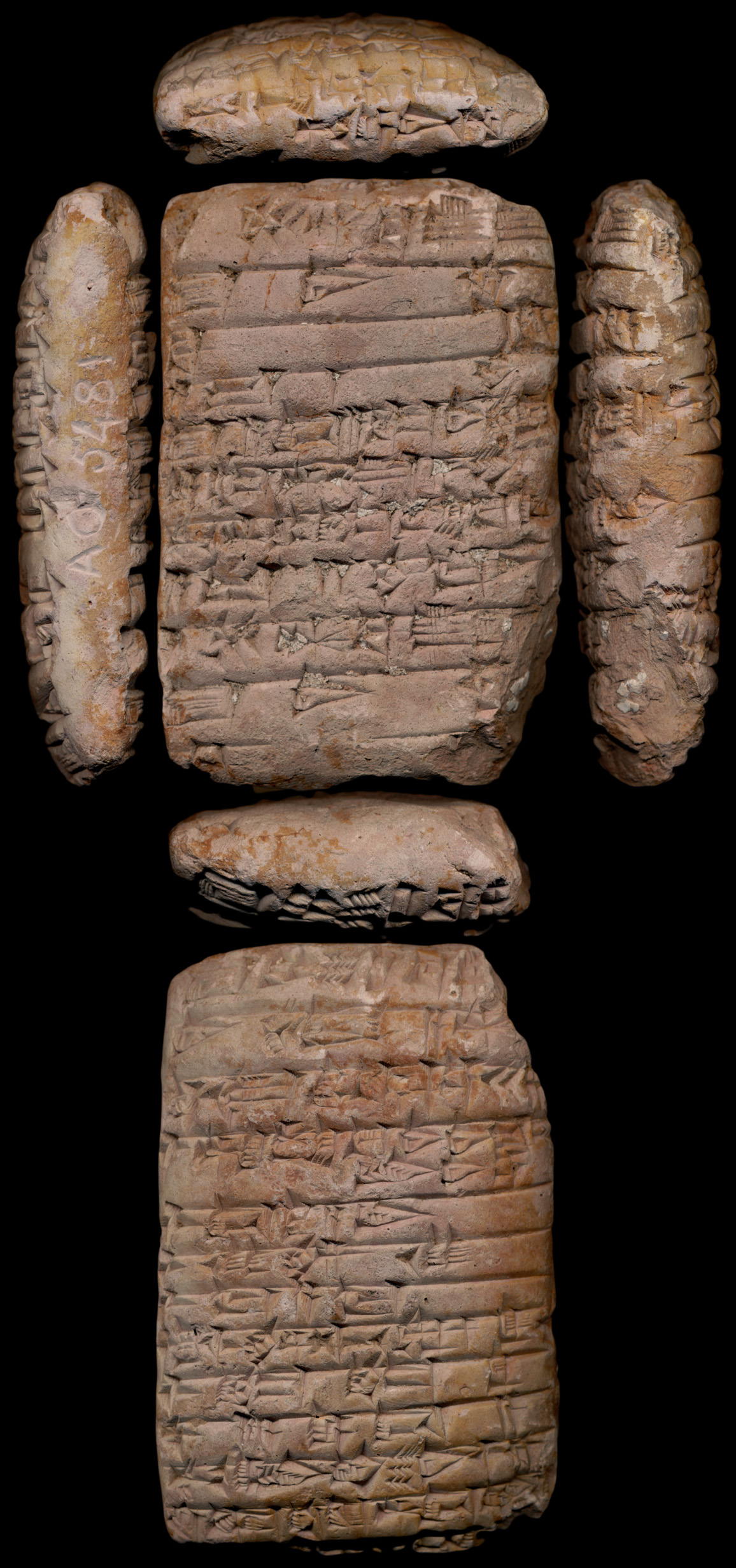
Index of translations of Sumerian tablets
Sumerian clay tablets that, as far as we could check, had no published English translation. We translate them ourselves. The page linked above is the index of the series. A new tablet is a new row there, not a list copied into every story.
All translations are new and unofficial, made from transliterations on the Cuneiform Digital Library Initiative (CDLI), and may contain errors. Tablet images are credited to the holding institutions and CDLI. Dates use the conventional middle chronology and are approximate.

The first time Geme-Baba ran, she was found staying in the house of a man called Ada’a. The second time, she was staying in the house of Išar-padan.
Then, at Puzriš-Dagan, in what is now southern Iraq, in the second year of King Ibbi-Suen (around 2027 BC), five men stood as witnesses while an oath was sworn by the king’s name: that she will not flee.
That is the story this small clay tablet tells, in two dozen short lines.
Two flights, two houses
The tablet is laid out like a little case file. It opens with her name, Geme-Baba, and says she “fled”. The verb is zah3, which the dictionary defines as “to disappear, flee”.
“First time,” the scribe writes: “she was lying in the house of Ada’a.” The word for “lying” (nu2) means “to lie down, to sleep”, and here it most likely just means she was staying there. The entry is dated to the month Ezem-Šulgi in the year “Ibbi-Suen became king”, around 2028 BC.
“For the second time,” it goes on, Geme-Baba fled again, and “in the house of Išar-padan she was lying”. This entry is dated to day 25 of the month Šah-ku-gu.
Five witnesses and an oath
Then come the witnesses: Šu-Suen-ili, described as a ra2-gaba, a “rider” or “messenger”; Da-KU-a, a leatherworker; Mimmi; Ma’ama; and Imtidam. “In their presence,” the tablet says, “that she will not flee, (she) swore by the name of the king.”
It closes with the place, Puzriš-Dagan, and the year: “the en-priest of Inanna of Uruk was chosen by omen”, Ibbi-Suen’s second year.
What we don’t know
As always, the tablet leaves a lot unsaid.
We don’t know who swore. The Sumerian verb has no written subject. Geme-Baba is the most natural reading, since the promise is about her, but it could have been someone answering for her.
We don’t know why she ran, or whom she ran from. Before each “fled” there is a short phrase, e2 i3-ru, that we can’t securely read. It might mean she left the house, or it might name the household she belonged to.
We don’t know what Ada’a and Išar-padan had to do with her. They might have taken her in, employed her, or simply been the people in whose houses she was found. The tablet doesn’t say, and we won’t guess.
And we don’t know who she was. Her name means “servant of (the goddess) Baba”, but the tablet never calls her a slave. It gives no age, no family and no reason, and it doesn’t say she was punished or returned to anyone.
A runaway at Puzriš-Dagan
Puzriš-Dagan, today’s Drehem, was “founded by King Shulgi as an important administrative center in the bala tax system”. The state’s livestock “was centralized at Drehem and subsequently redistributed to temples, its officials, and royal palaces”. It was a hub for animals; this tablet, unusually, is about a woman.
Flight was a common problem in the Ur III state. Historian J. N. Reid argues that studying it gives “insight into life at the bottom of society”, and that “the boundaries between slaves and other lower-stratum individuals were fluid and poorly defined”. That is one more reason not to force Geme-Baba into a category the tablet doesn’t use.
Reid also shows that oaths “in the name of the king” were used to bind captured runaways not to flee again. Our tablet fits that pattern, even though it doesn’t say she was captured.
The timing is striking too. Ibbi-Suen was the last king of the Third Dynasty of Ur, reigning from about 2028 to 2004 BC. Geme-Baba’s two flights fall in the first two years of that final reign.
Here we are speculating, but two flights within about a year suggest someone who very much wanted to be somewhere else. Why, and where she wanted to be, the tablet doesn’t say.
The tablet in full (our translation)
Front: Geme-Baba, (from?) the house (?), fled. First time: she was lying (= staying) in the house of Ada’a. Month: Ezem-Šulgi. Year: Ibbi-Suen became king. For the second time: Geme-Baba, (from?) the house (?), fl[ed].
Back: In the house of Išar-padan she was lying (= staying). Month: Šah-ku-gu, day 25. Before Šu-Suen-ili, the rider, man of the nitam (?); before Da-KU-a, the leatherworker; before Mimmi; before Ma’ama; and before Imtidam: in their presence, that she will not flee (again), (she) swore by the name of the king. In Puzriš-Dagan. Year: the en-priest of Inanna of Uruk was chosen by omen.
How we read it
Key lines in transliteration: e2 a-da-a-ka i3-nu2-am3, “she was lying (staying) in the house of Ada’a”, and nu-zah3-e-da-a / mu lugal-bi in-pa3, “that she will not flee, (she) swore by the name of the king”. Nu- makes the verb negative, and mu lugal is “the name of the king”.
Uncertain: the phrase e2 i3-ru before each “fled”; who swore the oath, since no subject is written; the title of the first witness, lu2 ni-tam, which we leave untranslated. The month names belong to the local calendar and are given as written.
Our confidence: medium-high. The sequence of events is clear; two phrases are not.
This translation is new and unofficial, made from the CDLI transliteration, and may contain errors. “Untranslated” means we found no translation on CDLI or in the tablet’s publication history (a hand copy in TCL 2, 1911, and a footnote citation in Landsberger’s study of animal names). Two caveats: J. N. Reid’s 2015 study of Ur III runaways may discuss this tablet, and we have seen only its abstract; and the website sumerianbook.com has a page for this tablet, which we deliberately did not open. Dates use the conventional middle chronology and are approximate.
Further reading
- CDLI artifact page for P131571
- J. N. Reid, “Runaways and Fugitive-Catchers during the Third Dynasty of Ur” (2015)
- J. N. Reid, “Punishment for the Coercion of Labour during the Ur III Period” (2023)
- Wikipedia, “Puzrish-Dagan”
- CDLI Wiki, Ibbi-Suen, including the year names
- Wikipedia, “Ibbi-Sin”
- Wikipedia, “Third Dynasty of Ur”
- ePSD2, the electronic Pennsylvania Sumerian Dictionary
- Oracc, Ancient Mesopotamian Gods and Goddesses