
Index of translations of Sumerian tablets
Sumerian clay tablets that, as far as we could check, had no published English translation. We translate them ourselves. The page linked above is the index of the series. A new tablet is a new row there, not a list copied into every story.
All translations are new and unofficial, made from transliterations on the Cuneiform Digital Library Initiative (CDLI), and may contain errors. Tablet images are credited to the holding institutions and CDLI. Dates use the conventional middle chronology and are approximate.

“1 garment, ordinary quality: Geme-kisal, from flight, overseer Ur-Numušda.”
Running away is one moment. This tablet seems to show what came after.
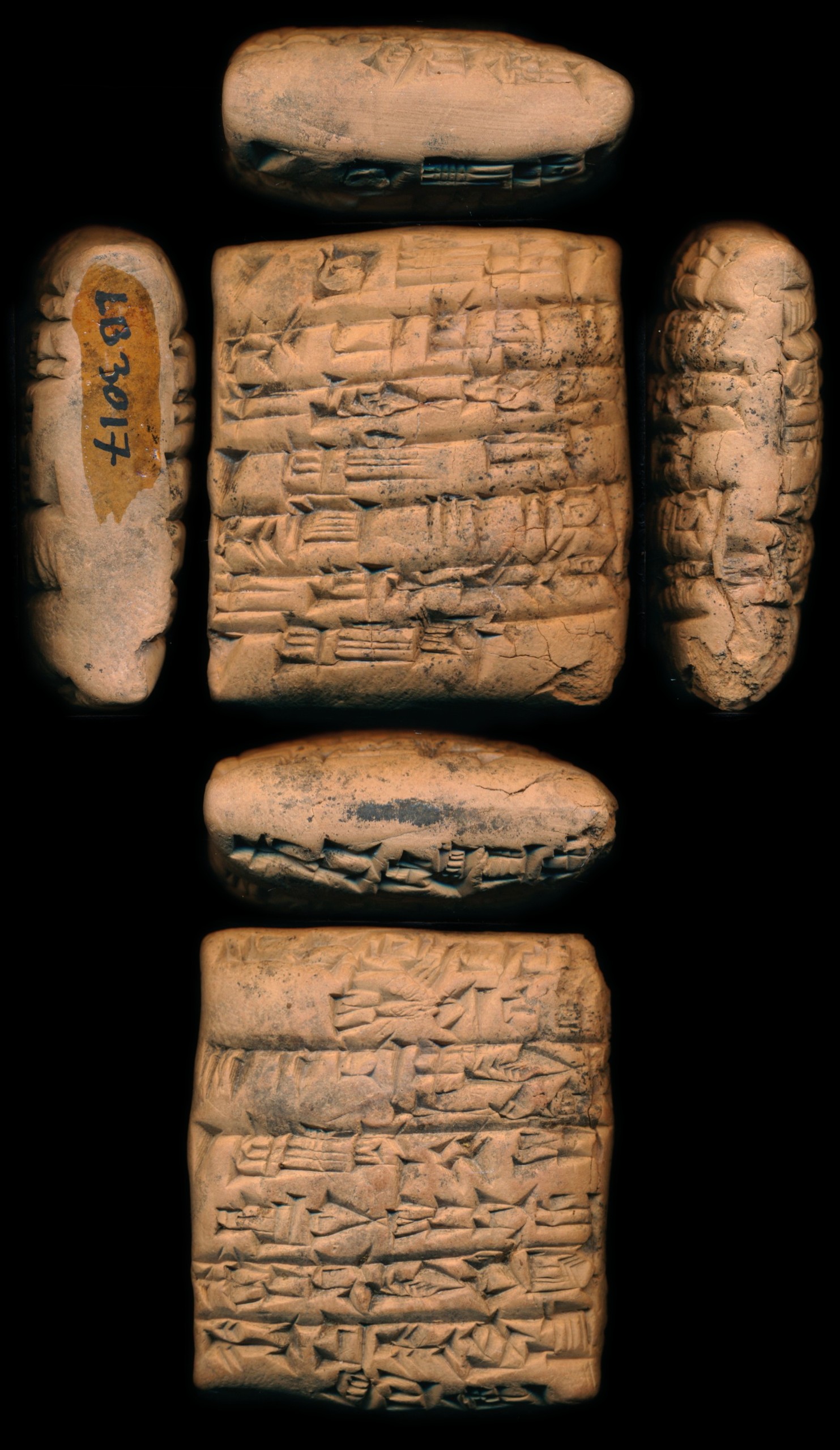
It comes from Umma, in what is now southern Iraq, probably around 2026 BC, the third year of King Ibbi-Suen. It lists four workers, each issued one garment and named with an overseer. Beside two of the names, the scribe wrote zah3-a-ta, “from flight”.
Four garments, four names
Each entry follows the same pattern: one garment of “ordinary” (u2) quality, a grade word, a name and an overseer.
The first two garments are graded kal. One goes to Geme-gigir, under the overseer Lu-hegal. After her name comes SIG7-a, a worker category whose meaning is debated. The second goes to Geme-kisal, “from flight”, under Ur-Numušda.
The next two are graded nesag. One goes to a man whose name is only partly legible, perhaps Amar-Suen-URU, son of a father whose name is doubtful. He too is “from flight”, under the overseer Lu-Nanna. The last goes to Gamgam-turrani (?), son of Gu-guz (?), under Lu-duga, the nubanda, or captain, of the oxen.
Then the year: “Simurrum was destroyed”.
What “from flight” seems to mean
The word zah3 means “to flee” or “to disappear”, and the ending -ta means “from”. So zah3-a-ta is literally “from (the) fleeing”.
Our most likely reading is that Geme-kisal and the man listed after her had run away, were back on the rolls, and were being clothed again along with the others. That is an interpretation. The tablet doesn’t say how they came back, or what, if anything, happened to them on their return.
What it does show is that, on paper at least, the two are handled like the others: one ordinary garment each, booked under an overseer.
The gaps in the story
We don’t know how long the two were gone, where they went or why they left.
We don’t know whether they were caught, punished or forgiven, or whether they came back of their own accord.
We don’t know what SIG7-a means for Geme-gigir. The dictionary links the word to a category of worker, but its sense here is uncertain, and we won’t guess.
We don’t know what the grades kal and nesag meant for the cloth, so we leave them as names.
And we can’t be sure of the year. The words “Simurrum was destroyed” were used for two different years.
Which Simurrum year?
Simurrum was a city the Ur III kings fought more than once: “The Ur III empire was frequently in conflict with the city.” Two kings named years after destroying it. The exact words on our tablet, mu si-mu-ru-um{ki} ba-hul, are the name of Šulgi’s 25th year, around 2070 BC. Ibbi-Suen’s third year, around 2026 BC, was “Year Ibbi-Sin the king of Ur destroyed Simurrum”, which could be shortened the same way.
CDLI dates the tablet to Ibbi-Suen 3 and marks the date as uncertain. One small clue favours the later date: the second runaway’s name seems to be built on the name of Amar-Suen, a deified king who reigned between the two. But that reading is itself doubtful, so we say “probably”. If the later date is right, the tablet comes from the last years of the busy Umma archive.
Flight was common among the state’s dependent workers. R. K. Englund describes them as “much comparable to chattel slaves but … inalienable wards to the state”, and J. N. Reid writes that “the boundaries between slaves and other lower-stratum individuals were fluid and poorly defined”. The tablet doesn’t call these four slaves, and neither do we.
The tablet in full (our translation)
Front: 1 garment, ordinary quality, kal-grade (?): Geme-gigir, SIG7-a (a worker category, meaning debated), overseer Lu-hegal. 1 garment, ordinary quality, kal-grade (?): Geme-kisal, from flight, overseer Ur-Numušda. 1 garment, ordinary quality, nesag-grade (?):
Back: Amar-Suen-URU (?), son of TE?-NIN? (reading doubtful), from flight, overseer Lu-Nanna. 1 garment, ordinary quality, nesag-grade (?): Gamgam-turrani (?), son of Gu-guz (?), (under) the captain of the oxen, Lu-duga. Year: Simurrum was destroyed.
How we read it
Key lines in transliteration: geme2-kisal zah3-a-ta / ugula ur-{d}nu-musz-da, “Geme-kisal, from flight, overseer Ur-Numušda”, where zah3 is “to flee”, -ta “from” and ugula “overseer”; and the date, mu si-mu-ru-um{ki} ba-hul, “year: Simurrum was destroyed”.
Uncertain: the sense of zah3-a-ta, which we read as “back from flight”; the year; the grades kal and nesag; SIG7-a; and two names, which are partly illegible.
Our confidence: medium. The pattern of the list is clear; the date, two names and a few terms are not.
This translation is new and unofficial, made from the CDLI transliteration, and may contain errors. “Untranslated” means we found no translation on CDLI or in the tablet’s publication history (none: CDLI lists the tablet as unpublished; it is LB 3017 in the de Liagre Böhl Collection, Leiden). We know of no edition. The date is uncertain, as explained above. Dates use the conventional middle chronology and are approximate.
Further reading
- CDLI artifact page for P390085
- CDLI Wiki, “The Province of Umma”
- CDLI Wiki, Ibbi-Suen, including the year names
- CDLI year names, “Šulgi”
- J. N. Reid, “Runaways and Fugitive-Catchers during the Third Dynasty of Ur” (2015)
- R. K. Englund, “Equivalency Values and the Command Economy of the Ur III Period in Mesopotamia” (2012)
- Wikipedia, “Simurrum”
- Wikipedia, “Ibbi-Sin”
- Wikipedia, “Third Dynasty of Ur”
- ePSD2, the electronic Pennsylvania Sumerian Dictionary
- Oracc, Ancient Mesopotamian Gods and Goddesses