
Index of translations of Sumerian tablets
Sumerian clay tablets that, as far as we could check, had no published English translation. We translate them ourselves. The page linked above is the index of the series. A new tablet is a new row there, not a list copied into every story.
All translations are new and unofficial, made from transliterations on the Cuneiform Digital Library Initiative (CDLI), and may contain errors. Tablet images are credited to the holding institutions and CDLI. Dates use the conventional middle chronology and are approximate.

“From the bala, from those who were returned: it is a shortfall.”
Four men ran away. To the office that kept this tablet, that was first of all a problem of numbers.
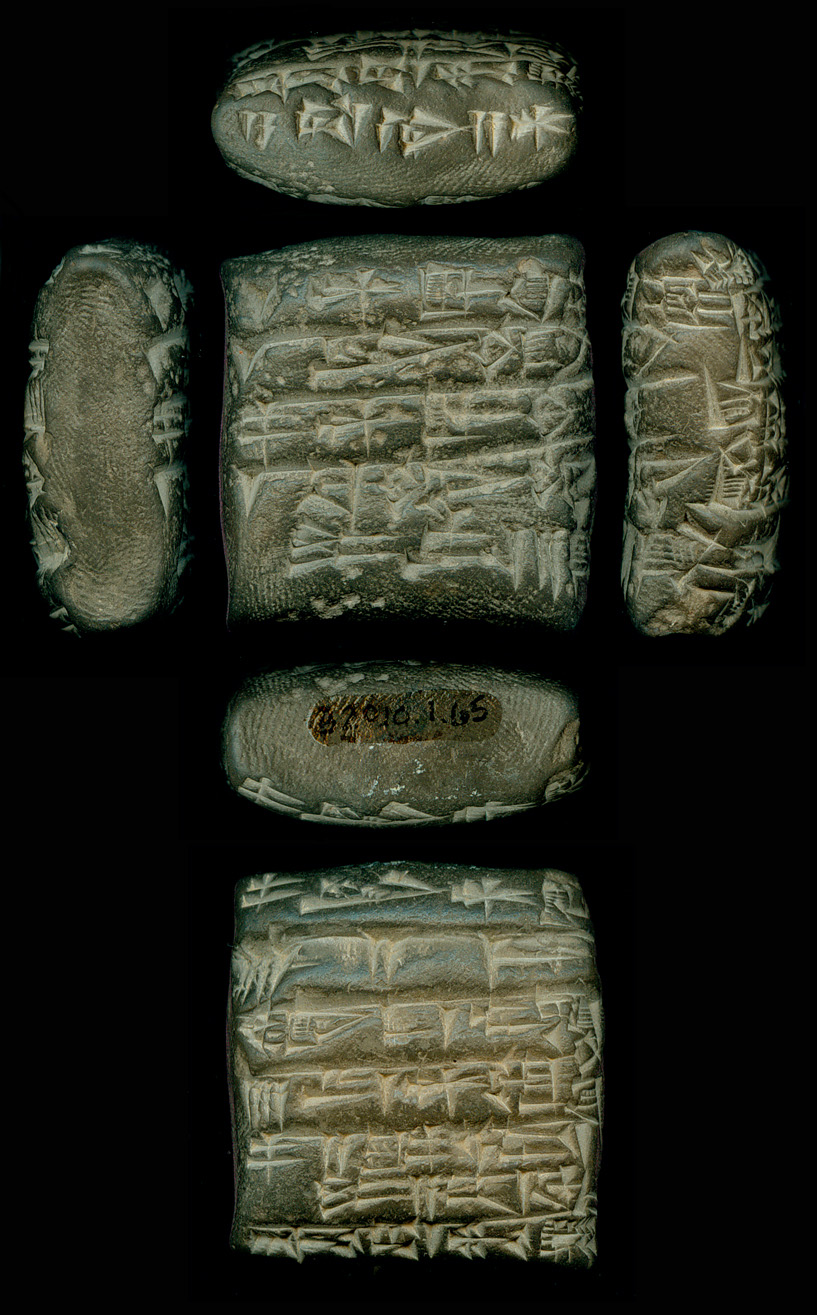
The tablet comes from Umma, in what is now southern Iraq, in the Ur III period, about 2100 to 2000 BC. It gives no year. It lists the four runaways and their overseers, and closes by booking them as a shortfall.
Four names
The first two are Šara-ki’ag and Lu-duga, under an overseer whose name is written {d}szara2-kam. That could be a man called Šarakam, or it could mean “(the crew) is Šara’s”. We read it as a name.
The third is Ba-lulu, son of Da’aga, under the overseer Lu-Šara. Then the scribe sums up: zah3-a-me, “they are runaways”, and adds “via Emah-kidu”, the official through whom the matter passed.
The fourth entry is separate: zah3 ur-{d}nin-su, “runaway: Ur-Ninsu”, under the overseer Ipa’e, son of A’abba.
The bookkeeper’s word
The last line says bala-ta mu-gi4-a-ta la2-ia3-am3. Word by word: “from the bala”, “from those who were returned”, “it is a shortfall”.
The bala was the rotating duty the provinces owed the crown, paid in goods and in labour. Workers went out on bala service and came back. Our best reading is that, when the workers were returned, these four were missing, and the office booked them as la2-ia3, the standard term for a deficit in an account.
That word turns people into a debit. The same term is used for missing barley or sheep. Someone, probably the overseers, would be expected to make up the difference.
Running away in the Ur III state
Flight was common among dependent workers in this period. R. K. Englund describes such workers as “much comparable to chattel slaves but … inalienable wards to the state”. Reid’s study of runaways shows the state spending real effort to find them, with men sent out to catch fugitives.
This tablet shows another side of it: the accounting. Before anyone went looking, the absence had to be written down, named and charged to someone.
What the tablet doesn’t tell us
We don’t know when or why the four men ran, or whether they ran together.
We don’t know whether they were ever found.
We don’t know exactly how “from the bala” and “from those who were returned” fit together. The line may mean the men were missing from the group that came back from bala service, as we read it, or something slightly different.
And we can’t be sure whether the overseer of the first two is a man named Šarakam.
The tablet in full (our translation)
Front: 1 Šara-ki’ag, 1 Lu-duga: overseer Šarakam (?). 1 Ba-lulu, son of Da’aga:
Back: overseer Lu-Šara. They are runaways. Via Emah-kidu. Runaway: Ur-Ninsu (?), overseer Ipa’e, son of A’abba. From the bala, from those who were returned: it is a shortfall.
How we read it
Key lines in transliteration: zah3-a-me, “they are runaways”, from zah3, “to flee”; and bala-ta mu-gi4-a-ta la2-ia3-am3, “from the bala, from those who were returned: it is a shortfall”, where gi4 is “to return” and la2-ia3 “deficit”.
Uncertain: whether {d}szara2-kam is a name; whether zah3 ur-{d}nin-su is “runaway: Ur-Ninsu” or “runaway of Ur-Ninsu”; and the exact sense of the last line.
Our confidence: medium. The runaways and their overseers are clear; the last line is our best reading.
This translation is new and unofficial, made from the CDLI transliteration, and may contain errors. “Untranslated” means we found no translation on CDLI or in the tablet’s publication history (none: CDLI lists the tablet as unpublished; it is B2010.1.65 in the Badè Museum, Berkeley). We know of no edition. Dates use the conventional middle chronology and are approximate.
Further reading
- CDLI artifact page for P405496
- CDLI Wiki, “The Province of Umma”
- J. N. Reid, “Runaways and Fugitive-Catchers during the Third Dynasty of Ur” (2015)
- R. K. Englund, “Equivalency Values and the Command Economy of the Ur III Period in Mesopotamia” (2012)
- Wikipedia, “Third Dynasty of Ur”
- ePSD2, the electronic Pennsylvania Sumerian Dictionary