
Index of translations of Sumerian tablets
Sumerian clay tablets that, as far as we could check, had no published English translation. We translate them ourselves. The page linked above is the index of the series. A new tablet is a new row there, not a list copied into every story.
All translations are new and unofficial, made from transliterations on the Cuneiform Digital Library Initiative (CDLI), and may contain errors. Tablet images are credited to the holding institutions and CDLI. Dates use the conventional middle chronology and are approximate.

“Fled: Ša-gubi.”
Almost every line on this tablet gives a woman a few litres of sesame oil. Three lines give a name and nothing else, only the word zah3, “fled”.
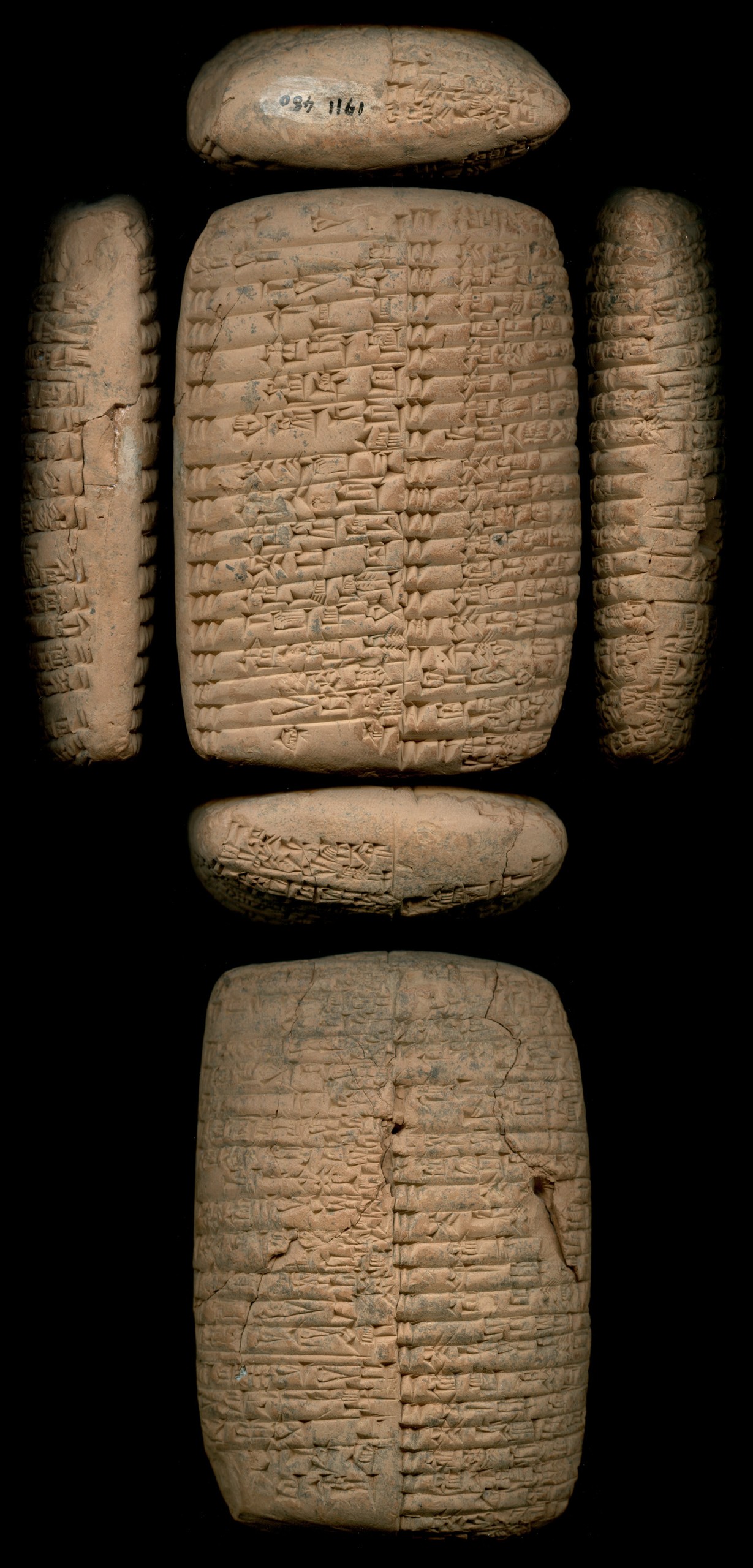
The tablet comes from Umma, in what is now southern Iraq, around 2041 BC, the sixth year of King Amar-Suen. It is a ration list for the lukur of Šara, the god of Umma, and it carries the words “sealed document of the governor”.
About sixty names and their oil
The list runs down four columns, two on each side. Each entry is a number and a name: 3 litres for Me-niku, 3 for Igi-susu, 3 for Ninkalla, and so on. Most women get 2 or 3 litres, and a few get 4. The unit is the sila, close to our litre.
Many of the women are identified through a parent: Igi-insasa, daughter of Lu-gula; Ama-ursage, daughter of Ur-zu; Nin-mangure, daughter of La’amu. The Sumerian word is dumu, “child”. The names we can read are women’s names, so we write “daughter”.
One woman, Geme-Lisi, is named as the child of Geme-Ašar, a woman’s name. A Geme-Ašar also appears earlier in the list with 3 litres of her own. It could be a mother and daughter on the same ration list. The tablet doesn’t say so, and the name may simply belong to two different women.
Partway down the back, the scribe wrote ugula tur-tur-a, “overseer: Turtura”. A Turtura also heads the list with 4 litres. The total follows the last name: 157 litres of sesame oil, “oil rations of the lukur of Šara”. Then the seal note and the year: “Šašrum was destroyed”.
Three names without oil
In three places the number is missing and zah3 stands in its place: Ša-gubi in the first column, Nin-kusig and Geme-Dumuzida in the second.
The scribe kept their names in the list and gave them nothing. That suggests the women still counted as members of the group after they had gone. The list records who belonged, not only who was there to collect.
A Geme-Dumuzida turns up again on the back, this time with 2 litres. It may be another woman with the same name, or the same woman entered twice. We can’t tell.
Who were the lukur of Šara?
The dictionary gives lukur as a kind of priestess, and also as a junior wife of a deified king. In an account like this one, “the lukur of Šara” seems to mean a group of women attached to the god’s temple, large enough to need an overseer and a sealed ration list.
Šara was the chief god of Umma. Oil was one of the regular rations of the Ur III state, along with barley and wool, and the Umma archive is full of lists like this one.
Here we are speculating, but more than sixty women, many named with a father, all drawing oil together, looks less like a handful of priestesses and more like a community of women dependent on the temple. The tablet doesn’t tell us what work they did.
What the tablet doesn’t tell us
We don’t know why Ša-gubi, Nin-kusig and Geme-Dumuzida left, where they went or whether they came back.
We don’t know how the lukur of Šara lived, or what their duties were.
We don’t know what libir-am3, “it is old”, means after one entry on the back. It may mark an entry carried over from an earlier list.
And the sum is one litre off. The entries, as we read them, add up to 158 litres; the tablet says 157. Either we have misread a worn number or the scribe slipped.
The tablet in full (our translation)
Front, first column: 4 litres of sesame oil: Turtura. 3: Me-niku. 3: Igi-susu. 3: Ninkalla. 3: Nin-kuzu. 3: Šat-Mami. 3: Geme-nigar. 3: Nin-kurma. 4: Nin-adda. 3: Geme-gigir. 3: Nin-ensa. 3: Me-egalta. 3: Nin-geškimzi. Fled: Ša-gubi. 3: Ikalla. 3: Kina.
Front, second column: 3: Nin-ebansa. 3: Geme-Ašar. Fled: Nin-kusig. 2: Nin-ensa. 2: Ama-kalla. 2: Nin-nammahzu. 2: Nin-mea. 2: Nin-egale. 2: Mami-hilisu. 2: Geme-dubla. 3: Nin-azu. 2: Nin-agrigzi. 2: Ama-gina. 2: Nin-egale. Fled: Geme-Dumuzida. 2: Igi-insasa, daughter of Lu-gula. 2: Ama-ursage, daughter of Ur-zu. 2: Agalzi, daughter of Inim-Šara.
Back, first column: 2: Nin-egale, daughter of E-u’e. 2: Munus-saga, daughter of Lu-gula. 2: Nin-gina, daughter of Ur-Mami. 2: Nin-geškimzi, daughter of Šeškalla. Overseer: Turtura. 4: Nin-inimgina. 2: Geme-Šara. 2: Geme-Ašnan. 3: Nin-azu. 3: Lukur-kalla. 3: Nin-kuli. 3: Turtura. 2: Geme-Dumuzida. 2: Nin-zagesi. 3: Lukur-kalla. 2: Geme-Šulpa’e. 2: Nin-nammahzu. 2: Nin-geškimzi. 2: Kisikil. 3: Geme-Enlila. 2: Me-ezita. 2: Geme-Lisi, child of Geme-Ašar.
Back, second column: 2: Geme-Ištaran, daughter of Lugal-isa. 2: Geme-gigir, daughter of Lu-Šara. 2: Ama-emahe, daughter of Inim-madingir. 2: Geme-Šara, daughter of Lu-Nanna. 3: Nin-mangure, daughter of La’amu. (It is) old (?). 2: Nin-egale, daughter of Ur-amma. 2: Nin-nammahzu, daughter of Ur-Numušda. 2: Nam-ninanidu, daughter of Dada. 2: Geme-ebgal, daughter of Lugal-emahe. 2: Ninkalla, daughter of Ur-sagamu. 2: E-lulagar. 3: Nin-batuku-šemdugal (?). Total: 157 litres of sesame oil, oil rations of the lukur of Šara. Sealed document of the governor. Year: Šašrum was destroyed.
How we read it
Key lines in transliteration: zah3 sza3-gu2-bi, “fled: Ša-gubi”, where zah3 is “to flee”; i3-ba lukur {d}szara2, “oil rations of the lukur of Šara”; and kiszib3 ensi2, “sealed document of the governor”.
Uncertain: the exact form of many names, which we give lightly normalised; whether every dumu is a daughter; the meaning of libir-am3; and the one-litre gap in the total.
Our confidence: high for the structure of the list, lower for the spelling of the names. The amounts and the three “fled” entries are clear.
This translation is new and unofficial, made from the CDLI transliteration, and may contain errors. “Untranslated” means we found no translation on CDLI or in the tablet’s publication history (AAICAB 1/1, 1996, a catalogue of the Ashmolean’s tablets). Dates use the conventional middle chronology and are approximate.
Further reading
- CDLI artifact page for P142753
- CDLI Wiki, “The Province of Umma”
- CDLI Wiki, Amar-Suen, including the year names
- R. K. Englund, “Equivalency Values and the Command Economy of the Ur III Period in Mesopotamia” (2012)
- Wikipedia, “Shara (god)”
- Wikipedia, “Third Dynasty of Ur”
- ePSD2, the electronic Pennsylvania Sumerian Dictionary
- Oracc, Ancient Mesopotamian Gods and Goddesses