
Index of translations of Sumerian tablets
Sumerian clay tablets that, as far as we could check, had no published English translation. We translate them ourselves. The page linked above is the index of the series. A new tablet is a new row there, not a list copied into every story.
All translations are new and unofficial, made from transliterations on the Cuneiform Digital Library Initiative (CDLI), and may contain errors. Tablet images are credited to the holding institutions and CDLI. Dates use the conventional middle chronology and are approximate.

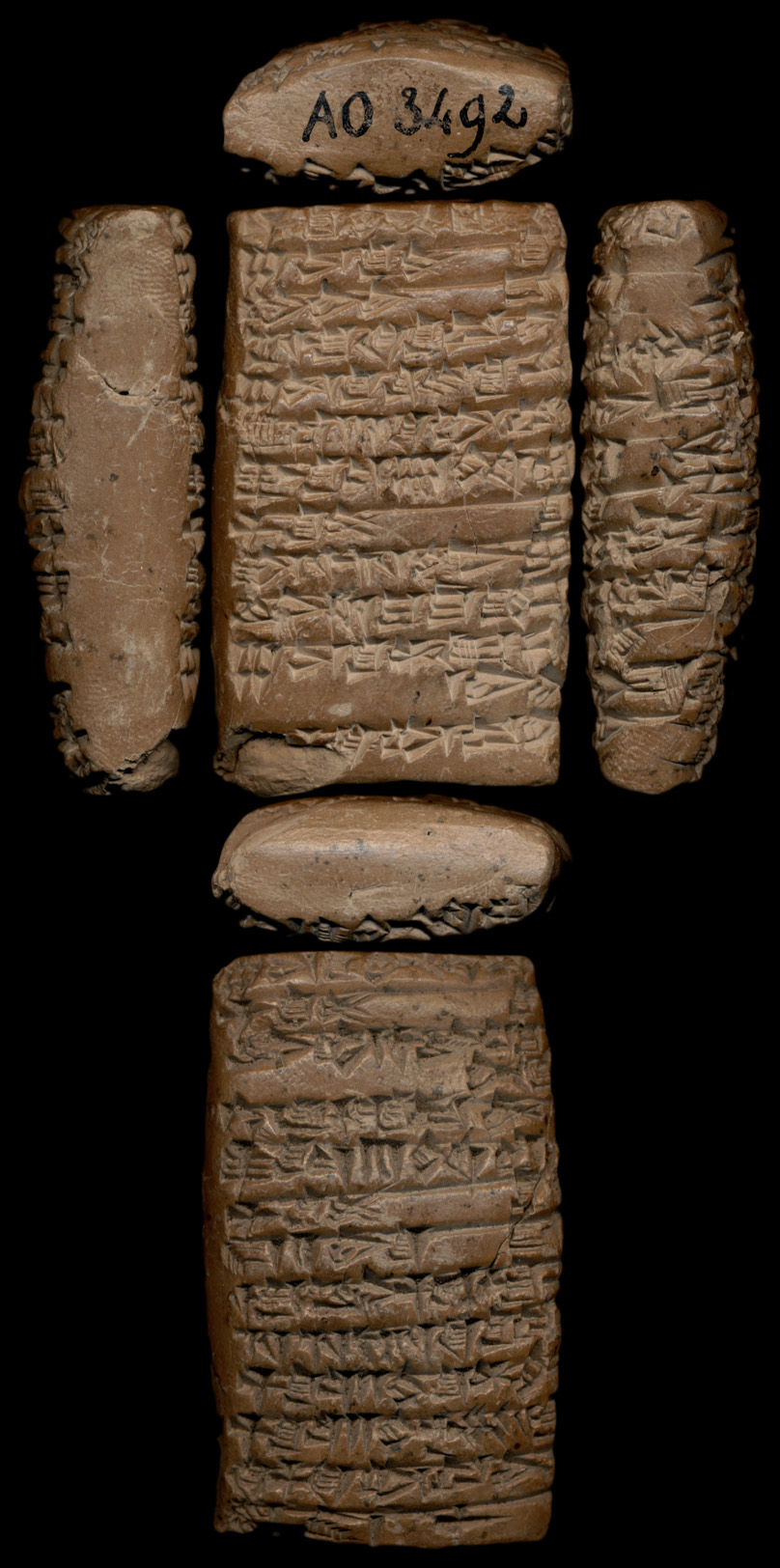
“5 litres of flour for the road: Durra-ili, the envoy, going to Si’u.”
Every traveller on this tablet gets two things: flour to eat while he is in town, and flour to carry with him.
The tablet comes from Girsu, in what is now southern Iraq, in the Ur III period, about 2100 to 2000 BC. It gives the month, the first of the Girsu year, but no year. It is one of the many “messenger texts” from Girsu, short records of food handed out to people passing through.
Who passed through
There are seven entries. Durra-ili, an envoy, is “going to Si’u”. Šu-Eštar, the brother of a lukur, a priestess, is “coming from Urua”. Šulgi-ili, an envoy, is coming from a place whose name is broken.
Lušalim, “the man of the great weapon”, a military title, is “going to Susa”, the great city of Elam. Eanišu, an envoy, travels with Lugal-massu, an ukul, a title we can’t translate, “going to Huhnuri”. Šu-Adad, an envoy, and a second ukul whose name is damaged are “coming from Kimaš”.
The places point east. Susa, Huhnuri and Kimaš lay on the routes from southern Babylonia toward the Iranian highlands, and Girsu was a stop on the way.
What a journey cost
The amounts follow a pattern. A traveller staying one day gets 5 or 10 litres “in the city” and 5 or 10 litres “for the road”. Eanišu and Lugal-massu get 30 litres “for 3 days in the city”, plus 10 for the road.
The largest ration goes to Šar-šepi, “son of the captain”, “who went to catch runaways”: 40 litres for 8 days in the city, and 10 for the road. That is 5 litres a day, generous by the standards of these lists.
Our earlier post The Hunt for the Palace’s Runaways reads RTC 354, a tablet catalogued next to this one in the same 1903 publication. It also feeds a captain’s son, and it too mentions Huhnuri. We can’t tell whether the two tablets come from the same days.
Roads, envoys and Elam
The Ur III state ran a network of way-stations, and Girsu was one of its busiest. Envoys, soldiers and officials travelled under orders, and each stop recorded what they ate. Another of our tablets, Two Goats for the Road to Elam, shows the same traffic from the livestock side.
Here we are speculating, but the mix on this one tablet, envoys going out, men coming in from the east and a captain’s son hunting fugitives, suggests a single office handing out flour to whoever came to the door with the right papers that day.
What the tablet doesn’t tell us
We don’t know why any of these men were travelling. The tablet gives destinations, not missions.
We don’t know whose runaways Šar-šepi was chasing, or whether he found them.
We don’t know what an ukul was, or the exact rank of “the man of the great weapon”.
And we don’t know the year.
The tablet in full (our translation)
Front: 10 litres of royal zi3-gu flour in the city, 5 litres of flour for the road: Durra-ili, the envoy, going to Si’u. 5 litres of flour: Šu-Eštar, brother of the lukur, coming from Urua. 40 litres of flour for 8 days in the city, 10 litres of flour for the road: Šar-šepi (?), son of the captain, who went to catch runaways. 5 litres of flour: Šulgi-ili, the envoy, coming from […].
Back: 5 litres of zi3-gu flour in the city, 10 litres of flour for the road: Lušalim, the man of the great weapon, going to Susa. 30 litres of flour for 3 days in the city, 10 litres of flour for the road: Eanišu, the envoy, and Lugal-massu, the ukul, going to Huhnuri. 10 litres of flour for 2 days: Šu-Adad, the envoy. 10 litres of flour for 2 days: […]-mu, the ukul, coming from Kimaš. Month: Gan-maš.
How we read it
Key lines in transliteration: lu2 zah3 dab5-dab5-de3 gen-na, “who went to catch runaways”, where lu2 zah3 is “fugitive” and dab5 “to seize”; and szuszin{ki}-sze3 du-ni, “going to Susa”.
Uncertain: the name we give as Šar-šepi; the title ukul; the rank of “the man of the great weapon”; and two broken names.
Our confidence: medium-high. The pattern of the entries is clear and the places are well known.
This translation is new and unofficial, made from the CDLI transliteration, and may contain errors. “Untranslated” means we found no translation on CDLI or in the tablet’s publication history (RTC, 1903, François Thureau-Dangin’s hand copies of Louvre tablets). Dates use the conventional middle chronology and are approximate.