
Index of translations of Sumerian tablets
Sumerian clay tablets that, as far as we could check, had no published English translation. We translate them ourselves. The page linked above is the index of the series. A new tablet is a new row there, not a list copied into every story.
All translations are new and unofficial, made from transliterations on the Cuneiform Digital Library Initiative (CDLI), and may contain errors. Tablet images are credited to the holding institutions and CDLI. Dates use the conventional middle chronology and are approximate.

Turtura. Narzi. Suhud. Ṣeluš-ṭab. Geme-Ašar. Nin-abbana. Geme-gipar. Geme-Ninurra.
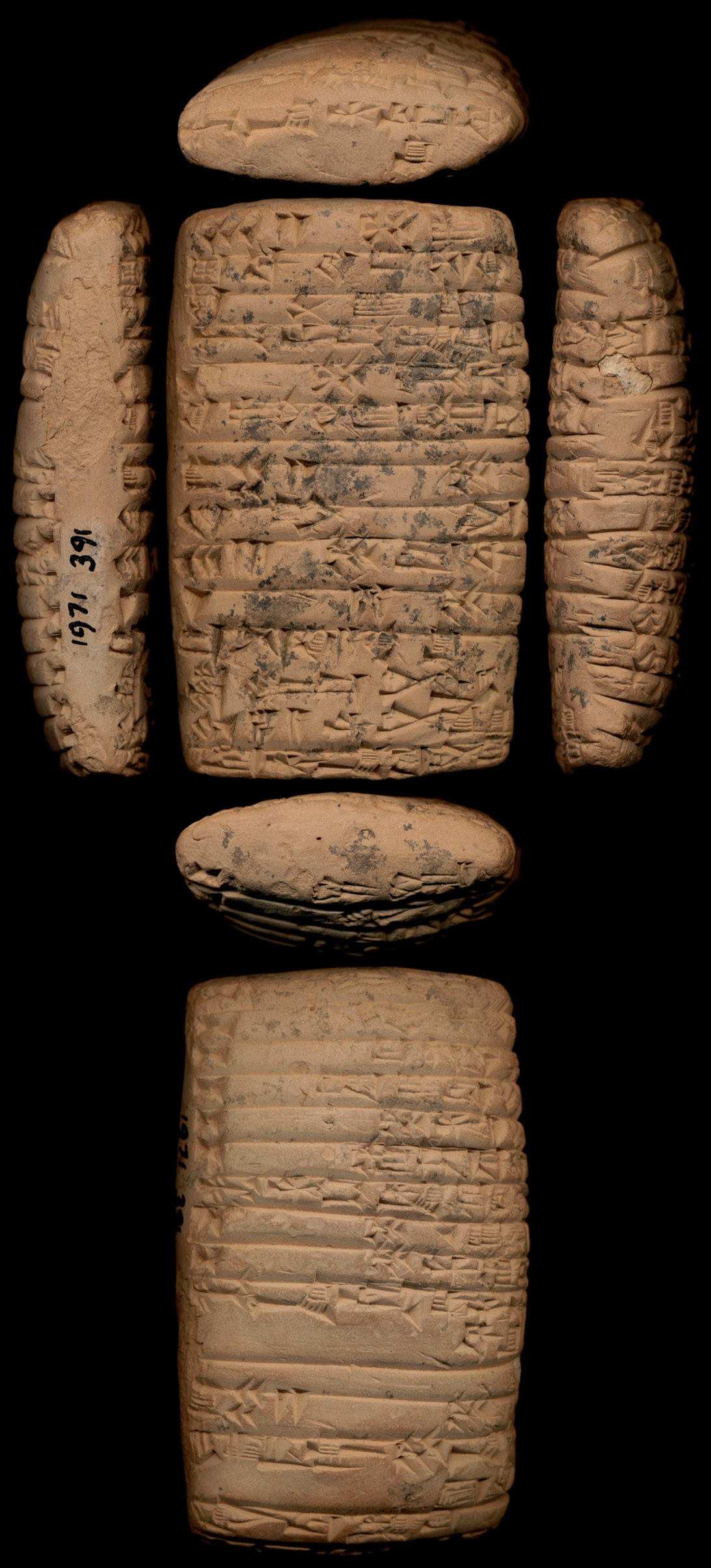
Eight names, each introduced by the same Sumerian word: uš2, “dead”. They stand on the back of a clay account from a mill in Umma, in what is now southern Iraq, covering the first years of King Amar-Suen and closed in his fifth year (around 2042 BC). The front tells us about the others: 42 women “of Nippur”, of whom 33 were still at work and one had fled.
Balancing the books
The tablet is a nig2-ka9-ak, an “account”, and it adds up exactly.
It starts with 32 female workers “at 30”, taken over in Umma in the month Pa’u’e of the year Amar-Suen became king. Ten more women were added “from the foremen of the millers”. Total: 42.
Then the scribe accounts for every one of them. “From among them: 33 female workers present, 1 fled female worker”, working “in Umma at the mill” until the 15th day of the month Sig-išubgar.
The back lists the dead. Six died in the year Amar-Suen became king: Turtura, Narzi, Suhud, Ṣeluš-ṭab, Geme-Ašar and Nin-abbana. Two more, Geme-gipar and Geme-Ninurra, died in the year “Enmahgalanna was installed”, Amar-Suen’s fourth year. Then the total again: 42. And 33 plus 1 plus 8 makes 42.
The account is labelled “account of the female workers of Nippur”, passed “via Ur-Suen”, and dated to the year “the en-priestess of Inana was installed”.
The gaps in the story
The account is precise about numbers and names, and silent about almost everything else.
We don’t know how any of the eight women died. The tablet gives no cause of death, and we won’t guess.
We don’t know who the woman who fled was. She is the only one without a name, and the tablet doesn’t say whether she was ever found.
We don’t know why women “of Nippur”, another city, were working at a mill in Umma.
And we don’t know their ages, or anything about their families.
Some of the names are tentative readings, especially Suhud and Ṣeluš-ṭab. Even so, it is striking that the scribe named the dead one by one, while the living appear only as a number.
Who were these women?
The word for them is geme2, the standard term for a dependent female worker. Historian R. K. Englund describes such workers as “much comparable to chattel slaves but were inalienable wards to the state”. They were not free, but as wards of the state they could not be sold. That is why we call them “workers” here rather than “slaves”.
The “30” in the first line fits what Englund reports about their pay: “a monthly ration of on average 30 liters of barley for women”.
Milling was women’s work in this world. Englund notes that grinding grain into flour “was done almost exclusively by female laborers”, with an “average production norm” of “10 liters of milled grain per workday per female laborer”. If the 33 women still present met that norm, and we don’t know that they did, they would have produced around 330 litres of flour a day between them.
One gone
One of the 42 had fled. Flight from labour, and the effort to catch runaways, is a recurring theme in Ur III documents. J. N. Reid’s study of runaways and fugitive-catchers calls it a window on “life at the bottom of society”. This tablet records only the fact: one woman, unnamed, gone.
Here we are speculating, but the careful tally may have been drawn up when responsibility for the group passed from one official to another. The tablet doesn’t say why it was written.
The tablet in full (our translation)
Front: 32 female workers (at) 30 litres (each), taken over in Umma, month Pa’u’e, year: Amar-Suen (became) king. 10 female workers added from the foremen of the millers. [blank space] Total: 42 female workers. From among them: 33 female workers present, 1 fled female worker: (they were) in Umma at the mill, until the 15th day of the month Sig-išubgar had passed.
Back: Dead: Turtura; dead: Narzi; dead: Suhud(?); dead: Ṣeluš-ṭab(?); dead: Geme-Ašar; dead: Nin-abbana; year: Amar-Suen (became) king. Dead: Geme-gipar; dead: Geme-Ninurra; year: Enmahgalanna was installed. [blank space] Total: 42 female workers. Account of the female workers of Nippur. Via Ur-Suen. Year: the en-priestess of Inana was installed.
How we read it
Key lines in transliteration: 3(u) 3(disz) geme2 gub-ba / 1(disz) zah3 geme2, “33 female workers present, 1 fled female worker”, and the repeated usz2, “dead”, before each name, as in usz2 tur-tur-a, “dead: Turtura”.
Uncertain: some name readings (su-hu-ud, s,e-lu-usz-du10); the word dab-ba, which we translate “taken over”; and the month numbers, which we haven’t verified. The “30” in line 1 is written without the word for barley; we read it as the monthly ration. CDLI’s date list for this tablet also mentions Amar-Suen’s sixth year, but by the standard list of year names the final date is year 5.
Our confidence: medium-high. The numbers add up and the structure is standard.
This translation is new and unofficial, made from the CDLI transliteration, and may contain errors. “Untranslated” means we found no translation on CDLI or in the tablet’s publication history (AAICAB 1/2, 2000, a catalogue with copies and photos). Dates use the conventional middle chronology and are approximate.
Further reading
- CDLI artifact page for P248903
- R. K. Englund, “Equivalency Values and the Command Economy of the Ur III Period in Mesopotamia” (2012)
- J. N. Reid, “Runaways and Fugitive-Catchers during the Third Dynasty of Ur” (2015)
- CDLI Wiki, “The Province of Umma”
- Wikipedia, “Third Dynasty of Ur”
- ePSD2, the electronic Pennsylvania Sumerian Dictionary
- Oracc, Ancient Mesopotamian Gods and Goddesses