
Index of translations of Sumerian tablets
Sumerian clay tablets that, as far as we could check, had no published English translation. We translate them ourselves. The page linked above is the index of the series. A new tablet is a new row there, not a list copied into every story.
All translations are new and unofficial, made from transliterations on the Cuneiform Digital Library Initiative (CDLI), and may contain errors. Tablet images are credited to the holding institutions and CDLI. Dates use the conventional middle chronology and are approximate.

“They are fugitive-catchers.”
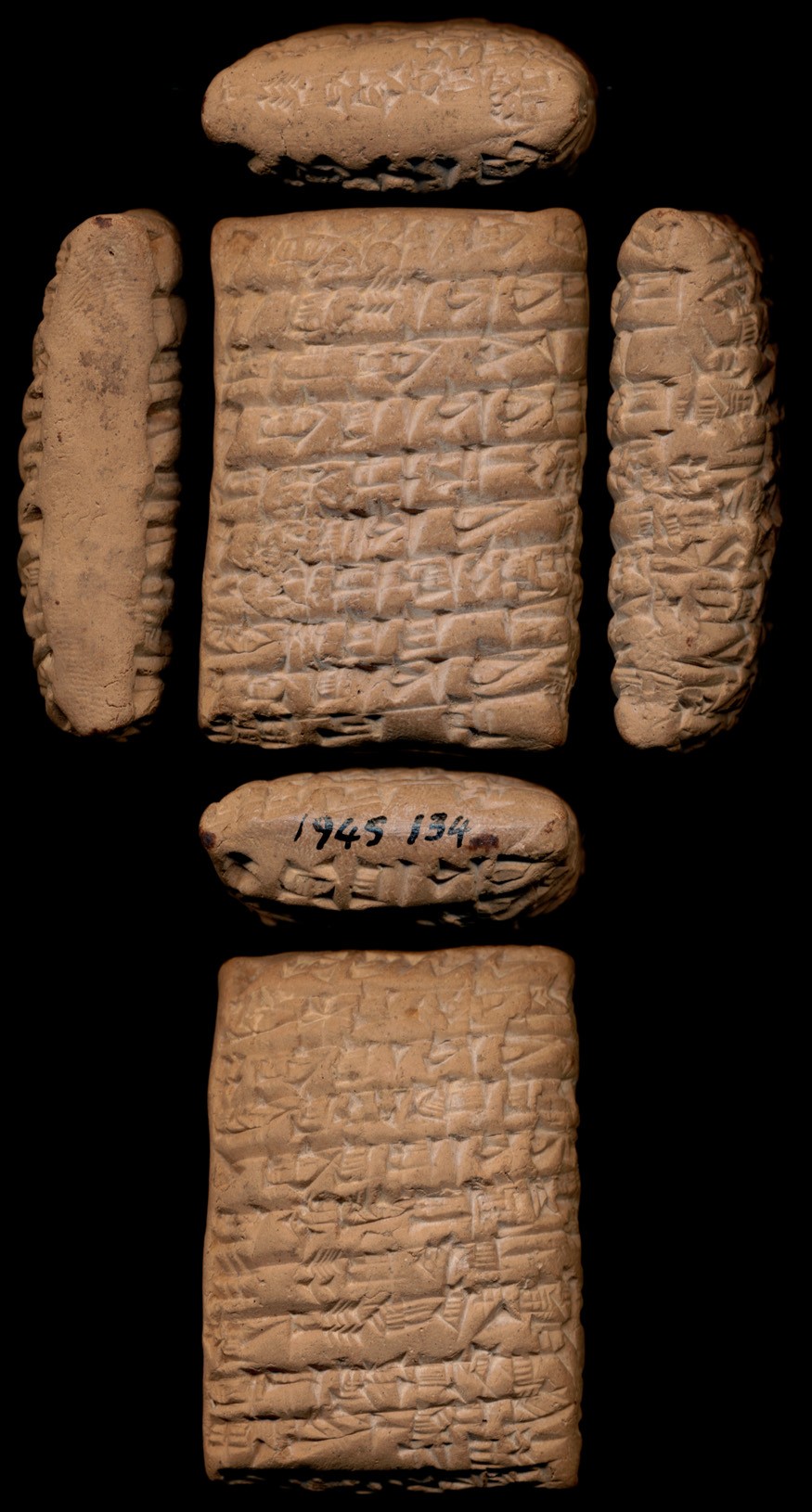
Runaways come up again and again in Ur III records. This tablet looks at the other side: the men paid to bring them back. It comes from Girsu, in what is now southern Iraq, and gives a month, Gu-rabi-mu, but no year, so we can only place it in the Ur III period, about 2100 to 2000 BC.
The two men are Ur-Lamma, “the Amorite”, and Abba-kalla, “the šarrabdu”, a kind of administrator. Each receives 120 litres of beer and flour and a litre of oil. Then comes the line lu2 zah3 dab5-dab5-me, literally “they are men who seize runaways”.
Who got what
The list opens with its biggest single entry. Kal-ubi, “the Elamite”, receives 60 litres of fine beer, 60 litres of ordinary beer, 180 litres of semolina and a litre of sesame oil.
Next come the two fugitive-catchers. Then the same amount, 120 litres of beer and flour and a litre of oil, goes to “the shepherd of the dogs” (sipa ur-ra), and again to a man named Lu-Igalim, whose title, lu2 ur3-ra, we can’t pin down.
Larger amounts follow: 240 litres for someone “who went to Lugal-nammah-su”, which may be a person or a place, and 300 litres for Ur-dun, another lu2 ur3-ra, “who went to the harvest”. Then 6 gur of barley, 1,800 litres, “as fodder for the donkeys of the messenger hostel, from Kisurra to Kalam-saga”. Last, 30 litres of bread go to Lu-melam, a hubbu, a kind of worker. The whole is booked as “expended”.
These amounts probably fed groups or covered several days, but that is our inference.
An Amorite on the catching side
Two labels stand out: “the Elamite” and “the Amorite”. By the last days of Ur, Amorites had become “such a force” that King Šu-Sin built a wall “to hold them off”.
Yet here an Amorite works for the state, on the side that catches runaways. The same may be true of Kal-ubi the Elamite, but we can’t be sure. His entry is laid out differently, and the line “they are fugitive-catchers” comes after the two names that follow his. It certainly covers Ur-Lamma and Abba-kalla. Whether it covers Kal-ubi too is open.
What we don’t know
We don’t know whether Kal-ubi was a fugitive-catcher.
We don’t know whom the catchers were after, or whether they caught anyone.
We don’t know what the dogs were for. The “shepherd of the dogs” comes straight after the fugitive-catchers, but the tablet doesn’t connect them, and we won’t either.
We don’t know exactly what kasz zi3 means. It may be “beer and flour”, or “beer-flour”, that is, flour for brewing.
And we don’t know the year, or where Kalam-saga was.
Catchers, hostels and the road
Fugitive-catchers are a named occupation in Ur III texts. J. N. Reid’s study “Runaways and Fugitive-Catchers during the Third Dynasty of Ur” places them in a world where “the boundaries between slaves and other lower-stratum individuals were fluid and poorly defined”. In a later study, Reid notes that runaways appear “guarded or restrained”.
The donkeys tie this tablet to the travel network. The dictionary gives zi-gum2 as “messenger hostel”, and Girsu’s records of supplies for messengers, many on the road between Ur and Susa, are the commonest kind of administrative text of the period. Here the hostel’s donkeys are fed for the road from Kisurra to Kalam-saga.
The tablet in full (our translation)
Front: 60 litres of fine beer, 60 litres of ordinary beer, 180 litres of semolina, 1 litre of sesame oil: Kal-ubi, the Elamite. 120 litres of beer (and) flour, 1 litre of sesame oil: Ur-Lamma, the Amorite. 120 litres of beer (and) flour, 1 litre of oil: Abba-kalla, the šarrabdu. They are fugitive-catchers. 120 litres of beer (and) flour, 1 litre of oil: the shepherd of the dogs.
Back: 120 litres of beer (and) flour, 1 litre of oil: Lu-Igalim, the lu2 ur3-ra (meaning unclear). 240 litres of beer (and) flour, 1 litre of oil: (the one) who went to Lugal-nammah-su (?). 300 litres of beer (and) flour, 1 litre of oil: Ur-dun, the lu2 ur3-ra, who went to the harvest. 6 gur (1,800 litres) of barley as fodder for the donkeys of the messenger hostel, from Kisurra to Kalam-saga (?). 30 litres of bread: Lu-melam, the hubbu. Expended. Month: Gu-rabi-mu.
How we read it
Key lines in transliteration: ab-ba-kal-la szar2-ra-ab-du / lu2 zah3 dab5-dab5-me, “Abba-kalla, the šarrabdu: they are fugitive-catchers”. Zah3 is “to flee”, and dab5, here doubled, “to seize”. Also sipa ur-ra, “shepherd of the dogs”, with ur “dog”.
Uncertain: whether “they are fugitive-catchers” includes Kal-ubi; the sense of kasz zi3; the title lu2 ur3-ra; the names Lugal-nammah-su and Kalam-saga; and a sign at the end of “Kisurra”, which the editor corrects.
Our confidence: medium. The structure and the key line are clear; several titles and places are not.
This translation is new and unofficial, made from the CDLI transliteration, and may contain errors. “Untranslated” means we found no translation on CDLI or in the tablet’s publication history (copies and photographs with a catalogue in AAICAB 1/2, 2000). Caveats: we have not checked whether J. N. Reid’s 2015 study of runaways and fugitive-catchers cites this tablet. The website sumerianbook.com shows a machine (“ai”) rendering of this tablet, which we deliberately did not open. That is not a human translation, but it does mean ours is not the first English rendering of any kind. Dates use the conventional middle chronology and are approximate.
Further reading
- CDLI artifact page for P248719
- J. N. Reid, “Runaways and Fugitive-Catchers during the Third Dynasty of Ur” (2015)
- J. N. Reid, “Punishment for the Coercion of Labour during the Ur III Period” (2023)
- Zhi Li, “Support for Messengers: Road Stations in the Ur III Period” (2021)
- Wikipedia, “Amorites”
- Wikipedia, “Third Dynasty of Ur”
- ePSD2, the electronic Pennsylvania Sumerian Dictionary
- Oracc, Ancient Mesopotamian Gods and Goddesses
Also useful, and not linked here because we have not pinned a stable page: P. Notizia, I testi dei messaggeri da Girsu-Lagaš della Terza Dinastia di Ur (Nisaba 22), and the Oracc metrology tables.