
Index of translations of Sumerian tablets
Sumerian clay tablets that, as far as we could check, had no published English translation. We translate them ourselves. The page linked above is the index of the series. A new tablet is a new row there, not a list copied into every story.
All translations are new and unofficial, made from transliterations on the Cuneiform Digital Library Initiative (CDLI), and may contain errors. Tablet images are credited to the holding institutions and CDLI. Dates use the conventional middle chronology and are approximate.

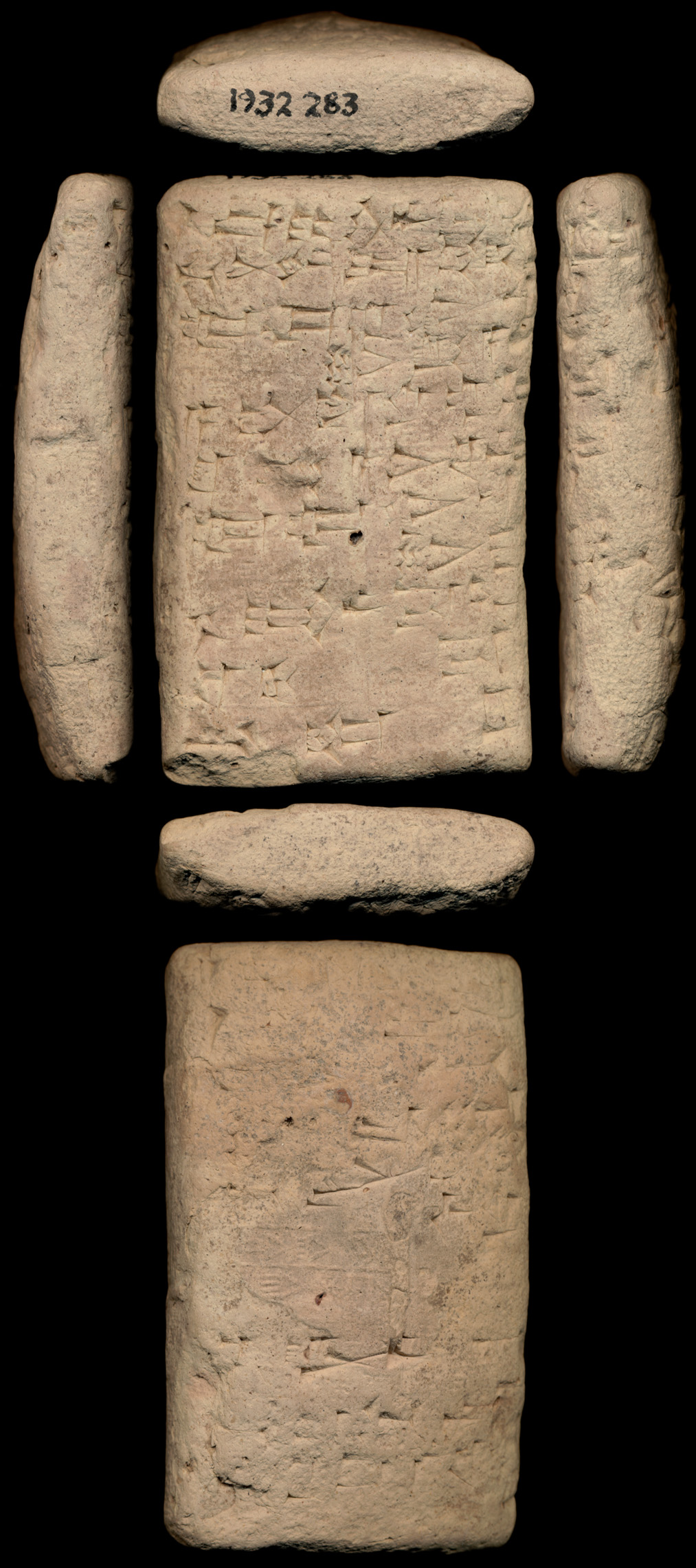
A young man named Iddin-Dagan stands with copper shackles on his feet. He is a carpenter. Another man, Abi-šarrum, steps forward and agrees to answer for him. The shackles come off. And Abi-šarrum swears by the king’s name that if Iddin-Dagan runs away, he will make it good.
That is the whole scene, and it all comes from one clay tablet from Nippur in southern Iraq. It is written in a handful of terse lines and sealed with Abi-šarrum’s own seal.
What happened, line by line
The tablet introduces “one young man, Iddin-Dagan by name”. The word for “young man” (guruš) is also the everyday word for a male worker. He is described as the tur of Abi-šarrum, literally “the small one” or “the junior”. That may mean he worked under Abi-šarrum, but the word is ambiguous.
Then comes the striking detail: “copper shackles were on his feet”. Abi-šarrum “stood as his guarantor”, the tablet says, and “loosened the shackles from his feet”.
The rest is the fine print. “On the day that Iddin-Dagan, the carpenter, runs away,” Abi-šarrum “will bring 1 […] to the workshop.” Unfortunately, the object he would have to bring sits in a damaged line. Only the number “1” survives. It could have been a replacement worker, but that word is not on the tablet, and we can’t restore it. Finally: “He swore by the king’s name.”
Abi-šarrum’s seal is impressed on the tablet: “Abi-šarrum, son of Ganza-[…]”. The end of his father’s name is unreadable. By sealing, Abi-šarrum put his own name to the risk.
What we don’t know
We don’t know why Iddin-Dagan was in shackles. The tablet doesn’t say whether he was enslaved, a prisoner, a conscripted worker or something else, and we won’t guess. We also don’t know whether he ever ran, or whether Abi-šarrum ever had to pay up. The story stops at the moment the shackles come off.
Speculating for a moment: a skilled carpenter is far more useful at a workbench than in chains. Perhaps this arrangement let Iddin-Dagan work freely while someone else carried the risk. Why Abi-šarrum was willing to do that, we can only wonder.
When was this?
Even the date is a small mystery. The tablet is dated to month 6 of the Nippur calendar, in the year “the great throne of Ninlil was fashioned”. The Cuneiform Digital Library Initiative (CDLI) tentatively assigns it to the third year of King Amar-Suen of Ur, around 2044 BC. That year was named after a “great throne” made for the god Enlil, which matches our wording, but our tablet names the goddess Ninlil instead.
There is another candidate. Tablets from the city of Isin, dated to the 28th year of King Išbi-Erra (around 1990 BC), use a year name about “the throne of Ninlil”. That is our own hypothesis, so for now: around 2044 BC, possibly around 1990 BC.
Shackles, runaways and oaths
In the Ur III state (about 2112 to 2004 BC), runaway workers were a constant concern. Historian J. N. Reid, studying punishment and forced labour in this period, concludes that “most runaways were guarded or restrained in some manner while being coerced to work”. He also documents captured slaves swearing oaths “in the name of the king” not to flee again. An oath by the king was serious: it put the ruler’s authority behind a promise.
The word for “workshop” on our tablet, geš-kin-ti, is a key term in the craft archive of Isin, studied by Marc Van De Mieroop. That archive records the workshops of the Isin kings Išbi-Erra and Šu-ilišu. If the later date is right, our carpenter may have belonged to that world of royal craftsmen. If not, he lived under Amar-Suen of Ur, who reigned around 2046 to 2038 BC.
The tablet in full (our translation)
Front: One young man, Iddin-Dagan by name, the “junior” (?) of Abi-šarrum: copper shackles were on his feet. Abi-šarrum stood as his guarantor and loosened the shackles from his feet. On the day that Iddin-Dagan, the carpenter, runs away, [unclear phrase]
Back: Abi-šarrum will bring 1 […] to the workshop (?). He swore by the king’s name. Month: Kin-Inanna (month 6). Year: the great throne of Ninlil was fashioned.
Seal: Abi-šarrum, son of Ganza-[…].
How we read it
Key lines in transliteration: ezem-ezem uruda giri3-na in-gal2-am3, “copper shackles were on his feet”, and szu du8-a-ni ba-x-gub, “he stood as his guarantor”.
Uncertain: the word for shackles, written ezem-ezem, is unusual. Its dictionary meaning (“festival”) makes no sense here, so “shackles” comes from context: they are on his feet and are removed from his feet. Another CDLI text counts copper ezem-ezem as objects. The phrase mu-ne-sze3 (front, last line) is unclear. The object he must “bring” (1(asz) x x x) is broken. Geš-kin-ti could mean “workshop” or “craft worker”. The date is disputed.
Our confidence: medium-low. The core story is fairly secure; the details of the penalty are not.
This translation is new and unofficial, made from the CDLI transliteration, and may contain errors. “Untranslated” means we found no translation on CDLI or in the tablet’s publication history (a hand copy in AAICAB 1/1, 1996). Dates use the conventional middle chronology and are approximate.
Further reading
- CDLI artifact page for P142864
- J. N. Reid, “Punishment for the Coercion of Labour during the Ur III Period” (2023)
- M. Van De Mieroop, Crafts in the Early Isin Period (1987)
- Wikipedia, “Third Dynasty of Ur”
- ePSD2, the electronic Pennsylvania Sumerian Dictionary
- Oracc, Ancient Mesopotamian Gods and Goddesses